

Archive position — measured, not model output
0 likes on Devpost
2,263 of the 7,850 archived projects have more likes, and 5,587 share exactly 0 — so this project's #6,583 place in the like-ranked listing is a tie-break inside that group, not a ranking.
Projects (log scale)
Likes on Devpost. ▲ marks this project's group.
Show the figures
| Likes | Projects | Share of archive |
|---|---|---|
| 0 | 5,587 | 71.2% |
| 1 | 1,758 | 22.4% |
| 2 | 284 | 3.6% |
| 3–4 | 132 | 1.7% |
| 5–9 | 75 | 1.0% |
| 10+ | 14 | 0.2% |
 User Stories BotA demo video on every pull request
Get a demo video on every new feature
GitHub App that watches your pull requests and records a narrated, captioned demo.
Save time on demo prep and make informed decisions faster with a video walkthrough of every new feature.
Executive Summary
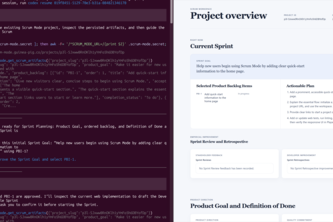
What the company appears to be: Scrum Mode is a self-reported tool that uses an AI agent — specifically Codex with GPT-5.6 — to structure software development using the official Scrum Guide. The author states it enables AI agents to act as a Scrum Master and Developer, while the user acts as Product Owner.
What changed: The project evolved from being built by one person (Ryo Moriwaki) using AI tools like Codex and GPT-5.6, with the AI writing all code, to a tool that can be used to build itself via Scrum Mode itself.
The single most important open question: Is there any evidence of real-world usage or adoption beyond the author's own development process? The description does not indicate whether Scrum Mode has been tested or used by others, nor does it show any traction, revenue, or customer data.
What The Product Actually Is
The description states that Scrum Mode is an MCP tool (likely a "Meta-Code Platform" or similar) that allows users to run Scrum projects with an AI agent. It persists Scrum artifacts such as the Product Goal, Product Backlog, Sprints, Increments, and Scrum events, and provides a web view of the project.
The author claims that Scrum Mode enables AI agents to act as a Scrum Master and Developer, while the user acts as the Product Owner. It is built using technologies like Codex, Docker, FastAPI, GPT-5.6, Nuxt, PostgreSQL, Python, TypeScript, and Vue.
Inference: The product appears to be an AI-assisted development environment structured around Scrum principles, where AI agents are used to enforce Scrum roles and artifacts. However, the description does not confirm whether it is a standalone tool or a framework for building other tools using Scrum processes.
Positioning & Claim Evolution
The author states that Scrum Mode was inspired by the need to better prompt AI during development and to maintain context as projects evolve. The project evolved from an idea of structuring AI-driven development with Scrum, to actually implementing this structure through AI itself.
Claim: Scrum Mode is a tool for running Scrum projects using AI agents, with strict adherence to the official Scrum Guide.
Inference: The positioning seems to be that Scrum Mode is a Scrum-based AI development environment, not just an AI tool but one that enforces Scrum roles and artifacts through AI. It is positioned as a way to improve AI-driven development by applying structured methodologies.
Target Customer & ICP
The description states that Scrum Mode is currently designed for a single user interacting with AI agents. The author also mentions plans to support multi-human team collaboration, but no evidence of current multi-user functionality or target customer segmentation is provided.
Claim: The initial target is a solo developer or small team using AI tools in a Scrum-like structure.
Inference: The ICP (Ideal Customer Profile) appears to be developers or product owners who are interested in AI-assisted development and want to apply structured methodologies like Scrum. However, no evidence of actual users or customer personas exists.
Business Model & Pricing Evidence
There is no evidence of a business model or pricing structure in the description. The author does not state whether Scrum Mode will be offered as a paid product, a free tool, or if it has any monetization strategy.
Claim: Not stated.
Inference: Given that this is a hackathon submission and no revenue or customer data is provided, there is no indication of how the project intends to generate value or charge users.
Technical & Delivery Signals
The author states that Scrum Mode was built using:
- Codex
- Docker
- FastAPI
- GPT-5.6
- Nuxt
- PostgreSQL
- Python
- TypeScript
- Vue
It is described as being built by AI agents (Codex) with minimal human involvement, except for the role of Product Owner.
Claim: The tool uses a combination of AI and standard development tools to build itself using Scrum principles.
Inference: The technical stack suggests that Scrum Mode is a web-based application with backend and frontend components, built using modern development practices. However, no evidence of delivery or deployment details beyond the author’s own use is provided.
Traction & Maturity Signals
The description states that this project was submitted to the OpenAI 2026 hackathon, but there is no indication of traction, adoption, or usage beyond the author's own development process. The author mentions that they used ChatGPT during initial design and Codex for most of the build.
Claim: No evidence of real-world usage, customers, or adoption.
Inference: This appears to be a proof-of-concept or prototype, not a product with traction or market validation. There is no mention of user feedback, beta testing, or commercial use.
Competitive Context
There is no evidence in the description of competitors or existing solutions in this space. The author does not reference any similar tools or platforms that might be competing with Scrum Mode.
Claim: Not stated.
Inference: Without a competitive analysis, it's impossible to assess whether Scrum Mode fills a gap or overlaps with existing AI-assisted development tools or Scrum frameworks.
Open Questions & Risks
- No evidence of real-world usage or adoption: The project is described as a hackathon submission and self-built tool.
- No revenue, customer, or traction data: No indication of monetization or user base.
- Unverified claims: All descriptions are self-reported and unverified.
- Unclear scalability or multi-user support: While the author mentions future plans for team collaboration, no current functionality is described.
- AI dependency: The tool relies heavily on Codex and GPT-5.6, which may not be stable or scalable in a commercial context.
Questions the description leaves open
- What specific Scrum artifacts are persisted by Scrum Mode, and how are they structured?
- How does the AI agent enforce Scrum roles (Scrum Master, Developer) in practice?
- Has Scrum Mode been tested or used by anyone other than the author?
- What is the intended business model for Scrum Mode?
- Are there any plans to support multi-user collaboration or team workflows?
- How does Scrum Mode handle version control or project history beyond the AI's memory?
- What are the limitations of using GPT-5.6 and Codex in a production context?
Overall Assessment
Not evidenced: There is no evidence of traction, revenue, customer data, or commercial viability to support an investment or partnership decision.
Inference: Based on the self-reported description alone, Scrum Mode appears to be a conceptual or prototype tool, not a product with market validation. It may have potential as a future product, but it is currently in early development and lacks any commercial signals.
The project is described as a hackathon submission, built by one person using AI tools, and does not show signs of real-world usage or adoption. Any investment or partnership decision would require further evidence of traction, customer interest, or product-market fit.
User Stories BotA demo video on every pull request
Get a demo video on every new feature
GitHub App that watches your pull requests and records a narrated, captioned demo.
Save time on demo prep and make informed decisions faster with a video walkthrough of every new feature.
Source
Submitted to the OpenAI 2026 hackathon on Devpost. Project home on Devpost. Back to the full gallery on Devpost.
This competitive analysis was produced by top-founders.com (opens in a new tab)
Generated by a language model from this project's public Devpost page — its tagline, the author's own write-up and any built-with tags listed there — as captured in August 2026. Short quotations are the author's words. It is an opinion on the idea as a business, not on the people behind it, and it reflects the description as published then. If the project has moved on, request a correction below. The analysis is not independent research and contains no verified traction, revenue or customer data.
An independent guide by KFG International LLC — not affiliated with, endorsed by, or connected to Devpost or OpenAI.