

Archive position — measured, not model output
0 likes on Devpost
2,263 of the 7,850 archived projects have more likes, and 5,587 share exactly 0 — so this project's #6,585 place in the like-ranked listing is a tie-break inside that group, not a ranking.
Projects (log scale)
Likes on Devpost. ▲ marks this project's group.
Show the figures
| Likes | Projects | Share of archive |
|---|---|---|
| 0 | 5,587 | 71.2% |
| 1 | 1,758 | 22.4% |
| 2 | 284 | 3.6% |
| 3–4 | 132 | 1.7% |
| 5–9 | 75 | 1.0% |
| 10+ | 14 | 0.2% |
 User Stories BotA demo video on every pull request
Get a demo video on every new feature
GitHub App that watches your pull requests and records a narrated, captioned demo.
Save time on demo prep and make informed decisions faster with a video walkthrough of every new feature.
Executive Summary
What the company appears to be
The description states that sdlc0.ai is a self-reported end-to-end software development lifecycle (SDLC) automation tool built for product teams. It claims to automate workflows from Google Meet conversations to code implementation using AI agents, including PRD generation, ticket creation in Linear, GitHub issue tracking, and autonomous coding via Codex.
What changed
The project was submitted as part of the OpenAI 2026 hackathon. The author describes building a functional agentic pipeline that integrates multiple tools (Slack, Linear, GitHub, Playwright, Codex) into an automated SDLC flow, with a focus on reducing time from conversation to code.
Single most important open question
Is there any evidence of actual usage or adoption by users beyond the author’s own development? The description is entirely self-reported and lacks data on traction, revenue, customers, or product-market fit.
What The Product Actually Is
The description states that sdlc0.ai is a system designed to automate parts of the software development lifecycle (SDLC) using AI. It claims to:
- Join Google Meet calls
- Transcribe audio via Deepgram
- Generate PRDs using OpenAI
- Post PRDs to Slack for approval
- Create Linear tickets from approved PRDs
- Mirror work into GitHub issues
- Launch Codex-based code generation
- Open Pull Requests automatically
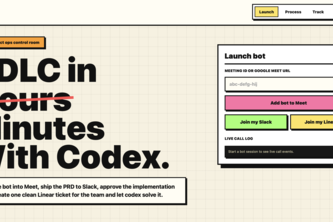
It also includes a neobrutalist frontend that allows users to monitor execution logs and manage workflows.
Inference This is described as an agentic SDLC pipeline, not just a prototype. It integrates several technologies including Node.js + TypeScript, Playwright, Codex CLI, Slack, Linear, GitHub, PostgreSQL, and others.
Not evidenced No information on actual product usage, customer feedback, or real-world deployment beyond the author’s own development.
Positioning & Claim Evolution
The description states that sdlc0.ai aims to make software development feel continuous:
“Conversation → Decision → PRD → Ticket → Code → Review → Shipped”
It positions itself as a tool that brings together a Product Manager, Engineering Manager, and Junior Software Engineer into one system.
Inference The author sees this as a step toward fully automated SDLC orchestration. The project evolved from generating multiple tickets per PRD to enforcing a strict 1:1:1 mapping (PRD → Ticket → Issue) for simplicity and clarity.
Not evidenced No evidence of market positioning beyond the hackathon submission, nor any indication of how it differentiates from existing tools like Linear, GitHub, or Slack integrations.
Target Customer & ICP
The description does not explicitly define a target customer segment. However, it implies that the intended users are:
- Product teams
- Engineering managers
- Developers working in agile environments
- Teams using Slack, Linear, and GitHub
Inference The tool is built for teams already using these platforms and looking to reduce manual steps between conversation and implementation.
Not evidenced No evidence of actual customer interviews, personas, or user feedback. No indication of whether the target audience has adopted or engaged with the product beyond the author’s own use.
Business Model & Pricing Evidence
The description does not mention any business model or pricing strategy. It focuses entirely on technical implementation and workflow automation.
Not evidenced No information about monetization, licensing, subscriptions, or revenue streams.
Technical & Delivery Signals
The description provides a detailed breakdown of the stack used:
- Backend: Node.js + TypeScript
- Automation: Playwright for Google Meet
- Speech-to-text: Deepgram
- AI Generation: OpenAI Responses API (PRD, Q&A, roadmap updates)
- Data Storage: PostgreSQL
- Communication: Slack (webhooks, slash commands, interactivity)
- Project Management: Linear
- Version Control: GitHub
- Agent Execution: Codex CLI
- Deployment: Render + Docker
It also mentions overcoming challenges in:
- Google Meet automation
- Slack integrations
- Codex infrastructure issues
- State management and identity handling
Inference The system is described as fully deployable, stateful, and capable of running unattended. It includes live execution logging and UI monitoring.
Not evidenced No evidence of scalability, performance metrics, or production stability beyond the author’s own testing.
Traction & Maturity Signals
The description states that sdlc0.ai is a “fully working agentic SDLC pipeline” but provides no data on:
- Number of users
- Customer retention
- Revenue
- Product usage statistics
- Feedback from early adopters
Not evidenced No signs of traction or adoption beyond the author’s own development and hackathon submission.
Competitive Context
The description does not reference competitors directly. However, based on its functionality, it overlaps with:
- Linear: For product management
- GitHub / GitLab: For issue tracking and code repositories
- Slack: For team communication
- Codex / GitHub Copilot: For AI-assisted coding
- Notion / Jira: For project planning
Inference It attempts to unify these tools into a single, automated workflow.
Not evidenced No competitive analysis or differentiation strategy provided.
Open Questions & Risks
- Unverified Claims: All claims are self-reported and unverified.
- Lack of Traction: No evidence of customer adoption or product-market fit.
- Limited Scope: The system is described as a hackathon project, not a scalable SaaS offering.
- Dependency on External Tools: Heavy reliance on Slack, Linear, GitHub, and OpenAI APIs may create fragility.
- No Pricing or Business Model: No indication of how the tool would be monetized.
- Single Developer Team: Only one team member is mentioned, which raises questions about scalability and long-term maintenance.
Questions the description leaves open
- What specific problems are you solving for your users that existing tools don’t?
- Have you tested this with real teams or customers? If so, what was their feedback?
- How do you plan to scale beyond a single developer’s use case?
- Is there any evidence of user engagement or retention?
- What is the long-term vision for monetization and product roadmap?
- How do you handle edge cases in workflows like meeting interruptions or failed API calls?
- Are there any legal or compliance concerns with using Codex, Slack, Linear, etc. in this way?
Overall Assessment
The description indicates that sdlc0.ai is a functional prototype built during a hackathon. It demonstrates technical capability but lacks evidence of traction, customer validation, or business model clarity.
Confidence Level: Low
This analysis is based entirely on self-reported information and does not include any external verification or data points regarding revenue, customers, or market adoption.
Assessment Summary:
There is no evidence that sdlc0.ai has moved beyond a proof-of-concept stage. While the technical execution appears solid, there are no signs of commercial viability or product-market fit. The project should be considered experimental at best, with significant uncertainty around its potential for growth or investment appeal.
User Stories BotA demo video on every pull request
Get a demo video on every new feature
GitHub App that watches your pull requests and records a narrated, captioned demo.
Save time on demo prep and make informed decisions faster with a video walkthrough of every new feature.
Source
Submitted to the OpenAI 2026 hackathon on Devpost. Project home on Devpost. Back to the full gallery on Devpost.
This competitive analysis was produced by top-founders.com (opens in a new tab)
Generated by a language model from this project's public Devpost page — its tagline, the author's own write-up and any built-with tags listed there — as captured in August 2026. Short quotations are the author's words. It is an opinion on the idea as a business, not on the people behind it, and it reflects the description as published then. If the project has moved on, request a correction below. The analysis is not independent research and contains no verified traction, revenue or customer data.
An independent guide by KFG International LLC — not affiliated with, endorsed by, or connected to Devpost or OpenAI.