

Archive position — measured, not model output
0 likes on Devpost
2,263 of the 7,850 archived projects have more likes, and 5,587 share exactly 0 — so this project's #6,553 place in the like-ranked listing is a tie-break inside that group, not a ranking.
Projects (log scale)
Likes on Devpost. ▲ marks this project's group.
Show the figures
| Likes | Projects | Share of archive |
|---|---|---|
| 0 | 5,587 | 71.2% |
| 1 | 1,758 | 22.4% |
| 2 | 284 | 3.6% |
| 3–4 | 132 | 1.7% |
| 5–9 | 75 | 1.0% |
| 10+ | 14 | 0.2% |
 User Stories BotA demo video on every pull request
Get a demo video on every new feature
GitHub App that watches your pull requests and records a narrated, captioned demo.
Save time on demo prep and make informed decisions faster with a video walkthrough of every new feature.
Executive Summary
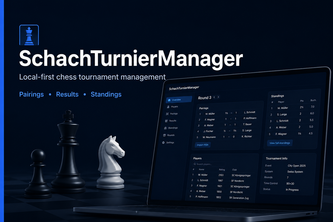
The company appears to be a solo developer project named SchachTurnierManager, a local-first chess tournament management application built during a hackathon. The author states the product aims to streamline chess tournament workflows by managing pairings, results, and data exchange in one system, with a mobile companion for Android.
Key changes noted: The project evolved from an initial concept into a working prototype with improved architecture, testing, and packaging — including AI-assisted development using tools like Codex and GPT-5.6.
The single most important open question is
Is there any evidence of real-world usage or adoption by chess clubs or tournament organizers?
This analysis is based entirely on the self-reported project description provided by the author. No third-party verification, traction data, revenue figures, or customer information are available beyond what was stated in the submission.
What The Product Actually Is
The description states that SchachTurnierManager is a tournament management application focused on chess events. It helps organizers manage:
- Tournaments
- Players
- Rounds
- Results
It also includes a mobile companion for Android, intended to support practical event scenarios where tournament information needs to be accessed easily.
The author notes the system was built as a real software product, not just a mockup, and includes backend, frontend, packaging, testing, and release preparation work. It supports full lifecycle management from preparation to operation and presentation.
Inference: The application is described as a local-first tool — implying it may operate without requiring cloud connectivity or centralized infrastructure.
Positioning & Claim Evolution
The author positions SchachTurnierManager as a solution to the chaos often found in running local chess tournaments. They claim it addresses issues such as:
- Spread across multiple tools
- Handwritten notes
- Ad-hoc workflows
Their stated goal is to provide one streamlined system that helps tournament organizers run events more reliably and with less stress.
The project evolved from a concept into a working prototype during the hackathon, with improvements made in architecture, testing, usability, and documentation. The author emphasizes AI-assisted development as a key part of its creation process.
Claim: SchachTurnierManager is designed to support full tournament lifecycle management.
Inference: The positioning suggests a niche B2B SaaS-style tool aimed at local chess clubs or event organizers — though no evidence of actual customers or market traction exists.
Target Customer & ICP
The author states that SchachTurnierManager targets tournament organizers, particularly those running local chess tournaments. These users are likely part of chess clubs or community groups who need to manage pairings, results, standings, and data exchange.
There is no explicit mention of specific user personas beyond this general category. The inclusion of a mobile companion for Android implies the tool may be used in physical settings where organizers need quick access to tournament data during events.
Claim: The target customer is local chess tournament organizers.
Inference: Based on the tagline and description, the ICP likely includes small-scale or amateur chess clubs with limited technical resources but a need for structured tournament management tools.
Business Model & Pricing Evidence
No information is provided about pricing models, monetization strategies, or business model assumptions in the project description. The author does not state whether SchachTurnierManager will be offered as a freemium product, paid subscription, one-time purchase, or open-source tool.
There is no mention of revenue streams, licensing terms, or customer acquisition costs.
Not evidenced
Technical & Delivery Signals
The application was built using:
- Frontend: React, TypeScript, Vite
- Backend: .NET, ASP.NET Core, C#
- Mobile: Android (via Capacitor)
- Database: SQLite
- Tools: GitHub Actions, Playwright, PowerShell, Gradle, OpenAI Codex, GPT-5.6
The author reports heavy use of AI-assisted development throughout the build process, particularly for implementation, refactoring, and cleanup.
Key technical improvements noted during Build Week include:
- Cleaner frontend structure
- Modularization of codebase
- Additional automated tests
- Firefox-related fixes
- Windows installer preparation
- Improved documentation
Inference: The tool is likely built with a modern stack suitable for cross-platform deployment, including desktop and mobile environments.
Traction & Maturity Signals
There is no evidence of real-world usage or adoption by users. The author describes the project as a working prototype developed during a hackathon, with improvements made in architecture, testing, and packaging.
The description includes accomplishments such as:
- Finalizing Android companion workflow
- Continuing frontend modularization
- Improving UX and visual polish
- Expanding testing and device validation
However, none of these indicate actual user engagement or product-market fit.
Not evidenced
Competitive Context
No competitive landscape is described in the project write-up. The author does not reference existing tools used by chess tournament organizers, nor do they compare SchachTurnierManager to alternatives.
The niche nature of local chess tournament management suggests potential overlap with general-purpose event management software or open-source solutions, but no such comparison is made.
Not evidenced
Open Questions & Risks
- Solo developer project: With only one team member (Randspringer Geißhirt), scalability and long-term maintenance are concerns.
- No real-world usage: No evidence of adoption or feedback from actual users.
- AI dependency: Heavy reliance on AI tools like Codex and GPT-5.6 raises questions about code quality, consistency, and future maintainability if those tools change or become unavailable.
- Limited scope: The tool is focused solely on chess tournaments; no indication of broader applicability or roadmap expansion.
- Unverified claims: All statements are self-reported and unverified.
Inference: The lack of traction and customer validation makes it difficult to assess commercial viability or product-market fit.
Questions the description leaves open
- Has SchachTurnierManager been tested with actual chess clubs or tournament organizers?
- What is the current status of the Android companion app? Is it functional in real-world settings?
- Are there any plans to monetize the tool, and if so, what model is being considered?
- How does the project handle data persistence and backup for tournaments?
- What are the long-term goals for the platform beyond its current scope?
- Can you provide examples of how AI tools like Codex were used in practice during development?
- Are there any known limitations or edge cases that affect usability?
Overall Assessment
Not evidenced.
The project is described as a solo developer hackathon effort, with no evidence of revenue, customers, or traction beyond the author’s own account. While it shows technical maturity and some progress in architecture and testing, there is no indication that SchachTurnierManager has reached a stage where it could attract investment or strategic partnerships.
The tool appears to be in early development, focused on solving a specific niche problem — but without any market validation or user feedback, its commercial potential remains unclear.
Confidence level: Low. This analysis is based entirely on self-reported information with no external corroboration.
User Stories BotA demo video on every pull request
Get a demo video on every new feature
GitHub App that watches your pull requests and records a narrated, captioned demo.
Save time on demo prep and make informed decisions faster with a video walkthrough of every new feature.
Source
Submitted to the OpenAI 2026 hackathon on Devpost. Project home on Devpost. Back to the full gallery on Devpost.
This competitive analysis was produced by top-founders.com (opens in a new tab)
Generated by a language model from this project's public Devpost page — its tagline, the author's own write-up and any built-with tags listed there — as captured in August 2026. Short quotations are the author's words. It is an opinion on the idea as a business, not on the people behind it, and it reflects the description as published then. If the project has moved on, request a correction below. The analysis is not independent research and contains no verified traction, revenue or customer data.
An independent guide by KFG International LLC — not affiliated with, endorsed by, or connected to Devpost or OpenAI.