

Archive position — measured, not model output
0 likes on Devpost
2,263 of the 7,850 archived projects have more likes, and 5,587 share exactly 0 — so this project's #6,552 place in the like-ranked listing is a tie-break inside that group, not a ranking.
Projects (log scale)
Likes on Devpost. ▲ marks this project's group.
Show the figures
| Likes | Projects | Share of archive |
|---|---|---|
| 0 | 5,587 | 71.2% |
| 1 | 1,758 | 22.4% |
| 2 | 284 | 3.6% |
| 3–4 | 132 | 1.7% |
| 5–9 | 75 | 1.0% |
| 10+ | 14 | 0.2% |
 User Stories BotA demo video on every pull request
Get a demo video on every new feature
GitHub App that watches your pull requests and records a narrated, captioned demo.
Save time on demo prep and make informed decisions faster with a video walkthrough of every new feature.
Executive Summary
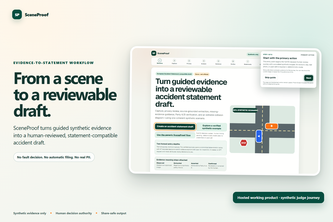
SceneProof is a self-reported tool built for the OpenAI 2026 hackathon that aims to guide users through structured accident documentation using synthetic evidence and bounded AI. The author states it is designed to help people prepare reviewable accident-statement drafts without determining fault or liability, using a deterministic path and an optional GPT-5.6-enhanced route.
Key changes from the original idea: The product evolved into a structured journey with explicit human verification steps, synthetic-only evidence use, and clear separation between deterministic replay and live model calls. It also includes a protected blind evaluation process for AI outputs.
The single most important open question is whether SceneProof's approach to synthetic evidence and bounded AI can scale beyond a hackathon prototype to real-world usage in accident documentation workflows — particularly around adoption by users who may not be technically inclined or familiar with such tools.
This analysis is based entirely on the self-reported project description provided. No independent verification, traction data, revenue figures, or customer information are available.
What The Product Actually Is
The description states that SceneProof is a tool designed to guide a reviewer through documenting a two-vehicle accident using synthetic evidence. It includes:
- A structured journey from evidence capture to editable collision diagram generation.
- Use of visibly watermarked synthetic images covering scene, vehicles, damage, and road context.
- Explicit approval steps for each image before analysis.
- Fields for incident details (9), Party A (22 fields), and Party B (22 fields).
- Human verification at multiple stages.
- An editable SVG collision diagram that remains labeled as a draft until confirmed.
- Two final report projections: private and share-safe.
The tool is built using Next.js, TypeScript, React, Firebase, GCP, GitHub Actions, Playwright, ElevenLabs, OpenAI APIs (including GPT-5.6), and Codex for development support.
Not evidenced:
- Whether SceneProof has been used in any real accident situations.
- If it has a user base or customer feedback.
- Any actual revenue or monetization model.
Positioning & Claim Evolution
The author claims SceneProof is not an official form, police report, insurer submission, or legal advice. It is described as a documentation aid that does not determine fault, liability, fraud, insurance coverage, compensation, or injury diagnosis.
It positions itself as a way to preserve evidence and structure information during stressful events like accidents, while avoiding claims about legal truth or fault determination.
The claim evolution shows a focus on:
- Separation of AI-generated insights from human decisions.
- Use of synthetic data to avoid privacy concerns.
- Clear boundaries around what the tool does not do.
- Emphasis on reproducibility and deterministic paths.
Inferences:
- The tool may be positioned for use in legal or insurance contexts where structured documentation is required but adjudication is outside its scope.
- It could appeal to accident assistance services, personal injury lawyers, or insurance adjusters looking for standardized documentation tools.
Not evidenced:
- Market positioning beyond the hackathon submission.
- Competitors or differentiation strategies.
- Any marketing claims or branding materials.
Target Customer & ICP
The description does not clearly identify a specific customer segment or ideal customer profile (ICP). However, it implies that SceneProof targets individuals involved in accidents who need to document incidents for legal, insurance, or personal review purposes.
It suggests a user journey designed for people under stress who might otherwise lose track of evidence or make errors in documentation. The tool is intended to guide them through the process step-by-step.
Inferences:
- Potential users include accident victims, witnesses, or those assisting with accident reporting.
- It may also appeal to professionals like insurance adjusters or legal advisors who require structured accident data.
Not evidenced:
- Specific customer personas.
- Customer acquisition channels.
- Any existing user base or usage metrics.
Business Model & Pricing Evidence
There is no evidence of a business model or pricing structure in the description. The tool is presented as a hackathon submission with no mention of monetization, subscription plans, licensing fees, or sales models.
The author notes that SceneProof does not connect to real customer accounts, insurer adapters, or production ARM connections — indicating it's not yet integrated into commercial workflows.
Inferences:
- If commercialized, the tool might be sold as a SaaS platform or embedded solution for accident assistance services.
- It could potentially be offered via API access or white-label integration.
Not evidenced:
- Revenue streams.
- Pricing tiers.
- Commercial partnerships or integrations.
- Any monetization strategy beyond the hackathon demo.
Technical & Delivery Signals
SceneProof is built as a standalone Next.js and TypeScript application using React, Firebase, GCP, GitHub Actions, Playwright, ElevenLabs, OpenAI APIs (including GPT-5.6), and Codex for development support.
Key technical features include:
- Strict Zod contracts for modeling fields, evidence sources, proposals, contradictions, analyzer provenance, and output projections.
- Shared parsed reducer to synchronize statement, diagram, reports, persistence, and exports.
- Protected model route that accepts only committed fixture identifiers and normalized redaction rectangles.
- Deterministic judge path with no API key or paid model request.
- Production GPT-5.6 path with budget limits and fail-safe mechanisms.
- Release candidate verification including runtime configuration, identity checks, secret binding, and health tests.
Inferences:
- The tool uses modern web technologies and cloud infrastructure.
- It emphasizes security through redaction, access control, and deterministic behavior.
- It has automated testing and coverage metrics indicating quality assurance practices.
Not evidenced:
- Deployment frequency or operational history.
- Scalability assumptions or performance benchmarks.
- Any production environment beyond the demo.
Traction & Maturity Signals
There is no evidence of traction or maturity beyond the hackathon submission. The author states that no real accident photographs were used, and all demonstrations rely on synthetic fixtures.
The tool includes:
- A deployed source revision (1a30815d12acf222865f25ecd12b48142ca7b1b5).
- Cloud Run revision (sceneproof-sp-29703490846-1).
- Automated tests across 31 files with high coverage percentages.
- A release process including rollback anchors and verification steps.
Inferences:
- The tool is at a prototype stage, likely not yet ready for commercial deployment.
- It shows technical maturity in terms of code quality and testing but lacks real-world usage data.
Not evidenced:
- Customer adoption or retention rates.
- User engagement metrics.
- Any revenue or funding history.
- Product roadmap or future development plans.
Competitive Context
The description does not provide any information about competitors or the competitive landscape. SceneProof is presented as a novel approach to accident documentation using synthetic evidence and bounded AI, but no comparison with existing tools or platforms is made.
Inferences:
- The tool may compete with traditional accident reporting forms, mobile apps for accident documentation, or legal assistance services.
- It could be positioned against AI-powered document processors or case management systems in insurance or law.
Not evidenced:
- Direct competitors.
- Market size or growth trends.
- Competitive advantages or disadvantages.
- Any market research or competitive analysis.
Open Questions & Risks
Key risks and open questions identified from the description:
- Lack of real-world testing: The tool uses only synthetic evidence, which raises questions about its effectiveness in actual accident scenarios.
- Limited scalability: As a single-developer project, there are no signs of team expansion or infrastructure scaling.
- Unclear commercial viability: No business model or monetization strategy is evident beyond the hackathon demo.
- Privacy and compliance concerns: While synthetic data is used, the tool doesn't address how it would handle real-world privacy regulations or jurisdiction-specific compliance requirements.
- AI dependency risk: The optional GPT-5.6 path introduces potential risks related to API availability, cost, and model accuracy in production environments.
Not evidenced:
- Any risk mitigation strategies.
- Regulatory compliance history.
- Data governance policies.
- Long-term sustainability plans.
Questions the description leaves open
- What are the key assumptions about user behavior and adoption that underpin SceneProof's design?
- How does SceneProof plan to transition from synthetic-only evidence to handling real-world accident data while maintaining privacy and compliance standards?
- Are there any plans for integrating with existing legal, insurance, or emergency services workflows?
- What are the expected costs of deploying GPT-5.6 in a production environment, and how will they be managed?
- How does SceneProof intend to ensure consistent performance across different devices and operating systems?
- Has the founder considered potential liability issues if incorrect information is generated by the AI component?
- What kind of feedback has been received from users or domain experts during development?
- Is there a plan for ongoing maintenance, updates, and feature enhancements beyond the current prototype?
Overall Assessment
SceneProof is currently a hackathon prototype with no demonstrated traction, revenue, or customer base. It presents an interesting concept around structured accident documentation using synthetic evidence and bounded AI, but lacks commercial viability indicators.
The tool shows strong technical execution and attention to detail in privacy and safety boundaries, especially regarding AI use and deterministic paths. However, without real-world usage data, user feedback, or a clear path to monetization, it is difficult to assess its potential for investment or partnership opportunities.
Investment or partnership decisions should be based on further validation of the product-market fit, scalability considerations, and alignment with strategic goals beyond the current prototype stage.
Not evidenced:
- Financial projections.
- Market demand data.
- Strategic fit with existing portfolios or business units.
- Any due diligence findings from third parties.
User Stories BotA demo video on every pull request
Get a demo video on every new feature
GitHub App that watches your pull requests and records a narrated, captioned demo.
Save time on demo prep and make informed decisions faster with a video walkthrough of every new feature.
Source
Submitted to the OpenAI 2026 hackathon on Devpost. Project home on Devpost. Back to the full gallery on Devpost.
This competitive analysis was produced by top-founders.com (opens in a new tab)
Generated by a language model from this project's public Devpost page — its tagline, the author's own write-up and any built-with tags listed there — as captured in August 2026. Short quotations are the author's words. It is an opinion on the idea as a business, not on the people behind it, and it reflects the description as published then. If the project has moved on, request a correction below. The analysis is not independent research and contains no verified traction, revenue or customer data.
An independent guide by KFG International LLC — not affiliated with, endorsed by, or connected to Devpost or OpenAI.