

Archive position — measured, not model output
0 likes on Devpost
2,263 of the 7,850 archived projects have more likes, and 5,587 share exactly 0 — so this project's #6,551 place in the like-ranked listing is a tie-break inside that group, not a ranking.
Projects (log scale)
Likes on Devpost. ▲ marks this project's group.
Show the figures
| Likes | Projects | Share of archive |
|---|---|---|
| 0 | 5,587 | 71.2% |
| 1 | 1,758 | 22.4% |
| 2 | 284 | 3.6% |
| 3–4 | 132 | 1.7% |
| 5–9 | 75 | 1.0% |
| 10+ | 14 | 0.2% |
 User Stories BotA demo video on every pull request
Get a demo video on every new feature
GitHub App that watches your pull requests and records a narrated, captioned demo.
Save time on demo prep and make informed decisions faster with a video walkthrough of every new feature.
Executive Summary
SceneBoard, as described by its author, is a visual workspace that enables Codex (a large language model) to explain complex software development work through structured, interactive, and presentation-grade artifacts. It operates as a plugin and Model Context Protocol server, connecting to Codex via a one-time pairing mechanism with explicit capability grants.
The product aims to expand context for decision-making by rendering internal references like D1, D2, or ADR-014 into accessible visual formats—such as diagrams, charts, HTML prototypes, WebGL experiences, and interactive decision workspaces. It supports Human-in-the-Loop (HITL) workflows where human decisions shape subsequent AI outputs, and all revisions are preserved immutably.
SceneBoard is built as an Apache-2.0 TypeScript monorepo, using technologies including Next.js, NestJS, React, Three.js, and GPT-5.6. The system includes sandboxed artifact execution, a capability-based security model, and a UI that supports both visual and textual content.
Key commercial due-diligence read: The author states SceneBoard is a working end-to-end product at sceneboard.dev, but there is no evidence of revenue, customers, or adoption beyond the project's own description. The core innovation lies in how it allows Codex to operate visually while preserving HITL decision control—this positioning may be novel, but its commercial viability and traction remain unproven.
What The Product Actually Is
The description states that SceneBoard is:
- A visual whiteboard designed for Codex to explain complex software development work.
- A plugin and Model Context Protocol server, enabling Codex to create and operate boards directly from CLI or IDE.
- An Apache-2.0 TypeScript monorepo with four main layers:
- Next.js web application
- NestJS API
- SceneBoard Codex plugin and MCP server
- Shared protocol schemas, SDKs, rendering components, and artifact runtime
It allows Codex to generate various types of visual content including:
- Structured documents, tables, diagrams, architecture flows
- Charts, SVGs, animated Canvas scenes
- Interactive HTML prototypes
- WebGL and Three.js experiences
- Human-in-the-Loop decision workspaces
The system uses a sandboxed artifact origin with a constrained capability bridge to ensure security.
Inference: SceneBoard appears to be a visual collaboration layer for AI agents, particularly those operating in development environments, aimed at improving transparency and decision-making during AI-assisted coding.
Positioning & Claim Evolution
The author positions SceneBoard as:
- A second surface for Codex, expanding context beyond terminal output or source files.
- A visual workspace where Codex explains work clearly and humans make informed decisions.
- A tool that turns dense AI work into presentation-ready briefings, supporting HITL workflows.
Key claims:
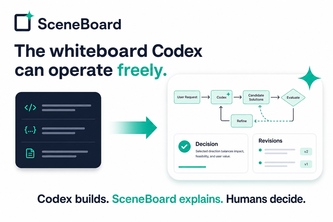
- “SceneBoard is the whiteboard Codex can operate freely.”
- “Codex builds. SceneBoard explains. Humans decide.”
- “A useful board must support interactive HTML and 3D content, but that content must never gain silent access to accounts or credentials.”
These statements suggest a shift from AI summarization to contextual explanation and visual collaboration, with an emphasis on security boundaries and human agency.
Inference: SceneBoard positions itself as a visual extension of AI development workflows, not just a tool for summarizing code, but one that supports decision-making through visual artifacts.
Target Customer & ICP
The description does not explicitly name target customers or define an Ideal Customer Profile (ICP). However, it implies:
- Users who work with AI agents like Codex in development environments
- Developers, product teams, engineers, operators, and decision-makers involved in AI-assisted coding workflows
- Teams that need to understand and review AI-generated code or decisions, especially when internal references (e.g., D1, ADR-014) are involved
It also suggests a developer-first approach—the system is built with open-source direction, contributor guidelines, and engineering practices.
Inference: SceneBoard likely targets technical teams using AI agents in software development, particularly those seeking better context and decision-making support during AI-assisted work.
Business Model & Pricing Evidence
There is no evidence of a business model or pricing structure in the description. The project is presented as a self-contained open-source tool, built by one person (Dexter Lee), and submitted to a hackathon.
The author mentions:
- An Apache-2.0 license
- Public engineering, security, Git, and QA rules for contributors and AI agents
- A monorepo with public documentation
Inference: SceneBoard is currently not monetized, nor does it appear to have any pricing or commercialization strategy described.
Technical & Delivery Signals
The description provides technical details:
- Built on TypeScript, Next.js, NestJS, React, Three.js, WebGL, GPT-5.6
- Uses Model Context Protocol (MCP) and plugin architecture
- Implements a sandboxed artifact runtime with capability-based access control
- Supports expressive visual output: HTML, Canvas, SVG, WebGL, 3D content
- Includes pairing flow with one-time approval, using short-lived codes
- Has immutable revision history for boards and decisions
It also notes:
- Self-hosted development workflow where Codex helped build the product itself
- Use of regression tests around artifact rendering, decision correlation, and pairing recovery
Inference: SceneBoard shows strong engineering maturity for a hackathon-level project. It demonstrates security-conscious design, modular architecture, and visual expressiveness—all critical signals for a developer tool.
Traction & Maturity Signals
The description states:
- A working end-to-end product at sceneboard.dev
- The system is open-source under Apache-2.0
- It was built in a single-person effort, with Codex contributing to its own development
- The author mentions regression testing, browser-tested desktop experience, and multilingual UI
However, there is no evidence of users, customers, revenue, or adoption metrics beyond the project’s own submission.
Inference: SceneBoard has reached a functional prototype stage, but lacks any traction signals such as user base, usage data, or commercial interest.
Competitive Context
The description does not mention competitors. However, based on its stated functionality:
- It operates in the space of AI collaboration tools
- It integrates with AI agents like Codex
- It supports visual explanation and HITL workflows
Potential areas of overlap include:
- Tools that visualize AI outputs (e.g., Notion, Obsidian, GitHub Copilot)
- AI agent interfaces or workspaces
- Human-in-the-loop systems for AI decision-making
Inference: SceneBoard appears to be a novel approach within AI development tools, but there is no evidence of existing competitive landscape or market positioning.
Open Questions & Risks
Key risks and open questions based on the description:
- No revenue, customers, or traction—the project is self-reported and unverified.
- Single-person team—limits scalability and long-term maintenance.
- Unproven commercial viability—no pricing, monetization strategy, or business model.
- High technical complexity—requires sandboxing, capability control, and multi-layered architecture; potential for security or performance issues.
- Limited evidence of real-world use cases—the author describes a vision, but no actual deployment or feedback from users.
Inference: SceneBoard is technically ambitious, but lacks commercial validation and real-world traction. Its success depends heavily on adoption by AI developers and teams using Codex.
Questions the description leaves open
- What specific use cases have you identified for SceneBoard in real-world development workflows?
- How do you plan to scale beyond a single developer or team?
- Have you tested SceneBoard with actual users or teams? If so, what feedback did you get?
- What are the key challenges in integrating SceneBoard into existing AI agent workflows?
- Is there any intention to monetize or commercialize this tool?
- How do you plan to handle security and access control at scale?
- What is your roadmap for expanding visual artifact types or HITL decision models?
Overall Assessment
SceneBoard, as described, is a technically sophisticated and conceptually innovative tool that bridges AI-generated work with human decision-making through visual artifacts.
However, the description is self-reported, unverified, and contains no evidence of traction, revenue, or customer adoption. It appears to be a proof-of-concept or prototype built by one person in a hackathon setting.
Confidence level: Low — due to lack of external validation, no financials, no users, and no commercial strategy.
Assessment: SceneBoard shows promise as an experimental tool for AI-assisted development, but it is not yet ready for investment or partnership without further evidence of traction, market fit, or commercial viability. It may be a preliminary version of a future product, but the current state is not commercially viable.
User Stories BotA demo video on every pull request
Get a demo video on every new feature
GitHub App that watches your pull requests and records a narrated, captioned demo.
Save time on demo prep and make informed decisions faster with a video walkthrough of every new feature.
Source
Submitted to the OpenAI 2026 hackathon on Devpost. Project home on Devpost. Back to the full gallery on Devpost.
This competitive analysis was produced by top-founders.com (opens in a new tab)
Generated by a language model from this project's public Devpost page — its tagline, the author's own write-up and any built-with tags listed there — as captured in August 2026. Short quotations are the author's words. It is an opinion on the idea as a business, not on the people behind it, and it reflects the description as published then. If the project has moved on, request a correction below. The analysis is not independent research and contains no verified traction, revenue or customer data.
An independent guide by KFG International LLC — not affiliated with, endorsed by, or connected to Devpost or OpenAI.