

Archive position — measured, not model output
1 like on Devpost
505 of the 7,850 archived projects have more likes, and 1,758 share exactly 1 — so this project's #1,862 place in the like-ranked listing is a tie-break inside that group, not a ranking.
Projects (log scale)
Likes on Devpost. ▲ marks this project's group.
Show the figures
| Likes | Projects | Share of archive |
|---|---|---|
| 0 | 5,587 | 71.2% |
| 1 | 1,758 | 22.4% |
| 2 | 284 | 3.6% |
| 3–4 | 132 | 1.7% |
| 5–9 | 75 | 1.0% |
| 10+ | 14 | 0.2% |
 User Stories BotA demo video on every pull request
Get a demo video on every new feature
GitHub App that watches your pull requests and records a narrated, captioned demo.
Save time on demo prep and make informed decisions faster with a video walkthrough of every new feature.
Executive Summary
What the company appears to be
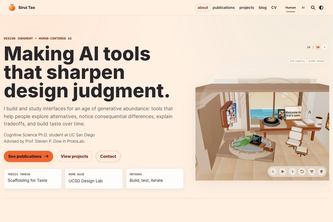
The project described by the author is a research portfolio built with AI tools (specifically Codex and GPT-5.6) that serves as a teaching artifact for interaction design. It is not a commercial product or service but rather an academic exercise aimed at making design processes inspectable, reusable, and teachable.
What changed
The author states that the project was extended during a build week after July 13, 2026, with new features such as a source-linked Human/AI research profile, publication catalog, case studies, and experiment reproduction guides. These additions were made to enhance the portfolio’s ability to show evidence of design decisions and critique loops.
The single most important open question
Is this project intended to be a prototype for a reusable teaching method or tool, or is it purely an academic artifact with no commercial application? The description does not clarify whether there are plans to scale beyond personal use or integrate into formal education systems.
What The Product Actually Is
The description states that the product is a research portfolio built using AI tools (Codex and GPT-5.6), designed as an inspectable teaching artifact for interaction design. It includes:
- A public-facing portfolio with:
- Major experiments exposing origins, dated evidence, limitations, and reproduction guides.
- A living Markdown heuristics file allowing inspection, copying, challenging, and adapting rules used during development.
- Paper Constellation — a desktop atlas and mobile trail showing research papers and connections.
- Build Rhythm — a guide through public activity evidence with metrics like cadence, change magnitude, token estimates, productivity, and quality.
- A source-linked Human/AI research profile.
- Seven experiments with case studies and reproduction paths.
- A homepage with a 2D desk and explorable Three.js cliff room.
The site is built using:
- Jekyll
- Liquid
- Sass
- JavaScript
- Three.js
- GitHub Pages
It uses Playwright for verification across devices and themes.
Inference The product is not a commercial SaaS offering but an academic tool or prototype intended to demonstrate how design processes can be made transparent and reusable.
Positioning & Claim Evolution
The author positions the project as:
- A research portfolio that shows not only finished work, but also the judgment behind it.
- An inspectable teaching artifact, where students can explore live experiments, inspect evidence, and reuse heuristics.
- A way to make AI coding agents useful for design critique rather than just speed.
The claim evolution appears to be:
- Start with a basic portfolio.
- Use Codex to accelerate iteration and documentation.
- Turn human critique into reusable design memory.
- Present this as a method that can be taught or adapted.
Inference The positioning is focused on teaching, transparency, and reusability, not on monetization or product-market fit.
Target Customer & ICP
The description states:
- The target audience includes students learning interaction design.
- It also targets educators who might use the approach in teaching.
- The project is framed as a tool for teaching design judgment, not for general users or consumers.
There is no mention of:
- Commercial clients
- End-users outside of academic settings
- Any specific industry or job function
Inference The ICP is likely students and educators in interaction design or related fields, with potential future adoption by institutions or course creators.
Business Model & Pricing Evidence
Not evidenced.
The description does not contain any information about:
- Revenue streams
- Pricing models
- Monetization strategy
- Customer acquisition costs
- Any commercial offering
Inference There is no evidence of a business model beyond the author’s personal use and academic demonstration.
Technical & Delivery Signals
The project uses:
- Codex with GPT-5.6 as a development collaborator (not embedded in runtime).
- Jekyll, Liquid, Sass, JavaScript, Three.js
- GitHub Pages for hosting
- Playwright for testing responsive behavior and accessibility
The author describes:
- A working loop involving defining visitor understanding, giving Codex a critique brief, implementing, inspecting, critiquing, removing weak directions, and writing surviving lessons into design memory.
- Customization of the open-source al-folio theme.
- Progressive enhancement techniques.
Inference The technical stack reflects a developer-focused academic project, likely built by one person (the author) using modern web technologies and AI-assisted development tools.
Traction & Maturity Signals
Not evidenced.
The description does not include:
- Customer data
- Usage metrics
- Adoption rates
- Revenue figures
- Product usage statistics
It does state that:
- The project was submitted to the OpenAI 2026 hackathon.
- It has been extended since July 13, 2026.
- Seven experiments have public case studies and reproduction paths.
Inference There is no evidence of traction or market validation. The maturity level is that of a personal academic prototype, not a product in the market.
Competitive Context
Not evidenced.
The description does not mention:
- Competitors
- Market size
- Substitutes
- Differentiation from similar tools
Inference No competitive context is provided, and it's unclear whether this project competes with other design portfolios or educational tools.
Open Questions & Risks
- No commercial intent: The project is framed as an academic artifact, not a product for sale.
- Single-person team: Only one individual (Sirui Tao) is involved, which raises concerns about scalability and long-term maintenance.
- No revenue or customer data: No evidence of monetization or user feedback.
- Unclear future direction: While the author mentions packaging the critique loop into a course-ready exercise, there’s no indication of execution plans or funding.
- Self-reported only: All claims are unverified and based on the author's own account.
Inference The biggest risk is that this remains an academic prototype with no clear path to commercialization or impact beyond the individual creator.
Questions the description leaves open
- What specific educational outcomes do you expect from using this method?
- Are there any plans to test this approach in a classroom setting?
- How would you scale this beyond one person’s use?
- Is there interest from institutions or educators to adopt this framework?
- Do you see any potential for monetizing the teaching methodology or tools?
Overall Assessment
Not evidenced.
There is no indication of:
- Funding rounds
- Valuation
- Investor interest
- Partnership opportunities
Inference This project does not appear to be seeking investment or partnerships at this stage. It is a personal academic endeavor, possibly with future educational applications, but not a commercial venture.
User Stories BotA demo video on every pull request
Get a demo video on every new feature
GitHub App that watches your pull requests and records a narrated, captioned demo.
Save time on demo prep and make informed decisions faster with a video walkthrough of every new feature.
Source
Submitted to the OpenAI 2026 hackathon on Devpost. Project home on Devpost. Back to the full gallery on Devpost.
This competitive analysis was produced by top-founders.com (opens in a new tab)
Generated by a language model from this project's public Devpost page — its tagline, the author's own write-up and any built-with tags listed there — as captured in August 2026. Short quotations are the author's words. It is an opinion on the idea as a business, not on the people behind it, and it reflects the description as published then. If the project has moved on, request a correction below. The analysis is not independent research and contains no verified traction, revenue or customer data.
An independent guide by KFG International LLC — not affiliated with, endorsed by, or connected to Devpost or OpenAI.