

Archive position — measured, not model output
1 like on Devpost
505 of the 7,850 archived projects have more likes, and 1,758 share exactly 1 — so this project's #1,863 place in the like-ranked listing is a tie-break inside that group, not a ranking.
Projects (log scale)
Likes on Devpost. ▲ marks this project's group.
Show the figures
| Likes | Projects | Share of archive |
|---|---|---|
| 0 | 5,587 | 71.2% |
| 1 | 1,758 | 22.4% |
| 2 | 284 | 3.6% |
| 3–4 | 132 | 1.7% |
| 5–9 | 75 | 1.0% |
| 10+ | 14 | 0.2% |
 User Stories BotA demo video on every pull request
Get a demo video on every new feature
GitHub App that watches your pull requests and records a narrated, captioned demo.
Save time on demo prep and make informed decisions faster with a video walkthrough of every new feature.
Executive Summary
What the company appears to be
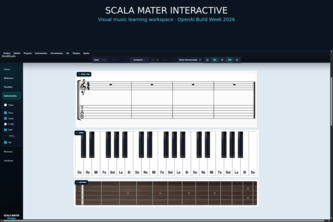
Scala Mater Interactive is a browser-based visual music-learning tool built as a prototype during OpenAI Build Week 2026. The author describes it as an interactive web app that maps musical concepts—major scale, diatonic chords, harmonic functions, and modes—into coordinated visual representations for guitarists, teachers, and digital creators.
What changed
The project evolved from an internal monolithic tool used to produce a music theory book into a modular, browser-based prototype. During Build Week, the author used AI tools (Codex, GPT-5.6) to extend, integrate, test, and stabilize this prototype into a working interactive experience.
Single most important open question
Is there evidence of traction, revenue, or customer adoption beyond the self-reported prototype?
Analysis basis: This report is based entirely on the author's own description. All claims are self-reported and unverified. No third-party data, financials, customers or usage metrics are available.
What The Product Actually Is
The description states that Scala Mater Interactive is a browser-based visual workspace for exploring music through connected representations. It includes:
- Standard notation and tablature
- Visual piano keyboard
- Guitar fretboard
- Piano-roll representation
- Interactive note states and visual relationships
- Controls for organizing and displaying the musical workspace
- A presentation-oriented canvas
The product is described as being built with React, TypeScript, Vite, SVG-based visualization, Git, GitHub, and Vercel. It uses AI tools (Codex, GPT-5.6) to assist in development.
Inference: The author claims the interface is modular and separates musical domain logic from visual representations, but no evidence of actual implementation or testing beyond Build Week is provided.
Positioning & Claim Evolution
The project began as a music-teaching method and book. It evolved into an internal tool for creating educational material before becoming a prototype during Build Week.
The author states that Scala Mater "uses the major scale as a generative framework" to connect intervals, diatonic chords, harmonic functions, and modes. The goal is to help users understand these subjects as interconnected rather than isolated.
Claim: The app aims to bridge traditional music theory instruction by showing how different concepts relate within one system.
Inference: This positioning implies a shift from static educational materials to an interactive learning platform, though no evidence of prior user feedback or product iteration exists.
Target Customer & ICP
The description identifies three target audiences:
- Guitarists and music students who want to understand the theory behind shapes and songs they play.
- Music teachers who need a clear visual environment for lessons and demonstrations.
- Digital music creators who produce educational videos, courses, presentations, and social media content.
Claim: These are the intended users of the prototype.
Inference: No evidence of actual customer interviews, usage data, or feedback from these groups is provided.
Business Model & Pricing Evidence
There is no mention of pricing, monetization strategy, or business model in the description. The project is described as a prototype submitted to a hackathon and remains an actively developed tool.
Not evidenced: No indication of revenue streams, subscription plans, licensing, or commercial viability.
Technical & Delivery Signals
The application is built using React, TypeScript, Vite, SVG-based visualization, Git, GitHub, and deployed via Vercel. The author notes that the architecture was restructured to separate musical domain logic from interface behavior.
Codex and GPT-5.6 were used for code inspection, component implementation, testing, documentation, and deployment.
Claim: The project uses modular architecture with clear separation between musical logic, visualizations, and user interaction.
Inference: While described as modular, there is no evidence of actual system performance, scalability, or robustness beyond the prototype stage.
Traction & Maturity Signals
The description indicates that Scala Mater Interactive is currently a prototype. It was built during OpenAI Build Week 2026 and remains in active development.
It has not yet been deployed for public use outside of the hackathon submission.
Not evidenced: No evidence of user engagement, retention, or adoption beyond the author's own testing and demonstration.
Competitive Context
No direct competitors are mentioned. The description does not reference similar tools or platforms in the music education space.
Not evidenced: No competitive analysis, market positioning, or differentiation from existing tools is provided.
Open Questions & Risks
- The product is described as a prototype with no evidence of real-world usage.
- The author is a solo developer without a team, raising questions about scalability and long-term maintenance.
- Heavy reliance on AI tools (Codex, GPT) may indicate limited technical depth or sustainability if those tools change or become unavailable.
- The interface is currently in Spanish only; lack of localization suggests limited market reach.
Inference: Without traction or revenue data, the risk of failure is high unless significant progress toward commercial viability occurs soon.
Questions the description leaves open
- What specific feedback have you received from potential users (guitarists, teachers, creators)?
- How do you plan to monetize this product beyond its current prototype stage?
- Are there any plans for localization or support for English-speaking users?
- What are the key technical challenges that remain unresolved in the current architecture?
- Do you have a roadmap for expanding beyond the current scope (e.g., additional instruments, audio playback)?
- How do you intend to scale beyond a solo developer?
Overall Assessment
Confidence Level: Low
The project is described as a prototype developed during a hackathon and lacks any evidence of traction, revenue, or customer adoption.
Claim: The author believes the tool can evolve into a broader learning platform.
Inference: This vision is unproven. There is no indication that the prototype has been tested with real users or validated in a market setting.
Assessment: Not ready for investment or partnership at this stage. Further development, user testing, and evidence of traction are required before considering deeper engagement.
User Stories BotA demo video on every pull request
Get a demo video on every new feature
GitHub App that watches your pull requests and records a narrated, captioned demo.
Save time on demo prep and make informed decisions faster with a video walkthrough of every new feature.
Source
Submitted to the OpenAI 2026 hackathon on Devpost. Project home on Devpost. Back to the full gallery on Devpost.
This competitive analysis was produced by top-founders.com (opens in a new tab)
Generated by a language model from this project's public Devpost page — its tagline, the author's own write-up and any built-with tags listed there — as captured in August 2026. Short quotations are the author's words. It is an opinion on the idea as a business, not on the people behind it, and it reflects the description as published then. If the project has moved on, request a correction below. The analysis is not independent research and contains no verified traction, revenue or customer data.
An independent guide by KFG International LLC — not affiliated with, endorsed by, or connected to Devpost or OpenAI.