

Archive position — measured, not model output
0 likes on Devpost
2,263 of the 7,850 archived projects have more likes, and 5,587 share exactly 0 — so this project's #5,788 place in the like-ranked listing is a tie-break inside that group, not a ranking.
Projects (log scale)
Likes on Devpost. ▲ marks this project's group.
Show the figures
| Likes | Projects | Share of archive |
|---|---|---|
| 0 | 5,587 | 71.2% |
| 1 | 1,758 | 22.4% |
| 2 | 284 | 3.6% |
| 3–4 | 132 | 1.7% |
| 5–9 | 75 | 1.0% |
| 10+ | 14 | 0.2% |
 User Stories BotA demo video on every pull request
Get a demo video on every new feature
GitHub App that watches your pull requests and records a narrated, captioned demo.
Save time on demo prep and make informed decisions faster with a video walkthrough of every new feature.
Executive Summary
What the company appears to be
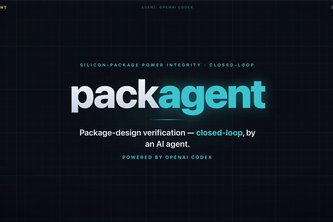
Packagent is a self-reported project that claims to integrate an AI agent (running GPT-5.6) into chip packaging design workflows, using commercial EDA tools like Cadence and Ansys. The system reportedly automates physical verification and layout fixes within a deterministic framework, with a focus on preventing erroneous designs from reaching tape-out.
What changed
The project description states that the team built a system where an AI agent interacts with real EDA tools to solve packaging problems, including predicting fixes before running simulations, drawing changes into Cadence, and refusing to ship designs that violate constraints. It also describes building a deterministic verification toolkit (pkgtk) as a foundation for this integration.
The single most important open question
Is the described AI agent capable of reliably closing physical design loops in commercial EDA environments, or is it limited to controlled, pre-defined scenarios?
Note: This analysis is based solely on the self-reported project description provided by the authors. No external verification, traction data, revenue figures, or customer information are available.
What The Product Actually Is
The description states that Packagent:
- Puts an OpenAI Codex agent (running GPT-5.6) into the chip packaging design loop.
- Reads field solver results from Ansys SIwave.
- Redraws copper in Cadence using SKILL scripting.
- Proves fixes by re-solving and verifying with commercial tools.
- Refuses to ship designs it cannot validate.
It also claims:
- The agent predicts capacitance values before simulation (e.g., 51 pF → 61 pF).
- It uses a deterministic verification toolkit called pkgtk.
- The system includes an eval harness with 28 seeded-defect tasks and zero-LLM graders.
- There is an AGENTS.md operating manual and specialist subagent roles.
Inference: The product appears to be a hybrid system combining AI agents with deterministic EDA tooling, designed for autonomous physical verification in packaging design. However, the extent of its autonomy or generalizability beyond specific test cases is not evidenced.
Positioning & Claim Evolution
The description states:
- The project aims to apply AI to packaging design — an area often overlooked in AI chip design efforts.
- It positions itself as closing a physical loop in EDA that has historically relied on spreadsheets and manual checks.
- The team emphasizes trustworthiness: “it refuses to ship the ones it can't” and “can’t quietly lie to us.”
- They claim their agent stops when it should, rather than bluffing.
Inference: The positioning is focused on reliability and safety in chip packaging automation. It evolved from a hackathon project into a system designed to integrate AI with real EDA workflows while maintaining deterministic control.
Target Customer & ICP
The description does not name specific customers or target industries beyond general chip design and packaging.
Not evidenced: No evidence of customer segments, buyer personas, or ideal customer profiles (ICPs) is provided. The project appears to be a proof-of-concept rather than a commercial offering.
Business Model & Pricing Evidence
The description does not contain any information about pricing models, monetization strategies, or business model assumptions.
Not evidenced: No evidence of how the product would be sold, priced, or integrated into existing workflows is available.
Technical & Delivery Signals
The description states:
- Built with: Ansys SIwave, Cadence Allegro APD, GDTK, GPT-5.6, IPC-2581, JSON Schema, KLayout, Matplotlib, NumPy, OpenAI Codex, Pydantic, PyEDB, PyTest, Python, Scikit-RF, SKILL, YAML.
- Uses a deterministic verification toolkit (pkgtk) with strict exit-code contracts and JSON output.
- The agent is wired in properly rather than prompted ad hoc.
- Includes an AGENTS.md manual, project config layer, repo skills, and eval harness.
- Implements a “golden fixture” rule: no agent-written code merges without human-authored validation.
Inference: Technical maturity is suggested through the use of deterministic tooling, structured interfaces, and internal controls. However, there is no evidence of production deployment or scalability beyond the hackathon context.
Traction & Maturity Signals
The description states:
- 26 solver-signed result trees with bit-identical reproduction.
- Open-source physics oracle within 3.68% to 1.00% of commercial solver resonance peaks.
- 28 seeded-defect tasks with zero-LLM graders.
- No revenue, customers, or adoption data are mentioned.
Not evidenced: There is no evidence of traction, user feedback, or market validation beyond the authors’ own claims.
Competitive Context
The description does not mention competitors or existing solutions in the chip packaging AI space.
Not evidenced: No competitive landscape or differentiation strategy is provided. The project appears to be positioned as a novel approach within a niche area of EDA.
Open Questions & Risks
Key risks inferred from the description:
- The system relies heavily on deterministic tooling and may not generalize beyond controlled environments.
- It uses GPT-5.6, which is not publicly available or verifiable; reliance on proprietary models introduces risk.
- The agent’s refusal mechanism (“stops when it should”) is described but lacks independent validation.
- Challenges with headless EDA integration suggest potential instability in real-world deployment.
- No evidence of production use, scaling, or long-term maintenance plans.
Open question: The project appears to be a hackathon prototype. There is no indication of commercial viability, product-market fit, or scalability beyond the authors’ controlled tests.
Questions the description leaves open
- What are the actual constraints and limitations of the deterministic verification layer (pkgtk)? Can it scale across different packaging technologies?
- How does the system handle edge cases not included in the 28 seeded-defect tasks?
- Is there any evidence of how the agent performs on real-world, unstructured problems outside of the testbed?
- What are the licensing and integration challenges with Cadence and Ansys that were encountered during development?
- How is the “golden fixture” rule enforced in practice — what does it look like in code or process?
- Are there any plans to open-source or commercialize the pkgtk toolkit, and how would that affect adoption?
- What are the key assumptions made about GPT-5.6’s behavior in this context, and how were they validated?
Overall Assessment
The description indicates a highly technical, experimental project built for a hackathon. While it shows some promising integration of AI with EDA tools, there is no evidence of traction, revenue, or commercial readiness.
Assessment: Not ready for investment or partnership at this stage. The project demonstrates potential in a narrow domain but lacks validation in real-world usage and market demand. It may be an early-stage idea worth exploring further if the team can demonstrate broader applicability and scalability.
User Stories BotA demo video on every pull request
Get a demo video on every new feature
GitHub App that watches your pull requests and records a narrated, captioned demo.
Save time on demo prep and make informed decisions faster with a video walkthrough of every new feature.
Source
Submitted to the OpenAI 2026 hackathon on Devpost. Project home on Devpost. Back to the full gallery on Devpost.
This competitive analysis was produced by top-founders.com (opens in a new tab)
Generated by a language model from this project's public Devpost page — its tagline, the author's own write-up and any built-with tags listed there — as captured in August 2026. Short quotations are the author's words. It is an opinion on the idea as a business, not on the people behind it, and it reflects the description as published then. If the project has moved on, request a correction below. The analysis is not independent research and contains no verified traction, revenue or customer data.
An independent guide by KFG International LLC — not affiliated with, endorsed by, or connected to Devpost or OpenAI.