

Archive position — measured, not model output
1 like on Devpost
505 of the 7,850 archived projects have more likes, and 1,758 share exactly 1 — so this project's #1,861 place in the like-ranked listing is a tie-break inside that group, not a ranking.
Projects (log scale)
Likes on Devpost. ▲ marks this project's group.
Show the figures
| Likes | Projects | Share of archive |
|---|---|---|
| 0 | 5,587 | 71.2% |
| 1 | 1,758 | 22.4% |
| 2 | 284 | 3.6% |
| 3–4 | 132 | 1.7% |
| 5–9 | 75 | 1.0% |
| 10+ | 14 | 0.2% |
 User Stories BotA demo video on every pull request
Get a demo video on every new feature
GitHub App that watches your pull requests and records a narrated, captioned demo.
Save time on demo prep and make informed decisions faster with a video walkthrough of every new feature.
Executive Summary
What the company appears to be
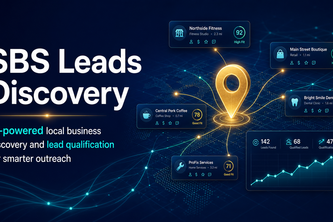
SBS Leads Discovery is a self-reported AI-powered local business discovery and lead qualification platform built as a hackathon project. The author states it supports small sales teams by automating parts of the lead lifecycle, including discovery, enrichment, scoring, CRM integration, and outreach preparation.
What changed
This is a single-person project submitted to an OpenAI 2026 hackathon. No prior version or development history is evidenced. It is described as a working prototype with end-to-end workflow capabilities but not yet deployed in production.
Single most important open question
Is there any evidence of traction, revenue, customer adoption, or actual use beyond the author's own development and submission?
What The Product Actually Is
The description states that SBS Leads Discovery is a platform that:
- Finds local businesses.
- Enriches each lead with website, SEO, technology, and contact signals.
- Ranks opportunities using configurable qualification criteria.
- Allows teams to review qualified leads, manage them in a CRM, create outreach campaigns, and track follow-ups from one place.
It is described as a "practical lead-discovery workspace" that aims to reduce manual research time for sales and operations teams.
Evidence
- The author states the product finds local businesses.
- It enriches with website, SEO, technology, and contact signals.
- It ranks leads using configurable criteria.
- It supports CRM management, outreach campaigns, and follow-up tracking.
- It is built as a single integrated workflow from discovery to outreach.
Inference The platform appears to be designed for small sales teams targeting local businesses, with an emphasis on automation and integration across lead lifecycle stages.
Positioning & Claim Evolution
The author positions SBS Leads Discovery as:
- An AI-powered solution for local business discovery.
- A tool that helps sales teams qualify leads more efficiently.
- A platform that streamlines outreach by centralizing lead data and workflows.
It is described as a "practical lead-discovery workspace" that reduces time spent on manual research.
Evidence
- Tagline: “AI-powered local business discovery, lead qualification, and outreach support for smarter sales teams.”
- The author claims it turns a fragmented process into one focused workflow.
- It supports dermatology clinics today and can be configured for other verticals.
Inference The positioning suggests a niche focus on small sales teams and local businesses, with potential scalability across industries. However, no evidence of market validation or customer feedback is provided.
Target Customer & ICP
The author states that the platform is designed to support:
- Small sales teams.
- Local business discovery and outreach.
- Dermatology clinics specifically (as a starting vertical).
- Potential expansion into additional local-business verticals.
Evidence
- The product targets small sales teams.
- It focuses on local businesses.
- Dermatology clinics are mentioned as the current vertical.
- Future expansion to other verticals is claimed.
Inference The ICP appears to be small B2B sales teams focused on local markets, with a potential for vertical-specific customization. No evidence of actual customers or use cases beyond the author’s own development.
Business Model & Pricing Evidence
No explicit business model or pricing information is provided in the description.
Evidence
- The author does not state how the product will be monetized.
- There is no mention of pricing tiers, subscriptions, or revenue streams.
- No evidence of customer contracts, sales cycles, or commercial agreements.
Inference The business model remains unknown. It may be a freemium, SaaS, or B2B tool, but the description does not confirm this.
Technical & Delivery Signals
The platform is built with:
- Python and FastAPI.
- SQLAlchemy and SQLite for data management.
- AI tools including Codex with GPT-5.6 for development acceleration.
- Integration of business discovery, enrichment, scoring, CRM workflows, outreach, and reporting.
Evidence
- Built with Python, FastAPI, SQLAlchemy, SQLite.
- Uses Codex with GPT-5.6 for development.
- Integrates multiple stages of lead lifecycle: discovery, enrichment, scoring, CRM, outreach, reporting.
- Modular architecture is claimed to support future integrations.
Inference The technical stack suggests a lightweight, developer-focused solution built for rapid iteration. The use of AI tools during development indicates an emphasis on automation and speed.
Traction & Maturity Signals
No evidence of traction or maturity beyond the hackathon submission is provided.
Evidence
- It was submitted to a hackathon.
- It is described as a working prototype.
- No revenue, customers, or adoption data are mentioned.
- No prior versions or iterations are referenced.
Inference The product is at an early stage — likely a proof-of-concept or MVP. There is no indication of real-world usage or product-market fit.
Competitive Context
No competitive landscape or market positioning is described.
Evidence
- The author does not mention competitors.
- No comparison to existing tools in the lead generation, CRM, or local business discovery space is made.
Inference The competitive context is unknown. It may overlap with tools like Hunter.io, ZoomInfo, or HubSpot, but no evidence supports this.
Open Questions & Risks
Key risks and open questions include:
- No revenue, customers, or traction.
- Single-person development team.
- Self-reported features without independent verification.
- No commercialization strategy or pricing model.
- Product is described as a hackathon submission — not yet a product in the market.
Evidence
- Only one team member listed.
- Submitted to a hackathon.
- No mention of users, adoption, or monetization.
- No evidence of prior versions or development history.
Inference This is a very early-stage idea with no commercial validation. The lack of traction and team size raises concerns about execution capability and scalability.
Questions the description leaves open
- What specific local business verticals are you targeting, and how do you plan to validate demand in each?
- How do you intend to monetize this product? Are there any early adopters or pilot customers?
- What is the current state of your lead qualification logic and scoring model?
- Have you considered integrating with existing CRM platforms like Salesforce or HubSpot?
- What are the key technical challenges in scaling this beyond a single-person prototype?
Overall Assessment
Not evidenced.
The description provides no evidence of revenue, customers, traction, or commercial viability. It is a self-reported hackathon project with no indication of market validation or product-market fit.
Confidence Low. This is a very early-stage idea with no demonstrated progress beyond the author’s own development and submission to a hackathon. There is no evidence of any commercial activity or adoption.
Inference If this were to evolve into a viable product, it would require significant development, validation, and team expansion. As a standalone project, it does not present a compelling case for investment or partnership at this time.
User Stories BotA demo video on every pull request
Get a demo video on every new feature
GitHub App that watches your pull requests and records a narrated, captioned demo.
Save time on demo prep and make informed decisions faster with a video walkthrough of every new feature.
Source
Submitted to the OpenAI 2026 hackathon on Devpost. Project home on Devpost. Back to the full gallery on Devpost.
This competitive analysis was produced by top-founders.com (opens in a new tab)
Generated by a language model from this project's public Devpost page — its tagline, the author's own write-up and any built-with tags listed there — as captured in August 2026. Short quotations are the author's words. It is an opinion on the idea as a business, not on the people behind it, and it reflects the description as published then. If the project has moved on, request a correction below. The analysis is not independent research and contains no verified traction, revenue or customer data.
An independent guide by KFG International LLC — not affiliated with, endorsed by, or connected to Devpost or OpenAI.