

Archive position — measured, not model output
0 likes on Devpost
2,263 of the 7,850 archived projects have more likes, and 5,587 share exactly 0 — so this project's #6,488 place in the like-ranked listing is a tie-break inside that group, not a ranking.
Projects (log scale)
Likes on Devpost. ▲ marks this project's group.
Show the figures
| Likes | Projects | Share of archive |
|---|---|---|
| 0 | 5,587 | 71.2% |
| 1 | 1,758 | 22.4% |
| 2 | 284 | 3.6% |
| 3–4 | 132 | 1.7% |
| 5–9 | 75 | 1.0% |
| 10+ | 14 | 0.2% |
 User Stories BotA demo video on every pull request
Get a demo video on every new feature
GitHub App that watches your pull requests and records a narrated, captioned demo.
Save time on demo prep and make informed decisions faster with a video walkthrough of every new feature.
Executive Summary
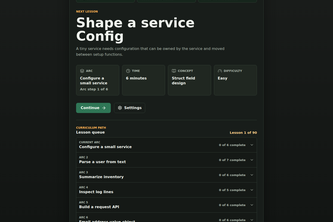
What the company appears to be: Rust Daily is a self-reported daily learning platform for Rust developers, modeled after Duolingo but focused on practicing idiomatic code writing without AI assistance. It presents short, realistic coding exercises within story arcs that emphasize practical Rust skills like ownership, error propagation, and type conversions.
What changed: The author reports building the entire platform solo using AI tools (Codex, GPT-5.6) for specification and implementation, but intentionally removing AI from the learner experience. The product is described as a personal project turned into a shared tool.
Single most important open question: Is there evidence of actual user engagement or adoption beyond the author's own use? The description contains no data on users, retention, or revenue — only self-reported intent and execution.
What The Product Actually Is
The description states that Rust Daily is a daily learning platform for Rust developers. It presents short, focused coding exercises designed to fit into 10-minute practice sessions. Lessons are structured as story arcs where learners gradually build and improve software over time. Each lesson emphasizes practical Rust skills such as ownership, borrowing, type conversions, parsing, collections, error propagation, service boundaries, request/response mapping, and writing idiomatic code.
The platform is built using React and TypeScript for the frontend, with a Rust backend powered by Actix. Exercises are maintained as canonical source files processed through a validation pipeline. Submitted Rust code runs inside restricted Podman containers to ensure security.
Evidence: The author describes how it was built (React/TypeScript frontend, Rust backend), what content it delivers (story arcs, practical skills), and how it enforces no-AI use during practice (sandboxed execution).
Inference: That the platform is intended for independent skill maintenance rather than formal education or enterprise training.
Positioning & Claim Evolution
The description positions Rust Daily as “Like Duolingo but for Rust,” emphasizing daily practice, idiomatic code writing, and deliberate skill retention without AI assistance. The author frames it as a response to feeling that AI tools were eroding their ability to write code independently.
It claims to focus on real-world applicability rather than algorithmic puzzles, aiming to teach developers how to write safe, expressive, maintainable Rust code.
Evidence: The author explicitly compares it to Duolingo and states the goal is to preserve independent coding skills while practicing idiomatic Rust.
Inference: The positioning reflects a niche market need for structured, AI-free practice among developers who rely heavily on AI tools in their work.
Target Customer & ICP
The description does not name specific customer segments or personas. However, it implies the target audience includes Rust developers who use AI coding assistants regularly but want to maintain or improve their independent coding abilities.
It suggests a user base that values deliberate practice and skill retention over productivity gains from AI.
Evidence: The author identifies himself as a developer who uses AI extensively but wants to avoid dependency on it for core skills.
Inference: The ICP likely includes experienced Rust developers who are concerned about losing proficiency due to over-reliance on AI tools.
Business Model & Pricing Evidence
There is no evidence of pricing, monetization strategy, or business model in the description. The author states that he built the platform for himself and now shares it publicly, without indicating any commercial intent or revenue streams.
Evidence: No mention of subscriptions, freemium tiers, enterprise licensing, or other financial mechanisms.
Inference: If there is a business model, it has not been disclosed in the provided description.
Technical & Delivery Signals
The platform uses React and TypeScript for the frontend and Rust with Actix for the backend. Lessons are stored as canonical source files and processed via a validation pipeline. Submitted code runs inside restricted Podman containers to prevent host system compromise.
AI was used during development (Codex, GPT-5.6) but not in the learner experience — users must write code without AI assistance.
Evidence: The author describes technical stack (React/TypeScript, Rust/Actix), containerized sandboxing for submissions, and use of AI only for building, not practicing.
Inference: The delivery approach prioritizes security and independence from AI during learning.
Traction & Maturity Signals
There is no evidence of user traction, customer adoption, or product maturity beyond the author’s own usage. The description does not include metrics such as active users, retention rates, lesson completion rates, or feedback from others.
Evidence: The author says he uses it daily and shares it with others who may feel similarly about AI reliance.
Inference: No external validation or measurable impact is reported.
Competitive Context
The description does not mention competitors or direct market comparisons. It references Duolingo as a conceptual model but does not name similar platforms or tools in the Rust learning space.
Evidence: The author compares it to Duolingo and mentions trying other coding platforms, but no specific competitor names are given.
Inference: The competitive landscape is unclear from this description alone.
Open Questions & Risks
- No user data or traction: The lack of evidence for users, engagement, or adoption raises questions about whether the product meets a real market need.
- Solo developer constraint: With only one team member (the author), scalability and long-term maintenance are uncertain.
- Unproven commercial viability: No pricing, monetization, or business model is described, suggesting no clear path to revenue.
- AI paradox: While AI was used in development, the product removes AI from the learner experience — this could be a unique value proposition or a potential contradiction if not clearly defined.
Evidence: The description lacks any data points on users, growth, or financials.
Questions the description leaves open
- What is your evidence of user engagement beyond personal use?
- How do you plan to scale beyond one developer?
- Are there any plans for monetization or pricing models?
- What are the key metrics you track to assess product success?
- How do you intend to differentiate from existing Rust learning resources?
- What is your strategy for building a sustainable user base?
Overall Assessment
Not evidenced.
The description provides no information on financials, traction, or commercial viability. It describes a personal project with strong self-reported intent and execution, but no evidence of market demand, revenue, or scalable impact.
Confidence level: Low — based entirely on the author’s own account, which is unverified and lacks any external validation or performance indicators.
User Stories BotA demo video on every pull request
Get a demo video on every new feature
GitHub App that watches your pull requests and records a narrated, captioned demo.
Save time on demo prep and make informed decisions faster with a video walkthrough of every new feature.
Source
Submitted to the OpenAI 2026 hackathon on Devpost. Project home on Devpost. Back to the full gallery on Devpost.
This competitive analysis was produced by top-founders.com (opens in a new tab)
Generated by a language model from this project's public Devpost page — its tagline, the author's own write-up and any built-with tags listed there — as captured in August 2026. Short quotations are the author's words. It is an opinion on the idea as a business, not on the people behind it, and it reflects the description as published then. If the project has moved on, request a correction below. The analysis is not independent research and contains no verified traction, revenue or customer data.
An independent guide by KFG International LLC — not affiliated with, endorsed by, or connected to Devpost or OpenAI.