

Archive position — measured, not model output
0 likes on Devpost
2,263 of the 7,850 archived projects have more likes, and 5,587 share exactly 0 — so this project's #6,490 place in the like-ranked listing is a tie-break inside that group, not a ranking.
Projects (log scale)
Likes on Devpost. ▲ marks this project's group.
Show the figures
| Likes | Projects | Share of archive |
|---|---|---|
| 0 | 5,587 | 71.2% |
| 1 | 1,758 | 22.4% |
| 2 | 284 | 3.6% |
| 3–4 | 132 | 1.7% |
| 5–9 | 75 | 1.0% |
| 10+ | 14 | 0.2% |
 User Stories BotA demo video on every pull request
Get a demo video on every new feature
GitHub App that watches your pull requests and records a narrated, captioned demo.
Save time on demo prep and make informed decisions faster with a video walkthrough of every new feature.
Executive Summary
Company: RustyBooks (as described by the author)
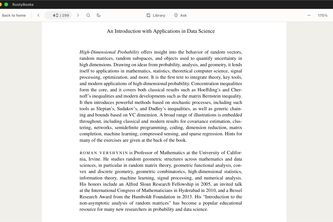
What it appears to be: A local-first desktop application for reading, organizing, annotating, and synthesizing academic papers using AI. It supports PDFs and EPUBs, allows contextual AI queries with clickable citations, and stores data locally.
Key change: The project is a self-contained desktop tool built around privacy and local processing, distinguishing itself from cloud-based alternatives by avoiding document uploads and telemetry.
Single most important open question: Is there any evidence of user adoption or feedback beyond the author's own account? The description provides no information on traction, revenue, customers, or usage metrics.
What The Product Actually Is
The description states that RustyBooks is a desktop application for reading PDFs and EPUBs. It allows users to ask questions about selected text, pages, or chapters and receive answers with clickable citations. The tool supports OCR fallback, reading statistics, and both cloud and local AI models.
- Functionality: Reading, organizing, annotating, synthesizing academic papers.
- Format support: PDFs and EPUBs.
- AI integration: Contextual questions with citations, support for OpenAI-compatible APIs, Anthropic, LM Studio, Ollama.
- Data handling: Local-first approach; keeps data on the user’s device.
- Technical stack: Built with Tauri v2, React, TypeScript, Vite, PDF.js, Zustand, SQLite.
Confidence level: High (based on self-reported technical and functional details)
Positioning & Claim Evolution
The author positions RustyBooks as an AI-powered reading tool that respects user privacy by avoiding cloud uploads. The project emphasizes local-first design, no accounts, no advertising, and no telemetry.
- Core positioning claim: A serious AI reading tool that respects privacy.
- Differentiation: Local-first approach; no document upload to the cloud.
- Evolution of claims: From a hackathon submission to a polished desktop application with configurable AI providers and secure credential storage.
Confidence level: Medium (claims are self-reported, not independently verified)
Target Customer & ICP
The description does not explicitly state target customers or ideal customer profiles. However, the focus on academic papers and local-first privacy suggests it may appeal to researchers, students, or professionals who value data control.
- Implicit audience: Researchers, students, academics.
- Use case: Reading, organizing, annotating, synthesizing academic papers.
- ICP not evidenced: No explicit segmentation or persona definition provided.
Confidence level: Low (no evidence of target customer or ICP)
Business Model & Pricing Evidence
The description does not provide any information on pricing, monetization, or business model. It is unclear whether the tool will be free, paid, or offered through a freemium model.
- Monetization: Not evidenced.
- Pricing: Not evidenced.
- Business model: Not evidenced.
Confidence level: Very low (no evidence of commercial structure)
Technical & Delivery Signals
The project is built with modern technologies and demonstrates some technical sophistication, particularly in local-first design and AI integration.
- Stack: Tauri v2, React, TypeScript, Vite, PDF.js, Zustand, SQLite.
- AI integration: Supports OpenAI-compatible APIs, Anthropic, LM Studio, Ollama.
- Privacy features: No accounts, no telemetry, secure credential storage.
- Delivery approach: Desktop application with local data handling.
Confidence level: Medium (based on self-reported technical details)
Traction & Maturity Signals
There is no evidence of traction, revenue, or user adoption. The project is described as a hackathon submission and lacks any metrics or feedback from users.
- User base: Not evidenced.
- Revenue: Not evidenced.
- Adoption: Not evidenced.
- Maturity: Not evidenced.
Confidence level: Very low (no traction signals)
Competitive Context
The description does not mention competitors or the broader market landscape. It is unclear how RustyBooks compares to existing tools in the academic reading or AI-powered note-taking space.
- Competitors: Not evidenced.
- Market context: Not evidenced.
- Differentiation from peers: Not evidenced.
Confidence level: Very low (no competitive analysis)
Open Questions & Risks
Several risks and open questions are present due to the lack of evidence or traction:
- No user feedback or adoption: The tool is described only by its author, with no external validation.
- Single-person team: Limited development capacity and scalability concerns.
- Unproven business model: No indication of monetization strategy or revenue streams.
- Limited market awareness: No mention of marketing, distribution, or user acquisition.
Confidence level: Medium (based on absence of evidence and self-reporting)
Questions the description leaves open
- What is the actual usage or feedback from users beyond your own experience?
- How do you plan to monetize this product, if at all?
- Are there any plans for user onboarding, community building, or marketing?
- What are the technical challenges you've faced in scaling local AI processing?
- Do you have a roadmap for expanding support beyond PDFs and EPUBs?
Note: These questions are based on the lack of evidence in the description.
Overall Assessment
There is no evidence to suggest that RustyBooks has reached a stage where it would be attractive for investment or partnership. The project is described as a hackathon submission with no traction, revenue, or user feedback. It lacks commercial structure and market validation.
- Investment potential: Not evidenced.
- Partnership opportunity: Not evidenced.
- Readiness for scale: Not evidenced.
Confidence level: Very low (no evidence of viability or traction)
User Stories BotA demo video on every pull request
Get a demo video on every new feature
GitHub App that watches your pull requests and records a narrated, captioned demo.
Save time on demo prep and make informed decisions faster with a video walkthrough of every new feature.
Source
Submitted to the OpenAI 2026 hackathon on Devpost. Project home on Devpost. Back to the full gallery on Devpost.
This competitive analysis was produced by top-founders.com (opens in a new tab)
Generated by a language model from this project's public Devpost page — its tagline, the author's own write-up and any built-with tags listed there — as captured in August 2026. Short quotations are the author's words. It is an opinion on the idea as a business, not on the people behind it, and it reflects the description as published then. If the project has moved on, request a correction below. The analysis is not independent research and contains no verified traction, revenue or customer data.
An independent guide by KFG International LLC — not affiliated with, endorsed by, or connected to Devpost or OpenAI.