

Archive position — measured, not model output
1 like on Devpost
505 of the 7,850 archived projects have more likes, and 1,758 share exactly 1 — so this project's #601 place in the like-ranked listing is a tie-break inside that group, not a ranking.
Projects (log scale)
Likes on Devpost. ▲ marks this project's group.
Show the figures
| Likes | Projects | Share of archive |
|---|---|---|
| 0 | 5,587 | 71.2% |
| 1 | 1,758 | 22.4% |
| 2 | 284 | 3.6% |
| 3–4 | 132 | 1.7% |
| 5–9 | 75 | 1.0% |
| 10+ | 14 | 0.2% |
 User Stories BotA demo video on every pull request
Get a demo video on every new feature
GitHub App that watches your pull requests and records a narrated, captioned demo.
Save time on demo prep and make informed decisions faster with a video walkthrough of every new feature.
Executive Summary
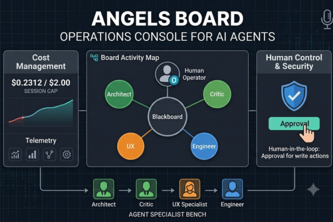
What the company appears to be: Angels Board is a self-reported governed multi-agent workspace and Model Context Protocol (MCP) host designed to transform ambiguous developer tasks into evidence-backed, budget-capped, and human-approved outcomes. It is described as a system that manages autonomous AI coding agents in a controlled environment with safety gates, real-time visibility, and cost controls.
What changed: The project was submitted as part of the OpenAI 2026 hackathon. No indication of prior development or commercial activity exists beyond this submission.
Single most important open question: Is there any evidence of actual usage, traction, or product-market fit beyond the author's own description?
What The Product Actually Is
The description states that Angels Board is:
- A governed multi-agent workspace
- An MCP host (Model Context Protocol)
- Designed to convert high-level developer prompts into safe, verified execution plans
- Built with Dart backend, Flutter frontend, and GPT-5.6 Structured Outputs
- Powered by a JSON-RPC Content-Length MCP host and client architecture
It features:
- Shared Blackboard Architecture for real-time agent deliberation display
- Dynamic Agent Lifecycle (Pool → Bench → Board pipeline)
- Context Broker & Evidence Hygiene
- Human Approval Gates
- Budget Governor with cost cap enforcement
Inference: The system appears to be a developer tool aimed at managing AI agents in code workspaces, especially where safety and governance are critical.
Positioning & Claim Evolution
The description states that Angels Board was built out of a core engineering necessity:
"when agents gain the capability to modify production workspaces, their execution must be completely transparent, strictly governed, and human-in-the-loop by design."
It positions itself as solving problems with unmonitored AI agents ("black boxes") in development environments.
Claims include:
- Converting ambiguous tasks into evidence-backed outcomes
- Enforcing budget caps per debate
- Requiring explicit human sign-off before applying changes
- Using deterministic backend validators instead of relying on LLM self-regulation
Inference: This is a positioning statement about safety, transparency, and governance in AI-assisted development workflows.
Target Customer & ICP
The description states that Angels Board targets developers who:
- Work with autonomous AI coding agents
- Need to manage agent execution in production workspaces
- Require visibility into agent deliberations and actions
- Want to enforce cost controls and safety gates
It is implied to be a tool for engineering teams or individuals working on software development projects where AI agents may make changes.
Not evidenced: No specific customer segments, personas, or use cases beyond general developer needs are provided.
Business Model & Pricing Evidence
The description does not provide any information about:
- Revenue model
- Pricing structure
- Monetization strategy
- Customer acquisition plans
Inference: There is no evidence of a business model or pricing mechanism in the self-reported materials.
Technical & Delivery Signals
The project was built with:
- Dart (backend)
- Flutter (frontend)
- GPT-5.6 Structured Outputs
- JSON-RPC Content-Length MCP host/client
- Context Broker
- Budget Governor
- Sandboxed test execution engine
- Human-in-the-loop approval dashboard
It includes features such as:
- Real-time event feed and graph display
- Vote distribution charts
- Cost/cache telemetry
- One-click session abort control
Inference: The technical stack suggests a developer-focused tool with strong emphasis on security, observability, and control.
Traction & Maturity Signals
The description states that this is:
- A hackathon submission (OpenAI 2026)
- Built by one person (Konstantin Merdzhanov)
- Not described as having any revenue, customers, or product-market fit
Not evidenced: No evidence of traction, adoption, or commercial maturity beyond the author’s own account.
Competitive Context
The description does not mention:
- Competitors
- Market landscape
- Differentiation from existing tools
- Prior art in multi-agent systems or AI governance for developers
Inference: The competitive context is unknown based on the provided information.
Open Questions & Risks
Key risks and open questions inferred from the description:
- No evidence of product-market fit or traction
- Only one team member involved
- Self-reported only; no independent verification
- No pricing, monetization, or business model described
- The system is presented as a hackathon prototype, not a commercial product
- Heavy reliance on GPT-5.6 and structured outputs without clarity on scalability or deployment
Questions the description leaves open
- What specific developer workflows does Angels Board aim to improve?
- How does it differ from other agent orchestration tools currently available?
- Is there any evidence of early adopters or pilot users?
- What is the plan for monetization and customer acquisition?
- Has the system been tested in real-world development environments?
- Are there any known limitations or trade-offs with the current architecture?
Overall Assessment
Assessment: Not evidenced.
The description provides no evidence of:
- Revenue
- Customers
- Traction
- Product-market fit
- Business model
- Team traction or prior experience
This is a self-reported hackathon project with no indication of commercial viability or market readiness. The author states that it was built for the OpenAI 2026 hackathon, and there is no evidence of any further development or product launch.
Confidence Level: Low — based entirely on self-reporting without corroboration or external validation.
User Stories BotA demo video on every pull request
Get a demo video on every new feature
GitHub App that watches your pull requests and records a narrated, captioned demo.
Save time on demo prep and make informed decisions faster with a video walkthrough of every new feature.
Source
Submitted to the OpenAI 2026 hackathon on Devpost. Project home on Devpost. Back to the full gallery on Devpost.
This competitive analysis was produced by top-founders.com (opens in a new tab)
Generated by a language model from this project's public Devpost page — its tagline, the author's own write-up and any built-with tags listed there — as captured in August 2026. Short quotations are the author's words. It is an opinion on the idea as a business, not on the people behind it, and it reflects the description as published then. If the project has moved on, request a correction below. The analysis is not independent research and contains no verified traction, revenue or customer data.
An independent guide by KFG International LLC — not affiliated with, endorsed by, or connected to Devpost or OpenAI.