

Archive position — measured, not model output
0 likes on Devpost
2,263 of the 7,850 archived projects have more likes, and 5,587 share exactly 0 — so this project's #6,480 place in the like-ranked listing is a tie-break inside that group, not a ranking.
Projects (log scale)
Likes on Devpost. ▲ marks this project's group.
Show the figures
| Likes | Projects | Share of archive |
|---|---|---|
| 0 | 5,587 | 71.2% |
| 1 | 1,758 | 22.4% |
| 2 | 284 | 3.6% |
| 3–4 | 132 | 1.7% |
| 5–9 | 75 | 1.0% |
| 10+ | 14 | 0.2% |
 User Stories BotA demo video on every pull request
Get a demo video on every new feature
GitHub App that watches your pull requests and records a narrated, captioned demo.
Save time on demo prep and make informed decisions faster with a video walkthrough of every new feature.
Executive Summary
What the company appears to be
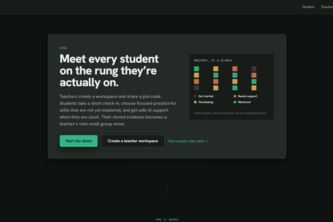
Rung is a self-reported educational platform designed to support differentiated instruction in classrooms. It claims to identify specific learning gaps for students through diagnostics, then provide AI-powered tutoring with escalating hints, and offer teachers tools to create targeted mini-lessons based on student performance.
What changed
The project description states that the team built this during an OpenAI 2026 hackathon, suggesting it is a prototype or early-stage product. It was not previously evidenced to have any commercial traction, revenue, or customer base.
Single most important open question
Is there evidence that Rung’s AI tutoring and diagnostic capabilities are effective in real-world classroom settings, or does the platform remain unproven in terms of pedagogical impact?
What The Product Actually Is
The description states that Rung is a differentiated-instruction platform. It allows teachers to set up digital classrooms where students take a short diagnostic test. Based on results, it builds individualized practice plans for each skill that needs improvement.
Key features include:
- AI tutor offering three levels of help: nudge, hint, and guided step
- Live heatmap showing where each student stands
- One-click actions from the evidence
- AI-drafted mini-lessons for small groups with shared learning gaps
- YouTube video guidance included in lessons
The platform uses Next.js, Supabase, and GPT 5.6 (as per author's declaration), with a clear separation between what GPT helps with and what the app decides itself.
Inference: The product is described as an educational tool aimed at helping teachers tailor instruction to individual student needs, using AI for both tutoring and lesson planning.
Positioning & Claim Evolution
The authors position Rung as a way to replicate the teaching style of Ms. Collins — a teacher who identifies exactly where each student is stuck, meets them there, and guides them without giving answers directly.
They state:
- “Rung finds the exact sub-skill each student is missing”
- “Tutors them there”
- “Turns the class's gaps into tomorrow's lesson plan”
This positioning implies a shift from traditional one-size-fits-all instruction to personalized learning at scale, using AI as an enabler.
Inference: The platform positions itself as a solution for educators seeking to improve student outcomes by addressing individual learning gaps more effectively than standard curricula allow.
Target Customer & ICP
The description states that Rung is intended for teachers and students in high school or similar educational environments, particularly those who want to implement differentiated instruction.
It also mentions:
- Teachers setting up digital classrooms
- Students taking diagnostics and receiving personalized practice plans
- Mini-lessons tailored to small groups with shared learning gaps
Inference: The primary customer is likely K–12 teachers, possibly in under-resourced or remote educational contexts where personalized attention is scarce.
Business Model & Pricing Evidence
Not evidenced. The description does not contain any information about pricing models, monetization strategies, subscription plans, or revenue streams.
Technical & Delivery Signals
The team built Rung using:
- Next.js
- Supabase
- GPT 5.6
They also mention:
- Clear architecture and contracts.md files
- Use of Codex for building data flow and UI
- Validation of model outputs before showing them
- Prevention of answer leaks in hints
- Safe fallbacks when AI features fail
- Test suite of 230 tests across 36 files
Inference: The team shows technical discipline, particularly around AI integration and safety measures. However, no evidence indicates deployment, scalability, or production readiness.
Traction & Maturity Signals
Not evidenced. There is no mention of:
- Customers
- Revenue
- Usage metrics
- Product adoption
- Any form of user feedback or pilot programs
The project was submitted to a hackathon and has no documented traction beyond its own description.
Competitive Context
Not evidenced. The description does not reference competitors, existing solutions in the edtech space, or market positioning relative to other platforms.
Open Questions & Risks
- Unproven pedagogical effectiveness: No evidence that AI tutoring improves learning outcomes.
- AI safety concerns: While they claim to prevent answer leaks and use fallbacks, there is no independent validation of these safeguards.
- Prototype status: Built for a hackathon; no indication of product-market fit or long-term viability.
- No commercial data: No revenue, customers, or usage data provided — all claims are self-reported.
Questions the description leaves open
- What specific learning outcomes have been observed in pilot classrooms using Rung?
- How does the platform validate that its diagnostic assessments accurately identify student skill levels?
- Can you provide examples of how the AI hints and guided steps differ from direct answer provision?
- Have you tested the system with real teachers and students, or is it still in experimental phase?
- What are your plans for scaling beyond a hackathon prototype?
Overall Assessment
Not evidenced. There is no information available regarding funding rounds, valuation, or investment interest. The project remains unproven as a commercial entity.
The description indicates that Rung is an early-stage idea built during a hackathon, with no evidence of traction, revenue, or customer validation. It is positioned as a potential solution to a real educational challenge but lacks any demonstration of effectiveness or market readiness.
Confidence Level: Low — based entirely on self-reported claims and prototype-level development.
User Stories BotA demo video on every pull request
Get a demo video on every new feature
GitHub App that watches your pull requests and records a narrated, captioned demo.
Save time on demo prep and make informed decisions faster with a video walkthrough of every new feature.
Source
Submitted to the OpenAI 2026 hackathon on Devpost. Project home on Devpost. Back to the full gallery on Devpost.
This competitive analysis was produced by top-founders.com (opens in a new tab)
Generated by a language model from this project's public Devpost page — its tagline, the author's own write-up and any built-with tags listed there — as captured in August 2026. Short quotations are the author's words. It is an opinion on the idea as a business, not on the people behind it, and it reflects the description as published then. If the project has moved on, request a correction below. The analysis is not independent research and contains no verified traction, revenue or customer data.
An independent guide by KFG International LLC — not affiliated with, endorsed by, or connected to Devpost or OpenAI.