

Archive position — measured, not model output
0 likes on Devpost
2,263 of the 7,850 archived projects have more likes, and 5,587 share exactly 0 — so this project's #6,481 place in the like-ranked listing is a tie-break inside that group, not a ranking.
Projects (log scale)
Likes on Devpost. ▲ marks this project's group.
Show the figures
| Likes | Projects | Share of archive |
|---|---|---|
| 0 | 5,587 | 71.2% |
| 1 | 1,758 | 22.4% |
| 2 | 284 | 3.6% |
| 3–4 | 132 | 1.7% |
| 5–9 | 75 | 1.0% |
| 10+ | 14 | 0.2% |
 User Stories BotA demo video on every pull request
Get a demo video on every new feature
GitHub App that watches your pull requests and records a narrated, captioned demo.
Save time on demo prep and make informed decisions faster with a video walkthrough of every new feature.
Executive Summary
What the company appears to be
Running Notes is a self-reported tool that turns voice memos into emails delivered to a private mailbox. The author describes it as a single-user proof-of-concept turned into a productized version with containerized deployment, guest access, and browser-based mailbox view.
What changed
The project evolved from a personal demo to a deployable system with public guest access, autoconfiguration for mail clients, and integration of AI tools (e.g., GPT-5.6 Sol) in development workflows.
Single most important open question
Is there any evidence of actual user adoption or commercial traction beyond the author’s own use case?
What The Product Actually Is
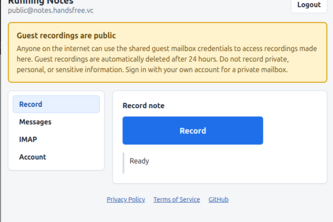
The description states that Running Notes is a system where users record audio via a browser, which then becomes an email delivered to an IMAP mailbox. It uses Dovecot for mail infrastructure and FastAPI for backend services.
- Functionality: Voice recording → upload → conversion into email → delivery via LMTP to Dovecot.
- Delivery method: Email inbox (IMAP), accessible through standard mail clients like Outlook or Thunderbird.
- User interface: Browser-based mailbox view with audio playback.
- Deployment: Containerized, with TLS termination, public guest path, and autoconfiguration for mail clients.
Inference The product is not a note-taking app but a bridge between voice capture and email delivery. It leverages existing mail infrastructure rather than building its own.
Positioning & Claim Evolution
The author claims that Running Notes was inspired by the need to capture ideas instantly and process them later using familiar tools — specifically, email inboxes.
- Original intent: To avoid disconnecting thoughts from work tools by delivering voice notes directly into a mailbox.
- Evolution: From a personal demo to a productized version with public access and developer-friendly deployment.
- Positioning: A minimal, no-registration solution for capturing and organizing ideas via email.
Inference The positioning is niche — targeting individuals who already use email as their primary work tool and want to capture spontaneous thoughts without switching apps.
Target Customer & ICP
The description does not state specific customer segments or personas.
- Self-reported target: Likely individuals who take voice memos during daily activities (e.g., walking, cooking) and prefer processing them in an email inbox.
- ICP inference: Early adopters of developer tools or productivity systems that integrate with email workflows.
Not evidenced No explicit customer data, user interviews, or segmentation beyond the author’s personal use case.
Business Model & Pricing Evidence
The description does not mention pricing or monetization strategies.
- Self-reported model: No registration required; public guest access.
- Monetization claims: None stated.
Inference The product appears to be free-to-use with no commercial layer. It may be a side project or prototype, not intended for revenue generation at this stage.
Technical & Delivery Signals
The author describes technical implementation details:
- Stack: FastAPI, Dovecot, IMAP, nginx, OAuth, Python, SQLite, voice recording via MediaRecorder API.
- Deployment: Containerized with Docker Compose; TLS termination; public access via boringproxy.
- AI integration: GPT-5.6 Sol used for DevOps tasks including debugging and service configuration.
- Workflow: Used tmux + Codex + Handsfree Vibe Coding Android app for remote development.
Inference The system is built with minimal infrastructure, leveraging existing mail servers and open-source tools. It shows a strong developer focus and use of AI in deployment and debugging.
Traction & Maturity Signals
The description does not provide any evidence of traction or user adoption.
- Maturity level: Productized but likely limited to the author’s own usage.
- User base: Not stated; no customers, users, or feedback mentioned.
- Growth metrics: None provided.
Inference The project is at a very early stage — possibly a prototype or personal tool with no external validation or market traction.
Competitive Context
The description does not mention competitors or similar tools.
- No competitive analysis: No reference to existing voice-to-email, note-taking, or productivity apps.
- Market positioning: Not compared to other tools in the space.
Inference The author has not positioned Running Notes within a broader market context. It may be an isolated solution with no known direct competitors.
Open Questions & Risks
Several risks and open questions are evident from the self-reported description:
- No commercial traction or revenue: No evidence of users, customers, or monetization.
- Single-person team: Only one developer (Oleg Parashchenko) involved.
- Unverified claims: All information is self-reported; no independent verification.
- Limited scope: Designed for personal use and basic functionality — not scalable or enterprise-ready.
- Developer-centric tooling: Uses AI tools like GPT-5.6, but this may limit accessibility to non-developers.
Inference The project lacks commercial viability or scalability without further evidence of adoption or funding.
Questions the description leaves open
- What is the actual user base beyond your own usage?
- Are there any customers or users who have paid for or subscribed to this service?
- How do you plan to scale beyond a single developer and personal use case?
- Is there a long-term vision for monetization or commercial growth?
- Have you considered how this would work in enterprise environments or with more complex workflows?
Overall Assessment
Not evidenced No financials, revenue, customer data, or traction metrics are available.
- Confidence level: Low — based entirely on self-reported narrative.
- Commercial viability: Not demonstrated; no evidence of market demand or commercial traction.
- Potential for growth: Possible if the idea gains traction, but currently lacks validation.
Inference The project is a personal tool or prototype with no clear path to commercialization or partnership opportunity. It requires further due diligence to assess real-world adoption or scalability potential.
User Stories BotA demo video on every pull request
Get a demo video on every new feature
GitHub App that watches your pull requests and records a narrated, captioned demo.
Save time on demo prep and make informed decisions faster with a video walkthrough of every new feature.
Source
Submitted to the OpenAI 2026 hackathon on Devpost. Project home on Devpost. Back to the full gallery on Devpost.
This competitive analysis was produced by top-founders.com (opens in a new tab)
Generated by a language model from this project's public Devpost page — its tagline, the author's own write-up and any built-with tags listed there — as captured in August 2026. Short quotations are the author's words. It is an opinion on the idea as a business, not on the people behind it, and it reflects the description as published then. If the project has moved on, request a correction below. The analysis is not independent research and contains no verified traction, revenue or customer data.
An independent guide by KFG International LLC — not affiliated with, endorsed by, or connected to Devpost or OpenAI.