

Archive position — measured, not model output
1 like on Devpost
505 of the 7,850 archived projects have more likes, and 1,758 share exactly 1 — so this project's #593 place in the like-ranked listing is a tie-break inside that group, not a ranking.
Projects (log scale)
Likes on Devpost. ▲ marks this project's group.
Show the figures
| Likes | Projects | Share of archive |
|---|---|---|
| 0 | 5,587 | 71.2% |
| 1 | 1,758 | 22.4% |
| 2 | 284 | 3.6% |
| 3–4 | 132 | 1.7% |
| 5–9 | 75 | 1.0% |
| 10+ | 14 | 0.2% |
 User Stories BotA demo video on every pull request
Get a demo video on every new feature
GitHub App that watches your pull requests and records a narrated, captioned demo.
Save time on demo prep and make informed decisions faster with a video walkthrough of every new feature.
Executive Summary
What the company appears to be:
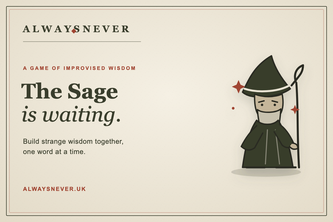
The description states that "Always Never" is a word-game experience where a human negotiates with an AI-powered "Sage" to build a proverb one word at a time. The Sage contributes one word, and the player chooses the next. The interaction is framed as a negotiation between two parties, with the Sage having emotional responses (approval, anger, silence) and the player able to push back or accept suggestions. The game includes elements of ritual, such as sealing proverbs with "five yeses and a bow", and allows sharing with a public archive.
What changed:
The project is described as an experiment in AI-driven creative collaboration, using OpenAI Codex and GPT-5.6 for development. It evolved from a simple improv game into a structured experience involving grammar-aware word selection, player choice, and a persistent archive of shared proverbs. The author notes that the game was built iteratively through feedback loops with Codex, and that it includes privacy-conscious design features.
The single most important open question:
Is there any evidence of user engagement or adoption beyond the initial build? The description does not indicate whether users have interacted with the system beyond the developer's own playtesting. No revenue, customer base, or usage metrics are provided.
What The Product Actually Is
The description states that "Always Never" is a word-game experience where a human negotiates with an AI-powered "Sage" to build a proverb one word at a time. The Sage contributes one word, and the player chooses the next. It includes:
- A turn-based interaction between the player and the Sage.
- Four choices offered on each player turn.
- The ability to ask for another offering from the Sage (at risk of incurring wrath).
- A mechanism to end the proverb at any time, with optional completion by the Sage.
- Sealing the proverb with "five yeses and a bow".
- A permanent link and title assigned to each proverb.
- Options to keep it private or share it publicly via a "Great Archive".
- A system that tracks parts of speech, clause shape, agreement, and what kinds of noun a verb can sensibly accept.
- Use of GPT-5.6 for editorial selection and constrained AI features.
- Deployment on Cloudflare Workers with D1 database.
The product is described as a small game, not a commercial service or platform.
Positioning & Claim Evolution
The description states that the project grew from "word-at-a-time improv games" where two people build a sentence without knowing where the other will take it. The author wondered whether this negotiation could work between a person and an AI character — not a chatbot, but an ancient Sage with opinions.
The positioning is framed as:
- A creative experience that blends improvisation, narrative, and AI.
- A ritualistic interaction where the player and Sage negotiate meaning while embracing unexpected outcomes.
- A game of discovery, where the proverb emerges through negotiation and intuition.
- An AI collaborator that contributes one word at a time, constrained by grammar and emotional logic.
There is no claim of commercial traction or monetization. The project is positioned as an experimental art piece or prototype, not a product with a market.
Target Customer & ICP
The description states that the target user is someone who:
- Enjoys improv-style games.
- Is interested in creative AI interaction.
- Values ritualistic or ceremonial elements in digital experiences.
- May be drawn to wordplay, humor, and unexpected wisdom.
There is no indication of a defined customer segment beyond the developer’s own playtesting. No demographic, behavioral, or psychographic data is provided.
Business Model & Pricing Evidence
The description states that:
- Players can sign, withdraw, or permanently delete their own work without creating an account.
- The system allows for private storage of proverbs and public sharing.
- There is no mention of pricing, subscriptions, or monetization.
- The public archive is described as a "Great Archive" where shared links have preview cards.
- No revenue model, pricing tiers, or customer acquisition costs are mentioned.
The project is not presented as a commercial offering.
Technical & Delivery Signals
The description states that:
- The game was built using OpenAI Codex and GPT-5.6.
- It runs on Cloudflare Workers, with Cloudflare D1 for data storage.
- The system includes 75 automated tests.
- There is a grammar-aware engine that tracks parts of speech, clause shape, agreement, and verb-noun compatibility.
- AI features include strict schemas, timeouts, rate limits, budgets, deterministic fallbacks, and independent off switches.
- The Sage's behavior is constrained to avoid full AI takeover, ensuring player agency.
The technical architecture appears to be a serverless web app with AI integration. It includes privacy-conscious design, such as anonymous daily totals instead of personal histories.
Traction & Maturity Signals
The description states that:
- The project has more than 1,300 structurally and semantically tagged words.
- It includes a permanent, controllable proverb archive.
- There is a public Great Archive with social-sharing cards.
- A daily GPT-5.6 editorial selection feature exists.
- The system has 75 automated tests.
- It was submitted to the OpenAI 2026 hackathon, suggesting it is a prototype or experimental project.
There is no evidence of user engagement, revenue, or adoption beyond the developer’s own use and iteration. No metrics on active users, retention, or monetization are provided.
Competitive Context
The description does not provide any information about competitors or market positioning. It does not mention similar products, platforms, or services in the space of AI-driven creative tools or word games.
No competitive analysis is evident.
Open Questions & Risks
- Lack of user data: No evidence of real-world usage or engagement.
- Prototype nature: The project appears to be a hackathon submission, not a commercial product.
- No monetization strategy: No indication of how the project might generate revenue.
- AI dependency: Heavy reliance on GPT-5.6 and Codex, with no clear fallback for AI unavailability or cost overruns.
- Limited scope: The experience is described as a small game, not scalable beyond the developer’s own use.
Questions the description leaves open
- What is the intended user base beyond the developer?
- Are there any plans to monetize or scale this experience?
- How would you handle AI cost inflation or unavailability?
- What are the long-term goals for the project — is it a prototype or a product in development?
- Is there any evidence of user feedback or engagement beyond your own testing?
Overall Assessment
The description states that this is a small game built as part of an OpenAI hackathon submission. It is not presented as a commercial venture, nor does it show signs of traction, revenue, or customer adoption.
There is no evidence to suggest that this project has moved beyond the experimental or prototype stage. The author describes it as a creative experiment in AI collaboration and improvisation, not a scalable business model.
Assessment: Not evidenced as a viable commercial opportunity. Likely a prototype or proof-of-concept with no demonstrated market or revenue potential.
User Stories BotA demo video on every pull request
Get a demo video on every new feature
GitHub App that watches your pull requests and records a narrated, captioned demo.
Save time on demo prep and make informed decisions faster with a video walkthrough of every new feature.
Source
Submitted to the OpenAI 2026 hackathon on Devpost. Project home on Devpost. Back to the full gallery on Devpost.
This competitive analysis was produced by top-founders.com (opens in a new tab)
Generated by a language model from this project's public Devpost page — its tagline, the author's own write-up and any built-with tags listed there — as captured in August 2026. Short quotations are the author's words. It is an opinion on the idea as a business, not on the people behind it, and it reflects the description as published then. If the project has moved on, request a correction below. The analysis is not independent research and contains no verified traction, revenue or customer data.
An independent guide by KFG International LLC — not affiliated with, endorsed by, or connected to Devpost or OpenAI.