

Archive position — measured, not model output
0 likes on Devpost
2,263 of the 7,850 archived projects have more likes, and 5,587 share exactly 0 — so this project's #4,519 place in the like-ranked listing is a tie-break inside that group, not a ranking.
Projects (log scale)
Likes on Devpost. ▲ marks this project's group.
Show the figures
| Likes | Projects | Share of archive |
|---|---|---|
| 0 | 5,587 | 71.2% |
| 1 | 1,758 | 22.4% |
| 2 | 284 | 3.6% |
| 3–4 | 132 | 1.7% |
| 5–9 | 75 | 1.0% |
| 10+ | 14 | 0.2% |
 User Stories BotA demo video on every pull request
Get a demo video on every new feature
GitHub App that watches your pull requests and records a narrated, captioned demo.
Save time on demo prep and make informed decisions faster with a video walkthrough of every new feature.
Executive Summary
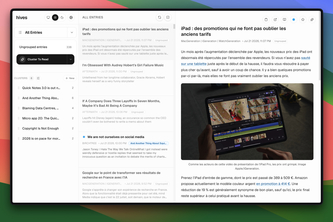
The description states that Hives is a web-based RSS reader using an on-device model to cluster entries. The author, Ethan Ohayon, describes building it with Codex (OpenAI's AI coding assistant), which wrote ~80% of the app since GPT-5.6 launch. The product supports standalone reading and Feedbin syncing, with features like semantic clustering, local storage, and browser-based summaries.
The most important open question is: What is the actual commercial viability or traction of this tool? The description contains no evidence of revenue, users, customer base, or adoption metrics — only self-reported claims about functionality and development process. It remains unclear whether Hives has any market presence beyond its author's personal use.
What The Product Actually Is
The description states that Hives is a web-based RSS reader with on-device semantic clustering capabilities. Key technical elements include:
- Uses transformers.js for embeddings
- Runs local clustering via Xenova/all-MiniLM-L6-v2 model
- Stores data in IndexedDB (browser-local persistence)
- Built with React, TypeScript, Tailwind, and base-ui
- Supports RSS, Atom, JSON feeds
- Offers both standalone and Feedbin sync modes
Inferred from the description: Hives is a browser-based reader that organizes content into clusters based on semantic similarity rather than keyword matching.
Positioning & Claim Evolution
The author states that Hives was built to solve their "slightly obsessive news habit" — managing unread items differently by marking almost everything read and maintaining a small To Read list. The core idea evolved from:
- Initial prototype using GPT-5 for clustering (slow and expensive)
- Shift to on-device clustering with GPT-5.5
- Final version with GPT-5.6 enabling full standalone functionality
The positioning appears to be: a focused, browser-based reader that clusters related content semantically while maintaining local-first design principles.
Inferred from the description: The author's intent was to create a personal tool that evolved into something shareable through AI-assisted development.
Target Customer & ICP
Not evidenced. The description does not state who the target customer is, nor does it describe any specific persona or ideal customer profile (ICP). No evidence of user segmentation, market targeting, or customer interviews is provided.
Business Model & Pricing Evidence
Not evidenced. There is no mention of pricing, monetization strategy, subscription tiers, or business model in the description. The author focuses entirely on product features and development process, not commercial aspects.
Technical & Delivery Signals
The description states:
- Built with Codex (OpenAI's AI coding assistant)
- ~80% of code written by Codex since GPT-5.6
- Uses transformers.js for embeddings
- Runs local clustering via Xenova/all-MiniLM-L6-v2 model
- Browser-local persistence with IndexedDB
- Responsive layouts for desktop, tablet, mobile
- Virtualized lists for large libraries
Inferred from the description: The product is built using modern web technologies and AI-assisted development tools, suggesting a technical approach focused on browser-based performance and edge computing.
Traction & Maturity Signals
Not evidenced. There is no evidence of revenue, customer base, user adoption, or market traction. The description emphasizes personal use and AI-driven development but provides no data points around product usage or business outcomes.
Competitive Context
Not evidenced. No mention of competitors, market positioning relative to other RSS readers, or competitive landscape is provided in the description.
Open Questions & Risks
- No commercial evidence: The description lacks any indication of revenue, customers, or adoption.
- Self-reported development process: Reliance on AI coding assistant (Codex) may indicate lack of human-driven product decisions or market validation.
- Single-person team: Only one member listed (Ethan Ohayon), which raises questions about scalability and operational capacity.
- Unverified claims: All statements are self-reported without external corroboration.
Questions the description leaves open
- What is your actual user base or market traction?
- How do you plan to monetize this product?
- Have you validated demand for this type of RSS reader with potential users?
- What is the long-term maintenance and feature roadmap beyond current functionality?
- Are there any technical limitations or scalability concerns with on-device clustering at scale?
Overall Assessment
Not evidenced. The description provides no information about financials, valuation, funding history, or partnership opportunities. It remains unclear whether Hives has any commercial viability or strategic value for investment or acquisition.
User Stories BotA demo video on every pull request
Get a demo video on every new feature
GitHub App that watches your pull requests and records a narrated, captioned demo.
Save time on demo prep and make informed decisions faster with a video walkthrough of every new feature.
Source
Submitted to the OpenAI 2026 hackathon on Devpost. Project home on Devpost. Back to the full gallery on Devpost.
This competitive analysis was produced by top-founders.com (opens in a new tab)
Generated by a language model from this project's public Devpost page — its tagline, the author's own write-up and any built-with tags listed there — as captured in August 2026. Short quotations are the author's words. It is an opinion on the idea as a business, not on the people behind it, and it reflects the description as published then. If the project has moved on, request a correction below. The analysis is not independent research and contains no verified traction, revenue or customer data.
An independent guide by KFG International LLC — not affiliated with, endorsed by, or connected to Devpost or OpenAI.