

Archive position — measured, not model output
0 likes on Devpost
2,263 of the 7,850 archived projects have more likes, and 5,587 share exactly 0 — so this project's #4,521 place in the like-ranked listing is a tie-break inside that group, not a ranking.
Projects (log scale)
Likes on Devpost. ▲ marks this project's group.
Show the figures
| Likes | Projects | Share of archive |
|---|---|---|
| 0 | 5,587 | 71.2% |
| 1 | 1,758 | 22.4% |
| 2 | 284 | 3.6% |
| 3–4 | 132 | 1.7% |
| 5–9 | 75 | 1.0% |
| 10+ | 14 | 0.2% |
 User Stories BotA demo video on every pull request
Get a demo video on every new feature
GitHub App that watches your pull requests and records a narrated, captioned demo.
Save time on demo prep and make informed decisions faster with a video walkthrough of every new feature.
Executive Summary
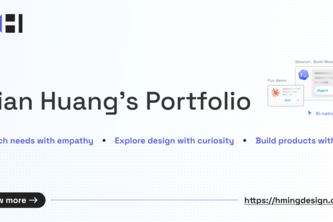
The description states that hmingportfolio is a product design portfolio built as an evolving system rather than a static collection of case studies. The author describes it as a reusable system layer with shared components and a local storytelling layer for individual projects, intended to help reviewers quickly understand the designer’s role, reasoning, contribution, collaboration model, and product impact.
The project was developed using a human-AI collaborative workflow, where AI supported implementation but the designer retained ownership of intent, prioritization, and quality. The portfolio includes design tokens, global navigation, interface primitives, and stable case-study components, while preserving unique visual structures per project.
It is positioned as a showcase for how complex challenges in AI, FinTech, and Web3 are turned into clear, practical, and buildable experiences — though no evidence of revenue, customers, or adoption is provided. The single most important open question is whether the portfolio demonstrates scalable design-system thinking that could be applied beyond this one project.
Confidence level: Low. This analysis is based entirely on self-reported information with no external verification or traction data.
What The Product Actually Is
The description states that hmingportfolio is a product design portfolio built as an evolving system rather than a one-time collection of static pages.
It includes:
- A reusable system layer:
- Design tokens
- Global navigation
- Interface primitives
- Project-card behavior
- Stable case-study components
- A local storytelling layer:
- Diagrams
- Matrices
- Workflow maps
- Scenario boards
- Media crops
- Project-specific visual structures
The portfolio was built to help reviewers quickly understand the designer’s role, reasoning, contribution, collaboration model, and product impact.
Inference: The system is described as a hybrid of shared components and local customization, intended to balance consistency with narrative flexibility.
Confidence: Low. No evidence of actual usage or adoption beyond the author's own account.
Positioning & Claim Evolution
The description states that hmingportfolio showcases how complex challenges across AI, FinTech, and Web3 are turned into clear, practical, and buildable experiences.
It positions itself as a tool for demonstrating product thinking through case studies, not just polished visuals. The author claims the portfolio shows:
- How problems were framed
- How assumptions changed
- How technical constraints were handled
- How design decisions connected to users and business outcomes
The project also emphasizes human-AI collaboration in its development process.
Inference: The positioning evolved from a traditional portfolio to one that demonstrates both design execution and system thinking.
Confidence: Low. Claims are self-reported without external validation or evidence of traction.
Target Customer & ICP
The description states that the portfolio is designed to help reviewers quickly understand the designer’s role, reasoning, contribution, collaboration model, and product impact.
It implies a target audience of:
- Hiring teams
- Recruiters evaluating design candidates
- Potential employers or clients looking for evidence of product thinking
There is no explicit mention of end users beyond these evaluators.
Inference: The ICP appears to be professionals in hiring roles who assess design portfolios.
Confidence: Low. No data on actual user base or customer segmentation.
Business Model & Pricing Evidence
Not evidenced.
The description does not contain any information about pricing, monetization, or business model.
Note: This is a personal portfolio project submitted to a hackathon; no commercial or revenue-related details are included.
Technical & Delivery Signals
The description states that the site was built using:
- A human-AI collaborative workflow
- AI agents supporting:
- Codebase analysis
- Component and token audits
- Implementation planning
- Front-end development
- Content-structure analysis
- Localization checks
- Responsive regression detection
- Build and lint verification
- Debugging
- Implementation review
The implementation was broken into bounded changes, with each task including constraints around scope, reusable-component boundaries, routes that could be modified, and validation requirements.
It also includes:
- A responsive and bilingual implementation (English and Traditional Chinese)
- Quality-control loops involving content review, component review, design-token checks, responsive checks, linting, interaction validation, bilingual review, and manual inspection
Inference: The technical approach shows a structured, iterative, and auditable process with AI integration.
Confidence: Medium. Some detail is provided but no evidence of production deployment or scalability.
Traction & Maturity Signals
Not evidenced.
There is no mention of users, customers, revenue, or adoption beyond the author’s own account.
Note: The project was submitted to a hackathon and is described as an evolving product, not yet deployed in a live environment.
Competitive Context
Not evidenced.
No information is provided about competitors or market positioning.
Note: This appears to be a personal portfolio project rather than a commercial offering.
Open Questions & Risks
- The project is self-reported and unverified.
- No evidence of revenue, customers, or adoption.
- The system described may not have been deployed in production or tested at scale.
- Risk of overstatement in claims about AI integration and design-system maturity without independent validation.
- Lack of clarity on whether the portfolio has been used for actual job applications or client pitches.
Inference: The lack of external validation raises concerns about the veracity of claims made about impact, scalability, and real-world usage.
Confidence: Medium. Risks are inferred from absence of evidence rather than explicit open questions.
Questions the description leaves open
- What specific feedback have you received from hiring teams or recruiters who reviewed this portfolio?
- How many projects were included in the portfolio, and how long did it take to build them all?
- Can you walk us through a typical workflow for updating or adding new case studies?
- Have you used this portfolio in actual job applications or client pitches? If so, what was the outcome?
- What are the key differences between the current version and earlier iterations of the system?
- How do you ensure that AI-generated outputs align with your design intent without over-relying on automation?
- Are there any parts of the portfolio that were not reviewed manually by you before publication?
Overall Assessment
Not evidenced.
There is no indication of investment interest, partnership opportunities, or commercial viability beyond the author’s own description.
Inference: As a hackathon submission and personal portfolio project, it does not appear to be seeking investment or strategic partnerships.
Confidence: Low. No evidence supports any commercial intent or traction.
User Stories BotA demo video on every pull request
Get a demo video on every new feature
GitHub App that watches your pull requests and records a narrated, captioned demo.
Save time on demo prep and make informed decisions faster with a video walkthrough of every new feature.
Source
Submitted to the OpenAI 2026 hackathon on Devpost. Project home on Devpost. Back to the full gallery on Devpost.
This competitive analysis was produced by top-founders.com (opens in a new tab)
Generated by a language model from this project's public Devpost page — its tagline, the author's own write-up and any built-with tags listed there — as captured in August 2026. Short quotations are the author's words. It is an opinion on the idea as a business, not on the people behind it, and it reflects the description as published then. If the project has moved on, request a correction below. The analysis is not independent research and contains no verified traction, revenue or customer data.
An independent guide by KFG International LLC — not affiliated with, endorsed by, or connected to Devpost or OpenAI.