

Archive position — measured, not model output
0 likes on Devpost
2,263 of the 7,850 archived projects have more likes, and 5,587 share exactly 0 — so this project's #6,484 place in the like-ranked listing is a tie-break inside that group, not a ranking.
Projects (log scale)
Likes on Devpost. ▲ marks this project's group.
Show the figures
| Likes | Projects | Share of archive |
|---|---|---|
| 0 | 5,587 | 71.2% |
| 1 | 1,758 | 22.4% |
| 2 | 284 | 3.6% |
| 3–4 | 132 | 1.7% |
| 5–9 | 75 | 1.0% |
| 10+ | 14 | 0.2% |
 User Stories BotA demo video on every pull request
Get a demo video on every new feature
GitHub App that watches your pull requests and records a narrated, captioned demo.
Save time on demo prep and make informed decisions faster with a video walkthrough of every new feature.
Executive Summary
What the company appears to be
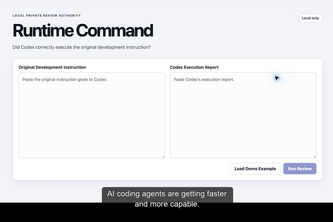
Runtime Command is a self-reported tool that evaluates whether AI coding agents — specifically those using Codex — have correctly executed development instructions based on their execution reports. It does not write or repair code but instead performs an independent review of the evidence provided in the execution report.
What changed
The project was submitted as part of the OpenAI 2026 hackathon, indicating a prototype phase with no commercial traction or revenue data available.
Single most important open question
Is there any evidence that Runtime Command has been used beyond its own development and testing, or validated in real-world use cases?
This analysis is based entirely on the self-reported description provided by the author. It contains no verified financials, customer data, or traction metrics. All claims are stated by the project owner and not independently confirmed.
What The Product Actually Is
The description states that Runtime Command:
- Independently compares:
- Original Development Instruction
- Codex Execution Report
- Returns a structured review containing:
- Review Result
- Confirmed Facts
- Findings
- Evidence Assessment
- Human Test Requirement
- Risks
- Omissions
- Evidence Gaps
- Does not write or repair code.
- Reviews whether the execution report provides enough evidence to support its completion claim.
It is a tool for validating AI-generated code execution reports, not generating code itself.
This is an author-stated function. No evidence of actual use or performance in real-world scenarios is provided.
Positioning & Claim Evolution
The project’s positioning appears to be:
- A verification layer for AI coding tools.
- An independent check on the completeness and accuracy of AI-generated execution reports.
- A response to a perceived gap in current AI agent behavior where confidence in output does not equate to correctness.
It claims to address the issue that "a confident completion report is not the same as verified execution."
The author describes an intent and problem space, but no evidence of market positioning or adoption. This is a self-stated claim about a need, not a demonstration of traction.
Target Customer & ICP
The description does not identify specific target customers or personas.
It implies that users would be developers or teams working with AI coding tools like Codex.
However, there is no evidence of:
- Specific customer segments
- Use cases beyond the prototype
- Feedback from potential users
Not evidenced. The author does not describe who uses this tool or how it fits into workflows.
Business Model & Pricing Evidence
There is no information in the description about:
- Revenue model
- Pricing structure
- Monetization strategy
- Customer acquisition plans
The project is described as a prototype submitted to a hackathon.
Not evidenced. No business model or pricing data are provided.
Technical & Delivery Signals
The author states:
- The system includes:
- Public-safe request and response contract
- Server-side Review Authority boundary
- Loopback-only Local Web Host
- Structured Review interface
- Synthetic local Stub Authority
- Schema validation
- Explicit error taxonomy
- Automated tests and runtime smoke tests
- Reproducible local Demo
- Architecture:
- Browser → Local Web Host → Private Web Adapter → Review Authority interface
- In public demo: Browser → Local Web Host → Private Web Adapter → Loopback Synthetic Stub Authority
- No API keys or direct OpenAI calls in the demo.
- Production components are intentionally excluded from the public repository.
These are technical claims made by the author. No evidence of deployment, scalability, or real-world usage is provided.
Traction & Maturity Signals
The description states:
- The project was built during a hackathon (OpenAI 2026).
- It includes a public prototype.
- It validated its own value during development by identifying gaps in execution reports.
- No revenue, customers, or adoption data are mentioned.
Not evidenced. There is no evidence of traction, usage, or product-market fit beyond the prototype phase.
Competitive Context
The description does not mention:
- Competitors
- Market landscape
- Existing tools addressing similar needs
It implies a niche in AI code verification but does not place Runtime Command within any competitive space.
Not evidenced. No competitive analysis or positioning against other tools is provided.
Open Questions & Risks
Key risks and open questions based on the description:
- The tool is described as a prototype, with no evidence of production use.
- It only works in a local environment (loopback-only).
- No API keys or direct OpenAI integration in public version.
- Production components are intentionally excluded from public repository.
- No evidence of real-world validation or customer feedback.
- The author notes that the hardest challenge was separating execution claims from human validation, suggesting complexity in implementation.
These are inferred risks based on the prototype nature and lack of deployment data. No actual risk assessment is provided.
Questions the description leaves open
- What specific real-world development cases have you tested Runtime Command on?
- How does it handle edge cases or ambiguous instructions?
- Have you validated its output against known correct implementations?
- Is there any plan to move beyond the local prototype into a scalable, cloud-based system?
- What is the intended path from prototype to commercial product?
- Are there any early adopters or partners interested in using this tool?
These questions are aimed at uncovering whether the prototype has moved beyond experimental use.
Overall Assessment
At this stage, Runtime Command appears to be a hackathon prototype with no demonstrated traction, revenue, or customer base. It addresses a plausible need in AI code verification but lacks evidence of real-world application or commercial viability.
This is a pre-prototype concept. No investment or partnership case can be made without further evidence of product-market fit, usage, or scalability.
User Stories BotA demo video on every pull request
Get a demo video on every new feature
GitHub App that watches your pull requests and records a narrated, captioned demo.
Save time on demo prep and make informed decisions faster with a video walkthrough of every new feature.
Source
Submitted to the OpenAI 2026 hackathon on Devpost. Project home on Devpost. Back to the full gallery on Devpost.
This competitive analysis was produced by top-founders.com (opens in a new tab)
Generated by a language model from this project's public Devpost page — its tagline, the author's own write-up and any built-with tags listed there — as captured in August 2026. Short quotations are the author's words. It is an opinion on the idea as a business, not on the people behind it, and it reflects the description as published then. If the project has moved on, request a correction below. The analysis is not independent research and contains no verified traction, revenue or customer data.
An independent guide by KFG International LLC — not affiliated with, endorsed by, or connected to Devpost or OpenAI.