

Archive position — measured, not model output
1 like on Devpost
505 of the 7,850 archived projects have more likes, and 1,758 share exactly 1 — so this project's #597 place in the like-ranked listing is a tie-break inside that group, not a ranking.
Projects (log scale)
Likes on Devpost. ▲ marks this project's group.
Show the figures
| Likes | Projects | Share of archive |
|---|---|---|
| 0 | 5,587 | 71.2% |
| 1 | 1,758 | 22.4% |
| 2 | 284 | 3.6% |
| 3–4 | 132 | 1.7% |
| 5–9 | 75 | 1.0% |
| 10+ | 14 | 0.2% |
 User Stories BotA demo video on every pull request
Get a demo video on every new feature
GitHub App that watches your pull requests and records a narrated, captioned demo.
Save time on demo prep and make informed decisions faster with a video walkthrough of every new feature.
Executive Summary
What the company appears to be
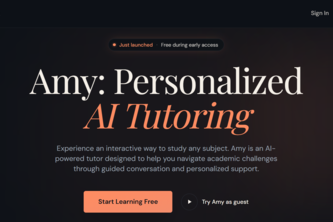
Amy An AI Tutor is a self-reported educational platform that claims to generate personalized learning experiences from syllabi or learning materials using AI. It is described as a full-stack web application built with TypeScript, deployed on Vercel, and powered by GPT-5.6. The author states it was developed by one person (aryam goyal), who also describes herself as a 15-year-old student from India.
What changed
The project evolved beyond a basic chatbot prototype into a system capable of generating multiple coordinated teaching resources—such as slides, scripts, whiteboard-style content, interactive activities, and infographics—from a single course or chapter. It includes a persistent bulk-generation workflow that supports queuing, progress tracking, and error handling.
Single most important open question
Is there evidence of actual usage or adoption by students or teachers? The description contains no data on user engagement, retention, revenue, or customer feedback—only self-reported claims about functionality and intent.
Note: This analysis is based solely on the author’s own description. No external verification, traction data, or third-party sources are available.
What The Product Actually Is
The description states that Amy is:
- A full-stack web application built with TypeScript
- Deployed on Vercel
- Powered by GPT-5.6 for educational content generation
- Designed to transform syllabi or learning material into structured teaching outputs including explanations, presentation slides, scripts, whiteboard-style content, interactive activities, infographics, and revision resources
It also uses Supabase for database and persistent application data.
The system implements a job-based generation architecture:
- Administrators can request bulk generation of an entire course
- Requests are placed into a queue and processed one course at a time
- Progress is tracked across page refreshes
- Duplicate generations are prevented
- Jobs can be resumed or cancelled
Claim: The product generates multiple teaching formats from a single source.
Evidence: The description explicitly states this.
Inference: The system supports different school boards and subjects.
Evidence: The description says it adapts depth, language, examples, and style to the learner but does not specify which boards or subjects are supported.
Positioning & Claim Evolution
The author positions Amy as:
- An AI tutor that personalizes learning by adapting lessons to individual students
- Not a replacement for teachers, but a tool to provide high-quality, personalized teaching regardless of location or access to private tutoring
- Built from the perspective of an actual student who experienced limitations in traditional education
Key claims include:
- Students should not have to adapt themselves to the lesson; the lesson should adapt itself to the student
- Amy creates resources that work together as one coherent learning experience
- It supports different learning formats (text, visuals, narration, interactivity)
- It is designed for students who struggle with one-size-fits-all education
Claim: Amy aims to make personalized teaching available to all students.
Evidence: The author states this directly.
Inference: The platform targets both students and teachers/administrators.
Evidence: The description mentions tools for administrators to generate course resources, implying dual use.
Target Customer & ICP
The description indicates that Amy is intended for:
- Students who learn differently or struggle with standard educational materials
- Teachers and administrators who want to create personalized learning experiences
- Schools or institutions seeking scalable educational content creation tools
It also notes that it supports Indian and international school boards, suggesting a global or multi-board audience.
Claim: The target includes students, teachers, and administrators.
Evidence: The description mentions both student-facing features and admin tools for generating resources.
Inference: The platform is aimed at educational institutions or individual educators.
Evidence: The mention of course-level generation and teacher dashboards implies institutional use cases.
Business Model & Pricing Evidence
There is no evidence in the description regarding:
- Revenue model
- Pricing structure
- Monetization strategy
- Customer acquisition plans
The author does not describe any commercial aspects beyond the product’s functionality.
Claim: No business model or pricing details are provided.
Evidence: The entire description focuses on technical and educational features, with no mention of monetization.
Technical & Delivery Signals
Technical elements mentioned:
- Built with TypeScript
- Deployed on Vercel
- Uses Supabase for database
- Powered by GPT-5.6
- Implements job-based generation architecture
- Handles queuing, retries, cancellation, and progress tracking
- Uses Codex for development assistance
Challenges addressed include:
- Reliable handling of large generation requests
- Preventing duplicate generation
- Ensuring consistency across formats
- Balancing AI flexibility with software constraints
Claim: The system supports persistent bulk-generation workflows.
Evidence: The description explicitly outlines how jobs are queued, tracked, and resumed.
Inference: The platform uses AI to generate educational content reliably.
Evidence: The use of GPT-5.6 and structured workflows suggest this is central to the product.
Traction & Maturity Signals
There is no evidence of:
- Revenue
- Customers or users
- Product adoption
- Growth metrics
- Market traction
The description only describes the development process, challenges overcome, and future plans.
Claim: No traction data is provided.
Evidence: The entire account is self-reported and lacks any quantifiable indicators of usage or impact.
Competitive Context
There is no mention in the description of:
- Competitors
- Market positioning relative to existing AI tutoring platforms
- Differentiation strategy
The author does not reference other tools or systems in the space.
Claim: No competitive context is provided.
Evidence: The description focuses solely on what Amy does, not how it compares to others.
Open Questions & Risks
Key risks and open questions based on the description:
- The project was built by a single developer (15 years old), raising questions about scalability, long-term maintenance, and team capacity
- No evidence of product-market fit or user feedback
- No indication of commercial viability or monetization strategy
- Heavy reliance on AI models like GPT-5.6 without clarity on access, cost, or control
- The author’s age and lack of prior experience may signal limited business maturity
Inference: Lack of team size and experience raises concerns about long-term sustainability.
Evidence: Only one member listed.
Inference: No commercial strategy implies risk of failure to monetize.
Evidence: No mention of pricing, customers, or revenue model.
Questions the description leaves open
- What is the current status of the product? Is it live or still in development?
- Have you tested Amy with real students or teachers? If so, what were the results?
- How do you plan to scale beyond a single developer?
- What are your plans for monetization and customer acquisition?
- How do you ensure factual accuracy and educational quality of generated content?
- Do you have any partnerships or institutional users yet?
- What is your roadmap for integrating voice-based tutoring, spaced repetition, and mastery tracking?
Overall Assessment
Not evidenced.
The description provides no data on:
- Financials
- Customers
- Traction
- Market size
- Competitive landscape
- Commercial strategy
This is a self-reported project submitted to a hackathon. It lacks any evidence of product-market fit, revenue, or adoption.
Assessment: No investment or partnership recommendation can be made due to lack of evidence.
Confidence Level: Very low — this is a conceptual prototype with no demonstrated traction or commercial viability.
User Stories BotA demo video on every pull request
Get a demo video on every new feature
GitHub App that watches your pull requests and records a narrated, captioned demo.
Save time on demo prep and make informed decisions faster with a video walkthrough of every new feature.
Source
Submitted to the OpenAI 2026 hackathon on Devpost. Project home on Devpost. Back to the full gallery on Devpost.
This competitive analysis was produced by top-founders.com (opens in a new tab)
Generated by a language model from this project's public Devpost page — its tagline, the author's own write-up and any built-with tags listed there — as captured in August 2026. Short quotations are the author's words. It is an opinion on the idea as a business, not on the people behind it, and it reflects the description as published then. If the project has moved on, request a correction below. The analysis is not independent research and contains no verified traction, revenue or customer data.
An independent guide by KFG International LLC — not affiliated with, endorsed by, or connected to Devpost or OpenAI.