

Archive position — measured, not model output
0 likes on Devpost
2,263 of the 7,850 archived projects have more likes, and 5,587 share exactly 0 — so this project's #6,472 place in the like-ranked listing is a tie-break inside that group, not a ranking.
Projects (log scale)
Likes on Devpost. ▲ marks this project's group.
Show the figures
| Likes | Projects | Share of archive |
|---|---|---|
| 0 | 5,587 | 71.2% |
| 1 | 1,758 | 22.4% |
| 2 | 284 | 3.6% |
| 3–4 | 132 | 1.7% |
| 5–9 | 75 | 1.0% |
| 10+ | 14 | 0.2% |
 User Stories BotA demo video on every pull request
Get a demo video on every new feature
GitHub App that watches your pull requests and records a narrated, captioned demo.
Save time on demo prep and make informed decisions faster with a video walkthrough of every new feature.
Executive Summary
What the company appears to be
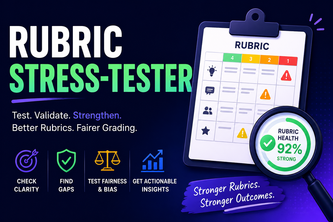
Rubric Stress-Tester is a self-reported web application designed to help educators identify and resolve ambiguity in grading rubrics by analyzing individual criteria. It uses AI (specifically GPT-5.6) to detect potentially ambiguous language, generate example student answers under different interpretations, reword criteria for clarity, and validate the revised wording.
What changed
The project was submitted as part of the OpenAI 2026 hackathon. The author describes it as a tool that shifts the timing of rubric ambiguity resolution from after grading to before, aiming to reduce disagreement between graders.
Single most important open question — the commercial due-diligence read
Is there a viable market need for this type of rubric refinement tool among educators or institutions, and can the tool scale beyond its current prototype form?
What The Product Actually Is
The description states that Rubric Stress-Tester is a web-based tool built with Next.js 14 and TypeScript. It uses GPT-5.6 to analyze rubric criteria line-by-line. The process involves:
- Identifying ambiguous phrases in a rubric criterion.
- Generating two plausible student answers under different interpretations of the phrase.
- Scoring each answer under both readings.
- Rewriting the criterion into smaller, 1-point pieces to eliminate ambiguity.
- Re-checking the revised wording against the same examples.
It is described as a live application deployed on Google Cloud Run with server-side API calls to OpenAI models. The tool is meant to be used by educators who paste in a single rubric criterion and receive feedback on how to improve it.
Evidence
- Built with: Next.js, TypeScript, Node.js, React, GPT-5.6, OpenAI API/Codex.
- Deployed on Google Cloud Run.
- Uses structured JSON schema for model outputs.
- Live web app accessible via paste-in interface.
Inference The tool appears to be a proof-of-concept prototype rather than a full product, given its hackathon origin and lack of traction data.
Positioning & Claim Evolution
The author claims the tool addresses a common problem in education: disagreement between graders due to ambiguous rubric language. It positions itself as a solution that prevents such disagreements before grading occurs, instead of during or after.
Key claims from the description
- "Make your rubric agree before your graders have to."
- Finds the criterion two graders would score differently.
- Proves the split with real answers.
- Rewrites the criterion to remove ambiguity.
- Talks in points, not percentages.
- Shows its work — not just telling users what's wrong but demonstrating it.
Inference The positioning is framed around precision and trustworthiness over cleverness or flashy features. The author emphasizes that the tool avoids “vibes” and abstract scores in favor of concrete point-based outcomes.
Target Customer & ICP
The description states that Rubric Stress-Tester is intended for educators, particularly those who grade student work using rubrics — such as teachers, TAs, or graders. It also implies use within institutional settings like schools or universities where rubrics are standard practice.
Evidence
- The inspiration comes from grading stacks of papers with others.
- The tool helps resolve disagreements between graders.
- It's meant to be used by teachers who paste in rubric criteria.
Inference The primary user group is likely educators working in K–12 or higher education environments, where rubrics are widely used. However, no specific ICP segmentation or targeting beyond “teachers” is provided.
Business Model & Pricing Evidence
There is no evidence of a business model or pricing structure in the description. The tool is described as a prototype built for a hackathon and deployed live, but there's no mention of monetization, subscription plans, or any commercial framework.
Evidence
- No revenue data.
- No pricing information.
- No mention of enterprise licensing or SaaS offerings.
- Tool is live but not described as part of a paid service.
Inference The tool appears to be in early-stage development and has no known monetization strategy. It may evolve into a SaaS offering, but this is not evidenced.
Technical & Delivery Signals
The project was built using:
- Next.js 14
- TypeScript
- Node.js
- React
- GPT-5.6 (via OpenAI API/Codex)
- Google Cloud Run for deployment
- Secret Manager for API key handling
It uses a strict JSON schema to structure model outputs and performs all AI processing server-side, avoiding exposure of API keys in the browser.
Evidence
- Built with specific tech stack.
- Server-side model calls.
- Structured output via JSON schema.
- Deployment on Google Cloud Run.
- API keys stored securely in GCP Secret Manager.
Inference The technical implementation suggests a functional prototype, though it is not described as scalable or production-ready. The use of GPT-5.6 implies reliance on proprietary AI infrastructure.
Traction & Maturity Signals
There is no evidence of traction, customers, or adoption beyond the hackathon submission. No user base, usage metrics, or feedback from real users are mentioned.
Evidence
- Submitted to OpenAI 2026 hackathon.
- Live web app exists.
- No mention of users, downloads, or engagement data.
- No product roadmap or version history.
Inference The tool is likely at a prototype stage and lacks any measurable traction or maturity indicators. It has not yet demonstrated real-world utility or scalability.
Competitive Context
No competitive landscape is described in the project write-up. The author does not reference existing tools for rubric creation, grading consistency, or AI-assisted education.
Evidence
- No mention of competitors.
- No comparison to other rubric or grading platforms.
- No indication of market saturation or differentiation strategy.
Inference There is no evidence of awareness of the competitive environment. The tool may be addressing a niche or underserved area, but this cannot be confirmed without external data.
Open Questions & Risks
Several risks and open questions are present based on the self-reported description:
- Unproven Market Need: No evidence of demand from educators or institutions.
- Prototype Limitation: Tool is described as a hackathon prototype, not a mature product.
- AI Dependency Risk: Heavy reliance on GPT-5.6 and OpenAI APIs may pose scalability or cost issues.
- Limited Scope: Currently only handles one rubric criterion at a time; lacks batch processing or integration capabilities.
- No Commercial Viability: No pricing, monetization, or business model described.
Inference The tool’s viability as a commercial product remains unproven and depends heavily on whether there is sufficient demand for such a solution among educators.
Questions the description leaves open
- What specific educational institutions or users have expressed interest in this tool?
- How does the tool plan to scale beyond single-criterion analysis?
- Are there any partnerships with schools, districts, or LMS providers already in place?
- What is the long-term vision for monetization and product development?
- Has the tool been tested by actual educators? If so, what feedback have you received?
- How does the tool handle edge cases or complex rubrics that don’t fit its current workflow?
- Are there any plans to integrate with platforms like Google Classroom or Canvas?
Overall Assessment
Not evidenced.
There is insufficient evidence to assess whether this project warrants investment or partnership. The description indicates a prototype built for a hackathon, with no demonstrated traction, revenue, or clear path to market adoption.
The tool shows potential in solving a real problem (rubric ambiguity) but lacks the commercial maturity, user validation, and business model needed to evaluate its viability as an investment opportunity or strategic partner. It may be worth revisiting once more evidence of traction or product development becomes available.
User Stories BotA demo video on every pull request
Get a demo video on every new feature
GitHub App that watches your pull requests and records a narrated, captioned demo.
Save time on demo prep and make informed decisions faster with a video walkthrough of every new feature.
Source
Submitted to the OpenAI 2026 hackathon on Devpost. Project home on Devpost. Back to the full gallery on Devpost.
This competitive analysis was produced by top-founders.com (opens in a new tab)
Generated by a language model from this project's public Devpost page — its tagline, the author's own write-up and any built-with tags listed there — as captured in August 2026. Short quotations are the author's words. It is an opinion on the idea as a business, not on the people behind it, and it reflects the description as published then. If the project has moved on, request a correction below. The analysis is not independent research and contains no verified traction, revenue or customer data.
An independent guide by KFG International LLC — not affiliated with, endorsed by, or connected to Devpost or OpenAI.