

Archive position — measured, not model output
1 like on Devpost
505 of the 7,850 archived projects have more likes, and 1,758 share exactly 1 — so this project's #585 place in the like-ranked listing is a tie-break inside that group, not a ranking.
Projects (log scale)
Likes on Devpost. ▲ marks this project's group.
Show the figures
| Likes | Projects | Share of archive |
|---|---|---|
| 0 | 5,587 | 71.2% |
| 1 | 1,758 | 22.4% |
| 2 | 284 | 3.6% |
| 3–4 | 132 | 1.7% |
| 5–9 | 75 | 1.0% |
| 10+ | 14 | 0.2% |
 User Stories BotA demo video on every pull request
Get a demo video on every new feature
GitHub App that watches your pull requests and records a narrated, captioned demo.
Save time on demo prep and make informed decisions faster with a video walkthrough of every new feature.
Executive Summary
What the company appears to be
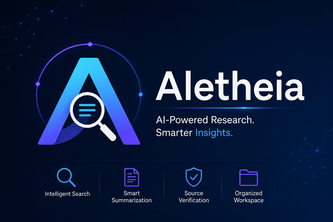
Aletheia is an AI-powered research assistant built as a full-stack web application. The author describes it as a platform that uses AI agents to discover, verify, summarize, and organize information from multiple sources in response to natural language queries.
What changed
This is a self-reported project submitted to the OpenAI 2026 hackathon. It represents an early-stage prototype or proof-of-concept with no evidence of commercial traction, revenue, or customer adoption.
Single most important open question
Is there any evidence that this product has been used by real users beyond the author's own development work?
Note: This analysis is based entirely on the self-reported description provided by the author. No independent verification, archived data, or third-party sources are available. All claims in this report are stated by the author and not independently confirmed.
What The Product Actually Is
The description states that Aletheia is an AI-powered research platform designed to transform hours of manual research into minutes. It uses AI agents to gather information from multiple sources, summarize content, compare viewpoints, and present structured insights in a single workspace.
Key technical components mentioned:
- Frontend: React, TypeScript, Tailwind CSS, Vite
- Backend: Node.js, Express.js, MongoDB
- AI stack: OpenAI API, LangChain, LangGraph
The system is described as using an agent-based architecture where different AI agents handle specialized tasks such as searching, reasoning, summarizing, and organizing information.
Evidence: The author's own write-up.
Confidence: Low — this is a self-reported technical description without evidence of actual functionality or user interaction.
Positioning & Claim Evolution
The author positions Aletheia as an AI-powered research assistant that goes beyond simple search to understand intent, verify sources, and organize knowledge. The tagline emphasizes transforming hours into minutes through AI agents.
The project evolved from a hackathon submission into what the author describes as a foundation for a more advanced research platform. The author notes they are proud of creating "the foundation for an AI-powered research platform instead of just another chatbot."
Evidence: Self-reported claims in the write-up.
Confidence: Low — no evidence of market positioning or competitive differentiation beyond the author's own narrative.
Target Customer & ICP
The description states that Aletheia aims to help students preparing assignments, developers debugging issues, researchers reviewing literature, and professionals making business decisions. It is intended for users across different domains who need to find trustworthy knowledge quickly.
Evidence: The author’s own write-up.
Confidence: Low — no evidence of actual customer segments or personas; this is a self-defined target audience.
Business Model & Pricing Evidence
There is no evidence in the description of any business model, pricing strategy, monetization approach, or revenue streams. The project is described as being under active development and not yet commercially deployed.
Evidence: Not evidenced.
Confidence: Very low — no indication of how the product would be sold or who pays for it.
Technical & Delivery Signals
The system is built using modern full-stack technologies including:
- Frontend: React, TypeScript, Tailwind CSS, Vite
- Backend: Node.js, Express.js, MongoDB
- AI stack: OpenAI API, LangChain, LangGraph
It uses an agent-based architecture with multiple AI agents handling specialized tasks like searching, reasoning, and summarizing.
The author mentions challenges in orchestrating AI agents, managing long-context conversations, and integrating frontend/backend/AI services into a smooth pipeline.
Evidence: The author's own write-up.
Confidence: Low — while technical details are provided, there is no evidence of deployment, performance metrics, or production readiness.
Traction & Maturity Signals
There is no evidence of any traction, user adoption, or maturity beyond the initial development phase. The project is described as still under active development and evolving continuously.
The author notes that although the project is still evolving, they've established a "solid technical foundation" that can support more advanced capabilities in the future.
Evidence: Not evidenced.
Confidence: Very low — no data on users, usage, or product-market fit.
Competitive Context
No competitive analysis or market positioning is provided. The author does not mention competitors or how Aletheia would differentiate itself from existing research tools or AI assistants.
Evidence: Not evidenced.
Confidence: Very low — no indication of awareness of the competitive landscape.
Open Questions & Risks
- Lack of commercial traction: No evidence of users, customers, or revenue.
- Single-person team: The project is built by one individual (Shubham Yadav), which raises questions about scalability and long-term maintenance.
- Unproven AI agent orchestration: While described as using LangGraph and multi-agent workflows, there is no demonstration of effectiveness or reliability in practice.
- No monetization strategy: No indication of how the product will be monetized or whether it has a viable business model.
- Early-stage prototype: Submitted to a hackathon, suggesting this is an early-stage idea rather than a mature product.
Evidence: Inferred from self-reported claims and lack of supporting data.
Confidence: Moderate — based on the absence of key signals like users, revenue, or competitive positioning.
Questions the description leaves open
- What specific problems are you solving for your target users?
- How do you plan to validate that your AI agents produce accurate and trustworthy results?
- Have you conducted any user testing or feedback sessions with potential customers?
- What is the timeline for moving from prototype to a commercial product?
- Are there any existing partnerships or integrations planned?
- What are the key assumptions behind your product vision, and how will you test them?
- How do you intend to scale beyond a single developer?
- What are the main technical challenges that remain unresolved?
Evidence: Inferred from lack of clarity in the author’s description.
Confidence: Moderate — these questions address gaps in the self-reported information.
Overall Assessment
At this stage, Aletheia appears to be a conceptual prototype or early-stage hackathon project. There is no evidence of commercial traction, revenue, customer adoption, or a clear path to monetization. The product is described as being under active development and not yet deployed in any real-world setting.
The author has built a technical foundation using modern tools but has not demonstrated market demand, user engagement, or business viability.
Assessment: Not ready for investment or partnership consideration at this time
Note: This conclusion is based solely on the self-reported description. No independent verification or additional data points are available to assess the true potential of the project.
User Stories BotA demo video on every pull request
Get a demo video on every new feature
GitHub App that watches your pull requests and records a narrated, captioned demo.
Save time on demo prep and make informed decisions faster with a video walkthrough of every new feature.
Source
Submitted to the OpenAI 2026 hackathon on Devpost. Project home on Devpost. Back to the full gallery on Devpost.
This competitive analysis was produced by top-founders.com (opens in a new tab)
Generated by a language model from this project's public Devpost page — its tagline, the author's own write-up and any built-with tags listed there — as captured in August 2026. Short quotations are the author's words. It is an opinion on the idea as a business, not on the people behind it, and it reflects the description as published then. If the project has moved on, request a correction below. The analysis is not independent research and contains no verified traction, revenue or customer data.
An independent guide by KFG International LLC — not affiliated with, endorsed by, or connected to Devpost or OpenAI.