

Archive position — measured, not model output
1 like on Devpost
505 of the 7,850 archived projects have more likes, and 1,758 share exactly 1 — so this project's #586 place in the like-ranked listing is a tie-break inside that group, not a ranking.
Projects (log scale)
Likes on Devpost. ▲ marks this project's group.
Show the figures
| Likes | Projects | Share of archive |
|---|---|---|
| 0 | 5,587 | 71.2% |
| 1 | 1,758 | 22.4% |
| 2 | 284 | 3.6% |
| 3–4 | 132 | 1.7% |
| 5–9 | 75 | 1.0% |
| 10+ | 14 | 0.2% |
 User Stories BotA demo video on every pull request
Get a demo video on every new feature
GitHub App that watches your pull requests and records a narrated, captioned demo.
Save time on demo prep and make informed decisions faster with a video walkthrough of every new feature.
Executive Summary
What the company appears to be
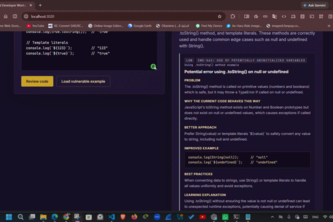
Alex.OS is an AI-powered code review assistant that combines cybersecurity analysis with software engineering guidance. The description states it helps developers understand secure and maintainable coding practices by offering explanations, remediation guidance, and educational summaries.
What changed
The project was submitted as a hackathon entry (OpenAI 2026) and is described as an MVP. It does not appear to have evolved beyond this stage or gained traction in the market.
Single most important open question
Is there any evidence of product-market fit, user adoption, revenue, or customer feedback beyond the author’s own account?
What The Product Actually Is
The description states that Alex.OS is an AI-powered code review and learning assistant. It allows developers to paste JavaScript code and receive:
- Security vulnerability detection
- Software engineering issue detection
- Severity assessment
- CWE mapping
- OWASP mapping
- Educational explanations
- Practical remediation guidance
- Learning summaries
It uses React, Monaco Editor, Node.js/Express, and OpenAI API for intelligent code analysis.
Inference The product is a developer tool that integrates AI-based code review with educational content. It is not described as a SaaS platform or enterprise solution.
Positioning & Claim Evolution
The author states that Alex.OS was inspired by the idea that many AI tools identify issues but do not teach developers how to learn from them. The positioning is to transform code review into a learning experience.
Claim
The tool aims to be more than an automated reviewer — it seeks to act as an educational mentor.
Inference This suggests a shift from purely functional tools (e.g., linting or static analysis) toward tools that support skill development and knowledge transfer.
Target Customer & ICP
The description indicates that Alex.OS targets developers who want to improve their coding practices, particularly in secure and maintainable software engineering.
Claim
The tool is aimed at developers learning or practicing secure coding techniques.
Inference The target audience likely includes junior-to-mid-level engineers who are interested in cybersecurity or software engineering best practices. No evidence of segmentation beyond this general group.
Business Model & Pricing Evidence
There is no evidence of pricing, monetization strategy, or business model in the description.
Not evidenced.
Technical & Delivery Signals
The project was built using:
- Frontend: React
- Editor: Monaco Editor
- Backend: Node.js + Express
- AI: OpenAI API
It processes code and sends it to an AI model with structured review instructions, presenting results in a developer-friendly format.
Inference The tool is likely delivered as a web application or browser-based interface. It uses existing AI infrastructure rather than proprietary models.
Traction & Maturity Signals
The project is described as a hackathon MVP (submitted to OpenAI 2026). No evidence of revenue, customers, or usage metrics beyond the author’s own account.
Not evidenced.
Competitive Context
No mention of competitors in the description. The author does not reference existing tools like SonarQube, CodeClimate, GitHub Copilot, or similar AI-assisted code review platforms.
Not evidenced.
Open Questions & Risks
- Lack of traction: No evidence of users, customers, or revenue.
- Single-founder team: The project is described as built by one person (hawraa mo).
- Unverified claims: All descriptions are self-reported and unverified.
- Limited scope: MVP focused only on JavaScript; no indication of multi-language support beyond future plans.
- No product-market fit evidence: No data or feedback from users to suggest demand.
Questions the description leaves open
- What specific problems do developers face that Alex.OS solves, and how did you validate this?
- Have you tested the tool with real developers? If so, what were their reactions?
- How does Alex.OS differentiate itself from existing tools like GitHub Copilot or SonarQube?
- Are there any plans to monetize the product, and if so, what is your pricing model?
- What are the technical limitations of using OpenAI API for code analysis at scale?
Overall Assessment
Not evidenced.
The project is described as a hackathon MVP with no evidence of commercial traction, revenue, or customer adoption. The author’s own account does not provide sufficient signal to assess viability or potential for investment or partnership.
The product appears to be an early-stage idea with educational intent, but lacks any demonstrated market validation or business momentum.
User Stories BotA demo video on every pull request
Get a demo video on every new feature
GitHub App that watches your pull requests and records a narrated, captioned demo.
Save time on demo prep and make informed decisions faster with a video walkthrough of every new feature.
Source
Submitted to the OpenAI 2026 hackathon on Devpost. Project home on Devpost. Back to the full gallery on Devpost.
This competitive analysis was produced by top-founders.com (opens in a new tab)
Generated by a language model from this project's public Devpost page — its tagline, the author's own write-up and any built-with tags listed there — as captured in August 2026. Short quotations are the author's words. It is an opinion on the idea as a business, not on the people behind it, and it reflects the description as published then. If the project has moved on, request a correction below. The analysis is not independent research and contains no verified traction, revenue or customer data.
An independent guide by KFG International LLC — not affiliated with, endorsed by, or connected to Devpost or OpenAI.