

Archive position — measured, not model output
0 likes on Devpost
2,263 of the 7,850 archived projects have more likes, and 5,587 share exactly 0 — so this project's #4,512 place in the like-ranked listing is a tie-break inside that group, not a ranking.
Projects (log scale)
Likes on Devpost. ▲ marks this project's group.
Show the figures
| Likes | Projects | Share of archive |
|---|---|---|
| 0 | 5,587 | 71.2% |
| 1 | 1,758 | 22.4% |
| 2 | 284 | 3.6% |
| 3–4 | 132 | 1.7% |
| 5–9 | 75 | 1.0% |
| 10+ | 14 | 0.2% |
 User Stories BotA demo video on every pull request
Get a demo video on every new feature
GitHub App that watches your pull requests and records a narrated, captioned demo.
Save time on demo prep and make informed decisions faster with a video walkthrough of every new feature.
Executive Summary
What the company appears to be
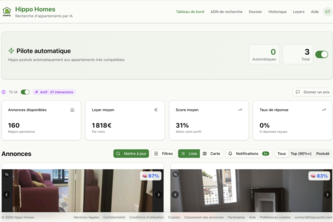
Hippo Homes is a self-reported Paris-based rental search tool built during an OpenAI hackathon. The project claims to unify live listings, learn user preferences, and provide personalized apartment matches using AI and data aggregation from multiple sources.
What changed
The author states that Hippo Homes was created in response to the difficulty of finding apartments in Paris, particularly due to outdated listings and fragmented information across platforms. It is described as a personal agent-like tool for renters, with some functionality for landlords.
Single most important open question
Is there any evidence of traction, revenue, or user adoption beyond the author’s own account? The description contains no data on customers, usage, monetization, or product-market fit beyond self-reported claims.
What The Product Actually Is
The description states that Hippo Homes is a Next.js and React application backed by Supabase and Firebase App Hosting, with connectors to rental listings from Paris agencies and portals. It uses TypeScript, AI tools (GPT 5.5/5.6), and image analysis for scoring apartments based on user preferences.
It is described as a tool that:
- Aggregates live rental listings
- Learns user preferences
- Scores apartments based on fit
- Allows comparison of price, location, size, etc.
- Supports auto-application mode
- Provides tools for landlords to list and manage properties
Inference The product appears to be a prototype or MVP built in a short timeframe (a hackathon), with AI used primarily for development acceleration rather than core user-facing intelligence.
Positioning & Claim Evolution
The author states that Hippo Homes was created because they asked: “what if you had a personal agent who helped you find an apartment?”
It positions itself as:
- A personalized rental assistant
- A unified platform for Paris apartment listings
- An AI-powered matchmaker between renters and apartments
- A tool that helps landlords list and manage properties
There is no evidence of prior positioning or evolution beyond the hackathon project. The claim is that it’s a “personal agent” version of a rental search tool, but this is not substantiated with any user feedback or market validation.
Target Customer & ICP
The description states that Hippo Homes targets:
- Renters in Paris
- Landlords and agencies (to list properties and manage leases)
It also mentions that the product is built with a focus on Paris, suggesting a narrow geographic ICP.
There is no evidence of customer segmentation, user personas, or feedback from target users beyond the author’s own experience.
Business Model & Pricing Evidence
The description does not state:
- Any pricing model
- Revenue streams
- Monetization strategy
- Customer acquisition costs
- Whether it charges for access or uses freemium models
It mentions that the long-term goal is an end-to-end rental journey, including lease signing and rent management, but no evidence of any business model in place.
Technical & Delivery Signals
The product is built with:
- Next.js, React, TypeScript
- Supabase, Firebase
- AI tools (GPT 5.5/5.6) for development
- Image analysis and scoring pipeline
- Google Maps integration
- Automated testing (Vitest)
The author states that the architecture is:
- Production-oriented
- Includes tests, quotas, locks, degraded modes
- Uses source-aware extraction, evidence-based geolocation, and graceful fallbacks
There is no evidence of production deployment or scale beyond the hackathon prototype.
Traction & Maturity Signals
The description states:
- A working Paris rental dashboard with live inventory
- Personalized matching based on hundreds of user interactions
- An AI “search DNA” that adapts without overriding explicit preferences
- Reusable renter application information
- A polished public experience with transparency in ranking and privacy
However, there is no evidence of:
- Real users or customer base
- Revenue or monetization
- Product adoption metrics
- Customer feedback or retention data
Competitive Context
The description does not mention any competitors. It does not state whether similar tools exist in Paris or globally for rental search.
No evidence of competitive analysis, market share, or differentiation from existing platforms is provided.
Open Questions & Risks
- Self-reported only: No independent verification of claims
- No traction or revenue: The product appears to be a prototype with no evidence of real-world usage
- AI dependency: Heavy reliance on AI tools for development, but no indication of AI being used in core user experience
- Limited scope: Focused solely on Paris, which may limit scalability or market appeal
- Legal and compliance risks: The author notes learning about strict European data laws, but no evidence of compliance measures in place
Questions the description leaves open
- What is the actual user base or customer traction beyond the prototype?
- How are you planning to monetize this product?
- Are there any partnerships with Parisian agencies or portals for listing data?
- What is the current status of auto-application functionality and integration with rental portals?
- How do you plan to scale beyond Paris?
- What are the legal and compliance risks around data collection and user privacy in Europe?
Overall Assessment
Not evidenced
There is no evidence of:
- Revenue or profitability
- Customer traction or adoption
- Product-market fit
- Scalable business model
- Team or funding beyond one person
The project is described as a hackathon prototype with limited real-world validation. It is not clear whether it has progressed beyond the experimental stage, nor if there is any commercial intent or market demand.
Confidence: Low
This analysis is based entirely on self-reported claims and lacks any external data or evidence of traction, customers, or revenue.
User Stories BotA demo video on every pull request
Get a demo video on every new feature
GitHub App that watches your pull requests and records a narrated, captioned demo.
Save time on demo prep and make informed decisions faster with a video walkthrough of every new feature.
Source
Submitted to the OpenAI 2026 hackathon on Devpost. Project home on Devpost. Back to the full gallery on Devpost.
This competitive analysis was produced by top-founders.com (opens in a new tab)
Generated by a language model from this project's public Devpost page — its tagline, the author's own write-up and any built-with tags listed there — as captured in August 2026. Short quotations are the author's words. It is an opinion on the idea as a business, not on the people behind it, and it reflects the description as published then. If the project has moved on, request a correction below. The analysis is not independent research and contains no verified traction, revenue or customer data.
An independent guide by KFG International LLC — not affiliated with, endorsed by, or connected to Devpost or OpenAI.