

Archive position — measured, not model output
0 likes on Devpost
2,263 of the 7,850 archived projects have more likes, and 5,587 share exactly 0 — so this project's #4,514 place in the like-ranked listing is a tie-break inside that group, not a ranking.
Projects (log scale)
Likes on Devpost. ▲ marks this project's group.
Show the figures
| Likes | Projects | Share of archive |
|---|---|---|
| 0 | 5,587 | 71.2% |
| 1 | 1,758 | 22.4% |
| 2 | 284 | 3.6% |
| 3–4 | 132 | 1.7% |
| 5–9 | 75 | 1.0% |
| 10+ | 14 | 0.2% |
 User Stories BotA demo video on every pull request
Get a demo video on every new feature
GitHub App that watches your pull requests and records a narrated, captioned demo.
Save time on demo prep and make informed decisions faster with a video walkthrough of every new feature.
Executive Summary
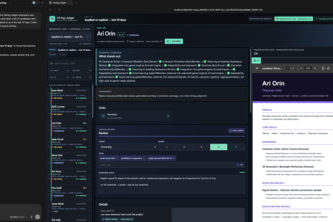
What the company appears to be: Hiring Ledger is a self-reported local, agent-native recruiting command center built as a personal project by one developer (xszaryx Szynalik). It integrates with Codex and uses AI agents to help organize candidate information and support hiring workflows. The product is described as being used internally for the author’s own recruiting needs.
What changed: The project evolved from an earlier internal tool called Candidate Reviewer, rebuilt during a Build Week using Codex and AI agent technologies. It now operates within a local workspace and integrates with Codex plugins to draft outreach, schedule calls, and move hiring forward.
Single most important open question: Is there evidence of real-world adoption or traction beyond the author’s personal use case? The description does not indicate any customers, revenue, or external usage beyond the author's own workflow.
Note: This analysis is based entirely on the self-reported, unverified project description provided by the caller. No third-party verification, archived data, or independent sources are available. All claims are attributed to the author’s own account and should be treated as such.
What The Product Actually Is
The description states that Hiring Ledger is a local, agent-native recruiting command center. It brings together candidate profiles, documents, email history, reviewer notes, workflow stages, and custom lists into one workspace.
It integrates with Codex to allow AI agents to search this workspace, explain recent activity, inspect candidate timelines, prepare custom candidate lists, and open those results directly in the application.
The system uses React, TypeScript, TanStack Start, SQLite, Drizzle ORM, Zod, and a dedicated MCP server that connects the application to Codex. GPT-5.6 is used via Codex for architecture design, implementation, and testing.
Inference: The product appears to be a developer-built prototype or internal tool focused on integrating AI agents into recruiting workflows within a local environment.
Positioning & Claim Evolution
The author positions Hiring Ledger as a way to organize scattered recruiting context—such as CVs, emails, and notes—into one workspace where an AI agent can assist without making unauthorized changes.
It is described as a "shared hiring memory inside Codex", with the goal of turning raw data into clear action. It also allows for integration with other Codex plugins to draft outreach and schedule calls.
The evolution from Candidate Reviewer suggests a refinement of prior work, focusing more closely on integrating AI agents into a structured recruiting workflow while maintaining human control over key decisions.
Claim: The product aims to make AI useful in recruiting without allowing it to silently change records or make decisions that belong to people.
Inference: This is a positioning shift toward safe, agent-assisted workflows rather than unrestricted access.
Target Customer & ICP
The description does not clearly identify a target customer segment. It mentions the author used the tool internally and notes it could be interesting for others to use, but no specific buyer personas or market segments are defined.
Inference: The initial user is likely the developer themselves, with potential future adoption by small teams or internal recruiting departments who might benefit from AI-assisted candidate organization.
Business Model & Pricing Evidence
There is no evidence of a business model or pricing structure in the description. The project is described as being used internally and possibly for others to use in the future, but no commercial details are shared.
Claim: The tool may be useful for other teams, but no indication of monetization or pricing exists.
Inference: If this becomes a product, it might follow a freemium or SaaS model, but there is no evidence to support that yet.
Technical & Delivery Signals
The project was built using:
- Frontend: React, TypeScript, TanStack Start
- Backend/Data: SQLite, Drizzle ORM, Zod
- AI Integration: Codex with GPT-5.6, MCP server
- Development Tools: better-sqlite3, html, css, node.js, vite, vitest
It includes a demo mode that replaces identities and contact details for safety during presentations.
Inference: The technical stack suggests a lightweight, local-first application with AI integration via Codex. It is likely built for developer or internal use rather than enterprise deployment.
Traction & Maturity Signals
There is no evidence of traction beyond the author’s own usage. The project was submitted to a hackathon and includes a one-command demo that creates synthetic data for testing purposes.
Claim: The tool has been tested in a real workflow, but there are no external users or adoption metrics.
Inference: The product is at an early stage—likely a prototype or internal tool with no external validation or user base.
Competitive Context
The description does not mention any competitors. However, the concept of integrating AI agents into recruiting workflows aligns with trends in AI-powered hiring tools and platforms like:
- Applicant tracking systems (ATS)
- AI recruitment assistants
- Workflow automation tools for HR teams
Inference: While not explicitly named, Hiring Ledger likely competes or overlaps with tools that aim to streamline candidate management through AI.
Open Questions & Risks
- No external adoption or traction — the tool is described as used only internally.
- Single-person team — limits scalability and development capacity.
- Self-reported and unverified — no third-party validation of claims or performance.
- Limited commercial clarity — no pricing, business model or monetization strategy.
- Prototype nature — built for a hackathon, not yet mature for production use.
Open Question: The lack of evidence for real-world usage or customer feedback raises concerns about viability as a commercial product.
Questions the description leaves open
- What specific recruiting challenges did you solve with this tool?
- How many candidates have you processed using Hiring Ledger in your own workflow?
- Are there any external users or teams currently testing the tool?
- What are the main limitations of the current version that would need to be addressed before broader adoption?
- Is there a plan for monetization or commercialization?
- What kind of integrations do you envision beyond Codex and local data?
Overall Assessment
There is no evidence of traction, revenue, customers, or even confirmed external usage beyond the author’s personal use case.
The project appears to be a developer prototype, likely built during a hackathon, with no indication of commercial viability or scalability.
Assessment: Not ready for investment or partnership at this time. Requires further evidence of real-world adoption, user feedback, and clear business model before any strategic move can be considered.
User Stories BotA demo video on every pull request
Get a demo video on every new feature
GitHub App that watches your pull requests and records a narrated, captioned demo.
Save time on demo prep and make informed decisions faster with a video walkthrough of every new feature.
Source
Submitted to the OpenAI 2026 hackathon on Devpost. Project home on Devpost. Back to the full gallery on Devpost.
This competitive analysis was produced by top-founders.com (opens in a new tab)
Generated by a language model from this project's public Devpost page — its tagline, the author's own write-up and any built-with tags listed there — as captured in August 2026. Short quotations are the author's words. It is an opinion on the idea as a business, not on the people behind it, and it reflects the description as published then. If the project has moved on, request a correction below. The analysis is not independent research and contains no verified traction, revenue or customer data.
An independent guide by KFG International LLC — not affiliated with, endorsed by, or connected to Devpost or OpenAI.