

Archive position — measured, not model output
0 likes on Devpost
2,263 of the 7,850 archived projects have more likes, and 5,587 share exactly 0 — so this project's #4,515 place in the like-ranked listing is a tie-break inside that group, not a ranking.
Projects (log scale)
Likes on Devpost. ▲ marks this project's group.
Show the figures
| Likes | Projects | Share of archive |
|---|---|---|
| 0 | 5,587 | 71.2% |
| 1 | 1,758 | 22.4% |
| 2 | 284 | 3.6% |
| 3–4 | 132 | 1.7% |
| 5–9 | 75 | 1.0% |
| 10+ | 14 | 0.2% |
 User Stories BotA demo video on every pull request
Get a demo video on every new feature
GitHub App that watches your pull requests and records a narrated, captioned demo.
Save time on demo prep and make informed decisions faster with a video walkthrough of every new feature.
Executive Summary
Company: HistoryLens AI
Self-reported purpose: To assist historical researchers, educators, and documentary creators in transforming research into structured storytelling using AI.
Key claim: AI-powered tools for generating scripts, timelines, storyboards, and citations to accelerate documentary creation workflows.
What changed: The project was submitted as a hackathon entry (OpenAI 2026) and is described as an end-to-end workflow tool built with OpenAI models.
Single most important open question: Is there evidence of any traction, revenue, or customer adoption beyond the author’s own description?
The description states that HistoryLens AI uses OpenAI models for content generation and includes features like script generation, timeline organization, storyboard suggestions, and citation tracking. It is presented as a tool to help creators work faster while maintaining human control over final output. However, no evidence of revenue, customers, usage metrics or product-market fit exists in the provided description.
What The Product Actually Is
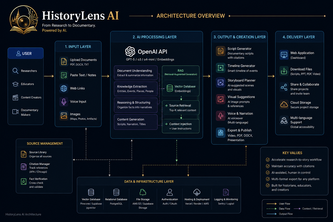
- The description states that HistoryLens AI helps users generate documentary-style scripts from research notes.
- It organizes historical events into a clear timeline.
- It suggests narration and scene structure.
- It creates storyboard ideas for each section.
- It keeps track of source references used during generation.
- The tool is built using OpenAI models (codex, gpt-5) and includes a modern web interface.
- It aims to reduce time spent on research organization and produce structured outputs from user input.
Inference: Based on the author's own account, HistoryLens AI appears to be an AI-assisted workflow tool for historical documentary creation. It is not a finished product or service but rather a prototype or proof-of-concept built during a hackathon.
Positioning & Claim Evolution
- The description states that HistoryLens AI was inspired by the need to help educators, researchers, and documentary creators transform trusted historical sources into structured storytelling with AI assistance.
- It positions itself as an assistant tool that accelerates creative workflows while keeping humans in control of final content.
- The author notes that they learned AI works best as a creative assistant rather than an autonomous author.
- Future plans include retrieval-augmented generation (RAG), multi-language support, voice narration, and automatic image generation.
Inference: The positioning has evolved from a basic idea to a more comprehensive workflow tool. However, the evolution is based on the author’s own claims and lacks external validation or evidence of market response.
Target Customer & ICP
- The description states that HistoryLens AI targets educators, researchers, and documentary creators.
- These users are described as those who spend hours researching sources, organizing information, drafting scripts, and planning visuals.
- There is no mention of specific personas, segments, or buyer types beyond these broad categories.
Inference: The ICP seems to be individuals or teams working in historical education or documentary production. No evidence suggests a defined customer segment or market size.
Business Model & Pricing Evidence
- Not evidenced.
- The description does not contain any information about pricing, monetization strategy, or business model.
Inference: There is no indication of how the tool would be monetized or whether it has a commercial plan beyond its hackathon submission.
Technical & Delivery Signals
- HistoryLens AI uses OpenAI models (codex, gpt-5).
- It combines AI-powered script generation, timeline organization, storyboard planning, and citation-aware workflows.
- The application includes a modern web interface.
- The author mentions challenges such as balancing creativity with factual accuracy and designing a workflow that assists without replacing editorial judgment.
Inference: The technical stack is based on OpenAI APIs. The delivery approach focuses on workflow integration rather than full automation. No evidence of scalability, infrastructure, or deployment details.
Traction & Maturity Signals
- Not evidenced.
- The project was submitted to the OpenAI 2026 hackathon.
- It is described as a prototype or proof-of-concept built by one person (Amonr Hupataya).
- No mention of users, adoption, revenue, or product-market fit.
Inference: There is no evidence of traction or maturity beyond its status as a hackathon submission. The project has not progressed beyond the idea stage.
Competitive Context
- Not evidenced.
- No information provided about competitors or market landscape.
- The description does not reference existing tools for historical research, scriptwriting, or documentary creation.
Inference: No competitive analysis is possible from the given information. It’s unclear whether similar tools exist in the market.
Open Questions & Risks
- Risk of over-reliance on AI without human oversight: The author notes that AI must be used as an assistant, not a replacement.
- Lack of traction or commercial viability: The project is only described as a hackathon submission with no evidence of real-world use or monetization.
- Single-founder team: The team size is listed as one person (Amonr Hupataya), which may limit execution capacity.
- No pricing or business model: There is no indication of how the tool would be sold or funded.
Inference: These are risks based on the limited evidence and assumptions drawn from the author’s self-reporting. They do not constitute verified facts.
Questions the description leaves open
- What specific historical topics or types of documentaries does HistoryLens AI target?
- How does the tool ensure factual accuracy when generating content?
- Are there any existing users or pilot programs beyond the hackathon?
- What is the intended pricing model, if any?
- How will the tool scale beyond a single-user prototype?
- Has the founder considered how to integrate with existing research or archival systems?
Overall Assessment
- Not evidenced.
- The project is described as a hackathon submission and lacks evidence of traction, revenue, or customer adoption.
- No indication of a clear path to monetization or market fit.
Inference: Without further evidence of product-market fit, user engagement, or commercial strategy, it is premature to assess investment potential. The tool remains in the early concept phase.
User Stories BotA demo video on every pull request
Get a demo video on every new feature
GitHub App that watches your pull requests and records a narrated, captioned demo.
Save time on demo prep and make informed decisions faster with a video walkthrough of every new feature.
Source
Submitted to the OpenAI 2026 hackathon on Devpost. Project home on Devpost. Back to the full gallery on Devpost.
This competitive analysis was produced by top-founders.com (opens in a new tab)
Generated by a language model from this project's public Devpost page — its tagline, the author's own write-up and any built-with tags listed there — as captured in August 2026. Short quotations are the author's words. It is an opinion on the idea as a business, not on the people behind it, and it reflects the description as published then. If the project has moved on, request a correction below. The analysis is not independent research and contains no verified traction, revenue or customer data.
An independent guide by KFG International LLC — not affiliated with, endorsed by, or connected to Devpost or OpenAI.