

Archive position — measured, not model output
0 likes on Devpost
2,263 of the 7,850 archived projects have more likes, and 5,587 share exactly 0 — so this project's #6,474 place in the like-ranked listing is a tie-break inside that group, not a ranking.
Projects (log scale)
Likes on Devpost. ▲ marks this project's group.
Show the figures
| Likes | Projects | Share of archive |
|---|---|---|
| 0 | 5,587 | 71.2% |
| 1 | 1,758 | 22.4% |
| 2 | 284 | 3.6% |
| 3–4 | 132 | 1.7% |
| 5–9 | 75 | 1.0% |
| 10+ | 14 | 0.2% |
 User Stories BotA demo video on every pull request
Get a demo video on every new feature
GitHub App that watches your pull requests and records a narrated, captioned demo.
Save time on demo prep and make informed decisions faster with a video walkthrough of every new feature.
Executive Summary
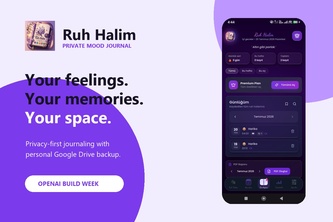
The company appears to be a solo developer project named Ruh Halim – Private Mood Journal, self-described as a privacy-first mobile app for mood tracking and personal journaling. The author states the app supports multilingual input (Turkish, English), integrates with Google Drive for backup, and avoids centralized data storage. It is built using React, TypeScript, Capacitor, Android Java plugins, and OpenAI tools during an OpenAI Build Week hackathon.
What changed: The project evolved from a personal need to simplify journaling while managing chronic health conditions into a functional prototype with incremental backup, resumable uploads, and theme-rich UI. It was submitted as part of the OpenAI 2026 hackathon.
Single most important open question: Is there any evidence of user adoption or monetization beyond the author’s own use case?
This analysis is based entirely on the self-reported project description provided by the author. No external verification, traction data, revenue figures or customer information are available. All claims are treated as stated by the author and not independently confirmed.
What The Product Actually Is
The description states that Ruh Halim is a privacy-first mobile mood journal designed for personal use. It allows users to:
- Record moods
- Add reasons and notes
- Attach up to five photos, one short video or voice recordings
- Revisit entries through calendar and history views
It supports:
- Live themes
- Reminders
- Streaks
- Statistics
- PDF reports
- Biometric protection
- Multilingual support (Turkish and English)
The app integrates with Google Drive for backup and does not rely on a shared media server. Media is uploaded once, with resumable transfers and foreground progress feedback.
The product is described as a mobile journaling tool focused on privacy and low-friction use. No evidence of third-party integrations or commercial features beyond Google Drive backup is provided.
Positioning & Claim Evolution
The author positions Ruh Halim as:
- A privacy-first alternative to centralized mood tracking apps
- A low-effort, personal, and expressive tool for emotional reflection
- Built with a focus on simplicity, calm, and user experience
It evolved from the author’s personal need to manage chronic health conditions, aiming to make journaling less burdensome during low-energy days.
The positioning is rooted in personal motivation rather than market research or user feedback. The evolution described shows a shift from basic functionality to performance and privacy enhancements, but no evidence of prior users or product-market fit beyond the creator’s own use case.
Target Customer & ICP
The description states that the app targets individuals who:
- Want to track emotions privately
- Value low-friction journaling experiences
- Are managing chronic health conditions (as per the author's experience)
- Prefer personal data ownership over shared platforms
There is no explicit mention of a defined persona or segment beyond “users who care about privacy and emotional well-being.”
No evidence of target customer segmentation, user personas, or market research is provided. The ICP appears to be inferred from the creator’s own needs rather than validated external demand.
Business Model & Pricing Evidence
The description does not mention:
- Any pricing model
- Monetization strategy
- Subscription plans or in-app purchases
- Paid features or freemium structure
It only states that users can back up data to their own Google Drive and that the app avoids sending data to a central server.
No evidence of a business model or pricing structure is available. The app appears to be free-to-use with no indication of commercial intent beyond its development as a personal tool.
Technical & Delivery Signals
The app is built using:
- React, TypeScript, Vite
- Capacitor 8 for cross-platform compatibility
- Android Java plugins
- Google Sign-In and Google Drive API
- OpenAI Codex (GPT-5.6) used during development
Key technical features include:
- Incremental, resumable uploads
- Fast index-first restore with background media recovery
- Merge-safe daily entries
- Foreground progress for long transfers
- Regression tests for key flows
The technical stack and delivery signals suggest a well-thought-out engineering approach focused on performance, privacy, and mobile lifecycle management. However, no evidence of production deployment or scalability beyond the prototype stage.
Traction & Maturity Signals
The description does not provide:
- Any user metrics
- Download numbers
- Customer feedback or testimonials
- Product usage data
- Evidence of market traction or growth
It is described as a hackathon project submitted to OpenAI Build Week 2026.
No evidence of traction, adoption, or maturity beyond the prototype phase. The app has not been publicly launched or monetized.
Competitive Context
The description does not reference:
- Competitors
- Market analysis
- Existing solutions in the mood tracking or journaling space
It implies a niche for privacy-focused apps but does not define how Ruh Halim differentiates from others.
No competitive landscape is described. The app’s positioning as privacy-first may imply differentiation, but no evidence of existing players or market dynamics is provided.
Open Questions & Risks
- Solo developer project: Limited resources for scaling, marketing, or long-term maintenance.
- No monetization strategy: Unclear path to revenue generation.
- Limited user base: No evidence of adoption beyond the creator’s own use.
- Hackathon prototype: Likely not production-ready or tested at scale.
- Privacy focus without commercial viability: A strong privacy stance may limit monetization options.
These are inferred risks based on the project's nature and lack of evidence for traction, funding, or business model. No direct evidence of failure points is available.
Questions the description leaves open
- What inspired you to build this specifically as a mobile app rather than a web or desktop tool?
- How did you validate the need for this product before building it?
- Have you tested the app with others, or is it purely personal use?
- Are there plans to expand beyond Google Drive backup (e.g., iCloud, local encryption)?
- What are your thoughts on monetization and long-term sustainability?
- How do you plan to scale beyond a solo developer?
- What are the biggest technical challenges you've faced in making this production-ready?
These questions aim to uncover unspoken assumptions, user validation, and strategic direction behind the project.
Overall Assessment
The description states that Ruh Halim is a solo developer project submitted as part of an OpenAI hackathon. It is not evidenced to have:
- Revenue
- Customers
- Traction
- A clear business model
- Market validation
It is described as a privacy-focused, low-friction mood journaling tool with strong technical execution and thoughtful design.
Not evidenced for investment or partnership consideration at this stage. The project lacks commercial signals, user data, or scalability indicators. It may be an interesting prototype or personal endeavor, but not a viable business opportunity without further development and evidence of traction.
User Stories BotA demo video on every pull request
Get a demo video on every new feature
GitHub App that watches your pull requests and records a narrated, captioned demo.
Save time on demo prep and make informed decisions faster with a video walkthrough of every new feature.
Source
Submitted to the OpenAI 2026 hackathon on Devpost. Project home on Devpost. Back to the full gallery on Devpost.
This competitive analysis was produced by top-founders.com (opens in a new tab)
Generated by a language model from this project's public Devpost page — its tagline, the author's own write-up and any built-with tags listed there — as captured in August 2026. Short quotations are the author's words. It is an opinion on the idea as a business, not on the people behind it, and it reflects the description as published then. If the project has moved on, request a correction below. The analysis is not independent research and contains no verified traction, revenue or customer data.
An independent guide by KFG International LLC — not affiliated with, endorsed by, or connected to Devpost or OpenAI.