

Archive position — measured, not model output
1 like on Devpost
505 of the 7,850 archived projects have more likes, and 1,758 share exactly 1 — so this project's #1,837 place in the like-ranked listing is a tie-break inside that group, not a ranking.
Projects (log scale)
Likes on Devpost. ▲ marks this project's group.
Show the figures
| Likes | Projects | Share of archive |
|---|---|---|
| 0 | 5,587 | 71.2% |
| 1 | 1,758 | 22.4% |
| 2 | 284 | 3.6% |
| 3–4 | 132 | 1.7% |
| 5–9 | 75 | 1.0% |
| 10+ | 14 | 0.2% |
 User Stories BotA demo video on every pull request
Get a demo video on every new feature
GitHub App that watches your pull requests and records a narrated, captioned demo.
Save time on demo prep and make informed decisions faster with a video walkthrough of every new feature.
Executive Summary
What the company appears to be
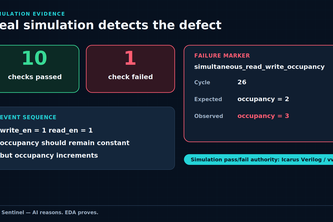
RTL Sentinel is a self-reported hardware verification tool built as a hackathon project. It claims to use deterministic EDA tools (like Icarus Verilog) alongside AI for organizing requirements, generating testbenches, diagnosing failures, and performing mutation testing. The system is described as structured, traceable, and maintaining final authority in simulation truth.
What changed
This is a hackathon submission with no evidence of prior development or commercial traction. It represents an initial proof-of-concept demonstration rather than a product in use.
Single most important open question
Is there any evidence that RTL Sentinel has moved beyond the demo stage, or that it can be scaled to real-world hardware engineering workflows?
What The Product Actually Is
The description states that RTL Sentinel is a tool designed to turn hardware requirements into executable verification. It implements a workflow from RTL and specification inputs through testbench generation, simulation, diagnosis, and mutation testing.
- Workflow stages: RTL + specification → validated requirements/scenarios → deterministic SystemVerilog testbench generation → Icarus Verilog simulation → structured simulator evidence → offline or optional GPT-5.6 diagnosis → mutation campaign → final traceable report.
- Technology stack: Built with Python, Pydantic models, Jinja2 templates, Icarus Verilog, vvp, Streamlit, pytest, and OpenAI APIs (GPT-5.6).
- Key features:
- Deterministic testbench generation
- Structured evidence capture from simulation
- Mutation testing with kill/survival results
- Optional GPT-based diagnosis (offline only)
- Traceable reporting
Inference The tool is described as a demonstration of an end-to-end workflow, not a production-ready system.
Positioning & Claim Evolution
The description positions RTL Sentinel as a hybrid solution combining AI reasoning with deterministic EDA authority. It emphasizes that AI does not decide simulation truth or modify RTL code.
- Core claim: AI organizes and explains engineering intent but never automatically modifies RTL or determines pass/fail.
- Differentiation: The system maintains deterministic simulation as the source of truth, using AI only for structured reasoning and diagnosis.
- Scope: The project is explicitly limited to a "prepared FIFO" interface and a specific defect scenario.
Inference This positioning reflects an early-stage attempt to address fragmentation in hardware verification by integrating AI with established EDA tools.
Target Customer & ICP
The description does not identify any specific customer or target market. It describes the tool as a demonstration for a hackathon, without indicating who would use it beyond hypothetical hardware engineers or verification teams.
- No stated customers
- No identified ICP (Ideal Customer Profile)
Inference The project is not positioned toward any known user base at this time.
Business Model & Pricing Evidence
There is no evidence of a business model, pricing strategy, or monetization approach in the description. It is presented as a hackathon submission with no indication of commercial intent.
- No stated pricing
- No business model
- No revenue or customer data
Inference No commercial viability or monetization path has been reported.
Technical & Delivery Signals
The project demonstrates technical implementation details including:
- Python-based architecture using Pydantic, Jinja2, and subprocess wrappers
- Use of Icarus Verilog and vvp for deterministic simulation
- Structured output via schema validation (Pydantic)
- Streamlit UI and pytest test suite
- Shell script for one-command demo execution
Inference The system is built with a clear technical architecture but remains in prototype form.
Traction & Maturity Signals
There is no evidence of traction, adoption, or maturity beyond the hackathon submission:
- No customers
- No revenue
- No user feedback
- No production usage
- Only demo-level execution
Inference The project exists only as a demonstration with no sign of real-world deployment.
Competitive Context
The description does not mention competitors or existing solutions in the hardware verification space. It focuses on its own unique approach rather than market positioning.
- No competitor analysis
- No mention of EDA tools or verification platforms
Inference No competitive landscape is described, making it impossible to assess how RTL Sentinel fits into the broader ecosystem.
Open Questions & Risks
Several key risks and open questions are evident from the self-reported description:
- Limited scope: The tool only works on a prepared FIFO interface with one intentional defect.
- No live AI integration: GPT-5.6 is used only offline, not in real-time or live simulation.
- Hackathon origin: No evidence of prior development or commercialization.
- No production-ready features: Features like waveform-aware diagnosis, multi-clock support, and UVM generation are listed as future work.
- Unverified claims: The system's ability to scale beyond this narrow use case is unproven.
Inference The project lacks scalability, real-world applicability, and commercial readiness.
Questions the description leaves open
- What is the roadmap for expanding beyond the prepared FIFO interface?
- How does RTL Sentinel plan to integrate with existing EDA toolchains or CI/CD pipelines?
- Has there been any internal or external testing outside of the hackathon demo?
- Are there plans to support broader RTL standards or SystemVerilog constructs?
- What is the expected timeline for moving from prototype to production-ready software?
Overall Assessment
Not evidenced.
There is no evidence of revenue, customers, traction, or a clear path to monetization. The project is described as a hackathon submission with no indication of commercial viability or strategic value beyond its demonstration.
The description makes claims about AI integration and deterministic verification but does not provide any data on performance, scalability, or adoption. It remains an unproven concept in early-stage development.
Confidence Low — based entirely on self-reported information without corroboration or evidence of real-world usage or impact.
User Stories BotA demo video on every pull request
Get a demo video on every new feature
GitHub App that watches your pull requests and records a narrated, captioned demo.
Save time on demo prep and make informed decisions faster with a video walkthrough of every new feature.
Source
Submitted to the OpenAI 2026 hackathon on Devpost. Project home on Devpost. Back to the full gallery on Devpost.
This competitive analysis was produced by top-founders.com (opens in a new tab)
Generated by a language model from this project's public Devpost page — its tagline, the author's own write-up and any built-with tags listed there — as captured in August 2026. Short quotations are the author's words. It is an opinion on the idea as a business, not on the people behind it, and it reflects the description as published then. If the project has moved on, request a correction below. The analysis is not independent research and contains no verified traction, revenue or customer data.
An independent guide by KFG International LLC — not affiliated with, endorsed by, or connected to Devpost or OpenAI.