

Archive position — measured, not model output
1 like on Devpost
505 of the 7,850 archived projects have more likes, and 1,758 share exactly 1 — so this project's #1,838 place in the like-ranked listing is a tie-break inside that group, not a ranking.
Projects (log scale)
Likes on Devpost. ▲ marks this project's group.
Show the figures
| Likes | Projects | Share of archive |
|---|---|---|
| 0 | 5,587 | 71.2% |
| 1 | 1,758 | 22.4% |
| 2 | 284 | 3.6% |
| 3–4 | 132 | 1.7% |
| 5–9 | 75 | 1.0% |
| 10+ | 14 | 0.2% |
 User Stories BotA demo video on every pull request
Get a demo video on every new feature
GitHub App that watches your pull requests and records a narrated, captioned demo.
Save time on demo prep and make informed decisions faster with a video walkthrough of every new feature.
Executive Summary
RuleGuard AI is a self-reported multi-agent AI system designed to discover hidden business rules from enterprise records and prevent risky software releases before deployment. The platform claims to act as an AI-powered release gate for software teams, using four specialized agents (Change, Rule, Test, Safety) to evaluate proposed code changes against historical company knowledge.
The description states that the project was built by one team member (Srinivasa Kamath B) over a hackathon period and deployed entirely on Netlify Serverless Functions without dedicated backend hosting. It includes claims about explainable AI outputs, GitHub/GitLab integration plans, and RAG-based rule discovery capabilities for enterprise use.
The single most important open question is whether RuleGuard AI can meaningfully extract and validate business rules from unstructured enterprise data sources in a way that provides actionable risk assessment for software releases — a capability that remains unproven by the self-reported evidence.
What The Product Actually Is
The description states that RuleGuard AI is a "multi-agent release intelligence platform" that acts as an "AI-powered release gate for software teams."
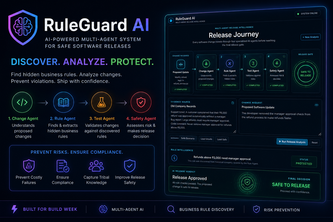
It claims to analyze historical company knowledge and compare it against proposed software updates through a workflow involving four specialized AI agents:
- Change Agent – Understands the proposed software modification.
- Rule Agent – Discovers hidden business rules from historical company records.
- Test Agent – Validates whether the proposed change violates discovered rules.
- Safety Agent – Produces the final release recommendation with supporting evidence.
The platform is described as providing "explainable AI outputs by showing the discovered rules, evidence sources, reasoning, risk assessment, and a final Safe or Unsafe release assessment."
It was built using React, TypeScript, Vite for frontend; Node.js, Netlify Serverless Functions for backend; and integrates with OpenAI LLMs.
Positioning & Claim Evolution
The description states that RuleGuard AI was inspired by the problem of undocumented business rules hidden in support tickets, bug reports, documentation, and developer comments — which are "easily forgotten, leading to production incidents, financial losses, and compliance risks."
It positions itself as a solution that goes beyond automated code testing to evaluate software changes against organizational knowledge.
The author claims it was built to solve the specific problem of "hidden business rules" in enterprise environments, where "automated testing catches many technical issues, [but] important business rules are often hidden inside old support tickets, bug reports, documentation, and developer comments."
It also states that the system is designed to provide "explainable AI outputs" rather than simple Safe/Unsafe predictions.
Target Customer & ICP
The description states that RuleGuard AI targets "software teams" and aims to act as an "AI-powered release gate for software teams."
It claims to be positioned as a platform for enterprise use, with stated future development plans including integration with GitHub, GitLab, Jira, Azure DevOps, and CI/CD pipelines.
The author notes that the system is designed to assist human decision-making rather than replace it, suggesting an ICP focused on development teams seeking to improve release safety and compliance.
Business Model & Pricing Evidence
Not evidenced. The description does not contain any information about pricing models, monetization strategies, or business model assumptions beyond the self-reported project scope.
Technical & Delivery Signals
The description states that the frontend was developed using React, TypeScript, and Vite; the backend logic was implemented using Node.js and deployed as Netlify Serverless Functions.
It claims to have migrated from a local Express backend to Netlify Serverless Functions, with the entire application running "entirely on Netlify without requiring dedicated backend hosting."
The multi-agent workflow is described as modular orchestration where each AI agent performs an independent responsibility before contributing to the final release decision.
Traction & Maturity Signals
Not evidenced. The description does not contain any information about revenue, customers, user adoption, or traction metrics beyond what was accomplished during a hackathon period.
The author states that this project was submitted to the OpenAI 2026 hackathon on Devpost and that it was built by one team member over a short time frame.
Competitive Context
Not evidenced. The description does not contain any information about existing competitive products, market positioning, or competitive landscape analysis beyond the self-reported claims of the author.
Open Questions & Risks
- Unproven business rule discovery: The system's ability to extract and validate business rules from unstructured enterprise data remains untested in real-world scenarios.
- Limited team capacity: Built by a single individual (Srinivasa Kamath B) over a hackathon period, raising questions about scalability and long-term development capacity.
- Deployment constraints: The system was deployed entirely on Netlify Serverless Functions without dedicated backend hosting, which may limit performance or functionality for enterprise use cases.
- Explainable AI claims: While the platform claims to provide explainable outputs, there is no demonstration of how this would work in practice beyond a hackathon prototype.
Questions the description leaves open
- How does RuleGuard AI actually extract business rules from unstructured data sources like support tickets and developer comments?
- What specific types of enterprise documentation or records are used to train or inform the rule discovery process?
- Can you demonstrate how the system would handle a real-world example of a software change that violates an undocumented business rule?
- How does RuleGuard AI distinguish between valid business rules and outdated or incorrect information in historical records?
- What is the expected accuracy rate for discovered rules and their impact on release decisions?
- How will the platform scale to support large enterprise environments with complex workflows and multiple teams?
Overall Assessment
Not evidenced. The description does not contain any information about funding rounds, valuations, or investment status beyond the fact that it was submitted as a hackathon project.
The author states that this is a "fully functional multi-agent software release analysis system" built during a hackathon period and deployed on Netlify, with future development plans to transform it into an enterprise-ready platform. However, no commercial traction, revenue, or customer data is provided to assess viability or potential for investment or partnership.
User Stories BotA demo video on every pull request
Get a demo video on every new feature
GitHub App that watches your pull requests and records a narrated, captioned demo.
Save time on demo prep and make informed decisions faster with a video walkthrough of every new feature.
Source
Submitted to the OpenAI 2026 hackathon on Devpost. Project home on Devpost. Back to the full gallery on Devpost.
This competitive analysis was produced by top-founders.com (opens in a new tab)
Generated by a language model from this project's public Devpost page — its tagline, the author's own write-up and any built-with tags listed there — as captured in August 2026. Short quotations are the author's words. It is an opinion on the idea as a business, not on the people behind it, and it reflects the description as published then. If the project has moved on, request a correction below. The analysis is not independent research and contains no verified traction, revenue or customer data.
An independent guide by KFG International LLC — not affiliated with, endorsed by, or connected to Devpost or OpenAI.