

Archive position — measured, not model output
0 likes on Devpost
2,263 of the 7,850 archived projects have more likes, and 5,587 share exactly 0 — so this project's #5,764 place in the like-ranked listing is a tie-break inside that group, not a ranking.
Projects (log scale)
Likes on Devpost. ▲ marks this project's group.
Show the figures
| Likes | Projects | Share of archive |
|---|---|---|
| 0 | 5,587 | 71.2% |
| 1 | 1,758 | 22.4% |
| 2 | 284 | 3.6% |
| 3–4 | 132 | 1.7% |
| 5–9 | 75 | 1.0% |
| 10+ | 14 | 0.2% |
 User Stories BotA demo video on every pull request
Get a demo video on every new feature
GitHub App that watches your pull requests and records a narrated, captioned demo.
Save time on demo prep and make informed decisions faster with a video walkthrough of every new feature.
Executive Summary
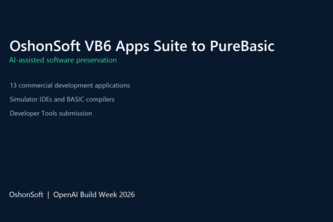
The author describes a self-contained migration tool for converting Visual Basic 6 (VB6) applications to PureBasic, targeting a suite of thirteen mature commercial microcontroller development tools. The project is built by one person, Vladimir Soso, and uses AI assistance (Codex + GPT-5.6 Sol Light) in a human-directed engineering collaboration. The system generates complete PureBasic code from VB6 sources, with an emphasis on preserving design intent and enabling future modernization of shared components.
The migration process is described as iterative and milestone-driven, with the current Build Week milestone completing keyword subsystems for one application (Z80 Simulator IDE), demonstrating syntax highlighting in both BASIC and assembly editors. The tool is said to regenerate all thirteen applications from scratch each time, ensuring consistency across the suite.
Key commercial signals are absent: no revenue, customers, pricing, or adoption data are provided. The project appears to be a personal engineering effort focused on preservation rather than product-market fit or scalability. The single most important open question is whether this migration approach can scale beyond this specific, narrow use case — particularly given the lack of evidence for broader applicability or commercial traction.
What The Product Actually Is
The description states that OshonSoft is a "purpose-built VB6-to-PureBasic migration system". It regenerates complete PureBasic application trees from current VB6 sources, covering thirteen simulator IDE and BASIC compiler products for various microprocessor architectures (PIC, AVR, Z80, 6502, 8085).
The converter is described as a mature engineering application with multiple conversion passes: general, module-specific, form-specific, and procedure-specific. It always recreates its complete output from scratch, so permanent migration work belongs in converter algorithms or shared PureBasic sources rather than manually patched generated files.
The system generates both the source code and Windows x86/x64 executables for all thirteen applications. The author claims that generated PureBasic remains readable and recognizably related to the original design.
Positioning & Claim Evolution
The description positions OshonSoft as a tool for preserving mature commercial VB6 development applications through an automatic, Codex-assisted migration to readable and maintainable PureBasic. It emphasizes that this is not a conventional rewrite but rather a method of preserving behavior, accumulated design decisions, and the ability to maintain original products during migration.
The claim evolution shows a shift from preservation-focused intent ("preserving decades of specialized engineering knowledge") to technical execution ("converter regenerates complete PureBasic application trees"). The author also frames this as a collaborative effort between human expertise and AI (Codex + GPT-5.6), which they describe as "genuine pair engineering".
Target Customer & ICP
Not evidenced.
The description does not identify any specific customer segment or target market beyond the author's own use case. There is no mention of external users, clients, or buyers. The project appears to be a personal engineering effort focused on migrating internal tools rather than serving an external market.
Business Model & Pricing Evidence
Not evidenced.
There is no information provided about pricing models, revenue streams, monetization strategies, or business model assumptions. The description focuses entirely on the technical aspects of migration and does not indicate any commercial intent beyond preservation.
Technical & Delivery Signals
The system uses a "generate-everything-from-scratch" architecture, meaning that local edits are insufficient for durability — solutions must originate in converter or common sources and regenerate consistently across the application family.
The converter is described as having multiple conversion passes: general, module-specific, form-specific, and procedure-specific. It integrates with tools like Git, Scintilla, Lexilla, and PureBasic 6.21.
Codex Desktop using GPT-5.6 Sol Light was used for repository-aware engineering assistance, including reading conventions, comparing implementations, proposing designs, implementing agreed solutions, checking consistency, and validating milestones.
The project includes a test repository with compiled executables and clear setup instructions for judges, demonstrating that the system produces working binaries.
Traction & Maturity Signals
Not evidenced.
There is no evidence of revenue, customers, user adoption, or market traction. The description focuses on internal development progress and technical milestones rather than external validation or usage metrics. The project appears to be a personal engineering effort without any indication of broader impact or commercial success.
Competitive Context
Not evidenced.
The description does not mention competitors, alternative solutions, or the competitive landscape in VB6-to-PureBasic migration or software preservation tools. No comparison with other migration technologies or platforms is provided.
Open Questions & Risks
- Narrow scope: The project appears to be a one-person effort focused on migrating a specific set of internal tools (thirteen microcontroller applications). There's no evidence that this approach scales beyond this particular use case.
- Lack of commercial traction: No revenue, customers, or adoption data are provided. The project seems to be an engineering exercise rather than a product with market demand.
- Dependency on proprietary AI tooling: The system relies heavily on Codex and GPT-5.6 Sol Light, which may not be available or replicable outside of the specific development environment described.
- Limited external validation: The project is self-reported and unverified. No third-party testing, user feedback, or independent assessment is mentioned.
Questions the description leaves open
- What is the long-term vision for this migration effort beyond these thirteen applications? Is there a plan to scale it to other VB6 codebases?
- How does this solution compare to existing commercial VB6-to-PureBasic or VB6-to-other-language migration tools, if any exist?
- Are there any plans to monetize or commercialize this tooling, or is it purely for personal use?
- What are the technical challenges in extending this approach to more complex or larger VB6 applications?
- How do you ensure that the AI-assisted migration preserves not just syntax but also semantic meaning and behavioral fidelity?
Overall Assessment
Not evidenced.
There is no evidence of any investment interest, partnership discussions, or commercial viability beyond the author's personal engineering effort. The description does not suggest any intention to build a scalable product or attract external capital or partners. The project appears to be a technical demonstration rather than a commercial proposition.
User Stories BotA demo video on every pull request
Get a demo video on every new feature
GitHub App that watches your pull requests and records a narrated, captioned demo.
Save time on demo prep and make informed decisions faster with a video walkthrough of every new feature.
Source
Submitted to the OpenAI 2026 hackathon on Devpost. Project home on Devpost. Back to the full gallery on Devpost.
This competitive analysis was produced by top-founders.com (opens in a new tab)
Generated by a language model from this project's public Devpost page — its tagline, the author's own write-up and any built-with tags listed there — as captured in August 2026. Short quotations are the author's words. It is an opinion on the idea as a business, not on the people behind it, and it reflects the description as published then. If the project has moved on, request a correction below. The analysis is not independent research and contains no verified traction, revenue or customer data.
An independent guide by KFG International LLC — not affiliated with, endorsed by, or connected to Devpost or OpenAI.