

Archive position — measured, not model output
0 likes on Devpost
2,263 of the 7,850 archived projects have more likes, and 5,587 share exactly 0 — so this project's #7,727 place in the like-ranked listing is a tie-break inside that group, not a ranking.
Projects (log scale)
Likes on Devpost. ▲ marks this project's group.
Show the figures
| Likes | Projects | Share of archive |
|---|---|---|
| 0 | 5,587 | 71.2% |
| 1 | 1,758 | 22.4% |
| 2 | 284 | 3.6% |
| 3–4 | 132 | 1.7% |
| 5–9 | 75 | 1.0% |
| 10+ | 14 | 0.2% |
 User Stories BotA demo video on every pull request
Get a demo video on every new feature
GitHub App that watches your pull requests and records a narrated, captioned demo.
Save time on demo prep and make informed decisions faster with a video walkthrough of every new feature.
Executive Summary
What the company appears to be
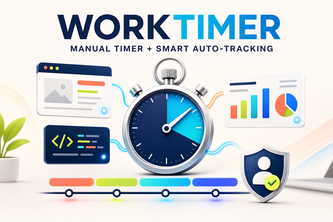
Worktimer is a time-tracking tool for individuals that combines a manual START/STOP timer with optional desktop automation to detect work context (e.g., apps, browser domains) and generate an editable summary of activity. The author states it was built during OpenAI Build Week 2026 using Codex and GPT-5.6.
What changed
The project evolved from a basic manual timer into a version that includes optional desktop tracking and AI-assisted summarization of work sessions, with an emphasis on privacy-awareness and user control over generated content.
Single most important open question
Is there any evidence of traction, revenue, or customer adoption beyond the author’s own use case?
What The Product Actually Is
The description states that Worktimer is a time-tracking tool for individuals. It includes:
- A manual START/STOP timer.
- An optional desktop helper for macOS and Windows that detects foreground app, window title, and browser domain.
- A summary feature that generates editable blocks of activity after pressing STOP.
- Privacy controls such as masking private domains and allowing users to review/edit every generated block before saving.
The author describes the tool as being built using React, TypeScript, Vite, Cloudflare Pages, and PWA technologies. It also uses Codex and GPT-5.6 for development assistance during the OpenAI Build Week.
Inference It is a personal productivity tool aimed at individuals who want to understand how they spend their time without being monitored by others.
Positioning & Claim Evolution
The author states:
- Worktimer was inspired by the need to understand where one’s time went, especially when working long hours.
- It started as a manual timer but evolved into an automated version with AI assistance.
- The goal is not to increase productivity or squeeze more work out of the day, but to help users reflect on their actual use of time.
- It emphasizes user control: automation provides evidence, not absolute truth.
Inference The positioning has shifted from a simple timer to a reflective tool that helps individuals gain insight into their own behavior and habits. The evolution reflects a move toward integrating AI for summarization while maintaining human judgment.
Target Customer & ICP
The description states:
- Worktimer is built for the person doing the work, not for managers or supervisors.
- It targets individuals who want to understand how they spend time at their desk.
- The tool supports both manual and automated tracking modes.
Not evidenced No explicit customer segments, personas, or target industries are mentioned. No indication of whether this is aimed at freelancers, remote workers, developers, or general professionals.
Business Model & Pricing Evidence
The description states:
- There is no mention of pricing or monetization strategy.
- The tool appears to be a personal utility with no clear commercial model described.
Inference There is no evidence of a business model beyond the author’s own use case. It may be an open-source or freemium product, but this cannot be confirmed from the provided information.
Technical & Delivery Signals
The description states:
- Built using React, TypeScript, Vite, Cloudflare Pages, and PWA.
- Uses macOS and Windows desktop automation for context detection.
- Integrates Codex and GPT-5.6 during development.
- Includes privacy masking features.
- Has an interactive demo that judges can try without installing the desktop helper.
Inference The technical stack suggests a modern web-based application with cross-platform capabilities, likely designed for ease of access and minimal installation requirements.
Traction & Maturity Signals
The description states:
- The project was submitted to the OpenAI 2026 hackathon.
- It evolved from an initial manual timer into a more complex version during Build Week.
- The author used Codex and GPT-5.6 to implement changes iteratively.
Not evidenced No data on downloads, users, customer engagement, or revenue is provided. No mention of any public launch, marketing efforts, or user feedback.
Competitive Context
The description states:
- Worktimer is not intended to be a replacement for enterprise time-tracking tools.
- It focuses on individual use and privacy-awareness.
- It does not assume that every open window means productive work.
Inference It likely competes with personal productivity apps like RescueTime, Toggl, or Clockify, but with a focus on AI-enhanced summarization and user control over data. However, no direct competitors are named or compared.
Open Questions & Risks
- No traction evidence: No signs of adoption, revenue, or customer base.
- Self-reported only: All claims are unverified; no third-party validation.
- Unclear monetization: No indication of how the tool will be monetized or scaled.
- Limited scope: The project is described as a personal utility with no clear path to broader market appeal.
- Developer-centric: The tool seems tailored for developers or technical users, limiting its general appeal.
Questions the description leaves open
- What is the intended user base beyond yourself?
- Are there any plans to monetize or scale this product?
- How do you plan to differentiate from existing time-tracking tools?
- What are your long-term goals for Worktimer?
- Have you tested it with other users, and what feedback did you receive?
Overall Assessment
Not evidenced.
There is no evidence of revenue, customers, or traction that would support an investment or partnership decision. The project appears to be a personal tool developed during a hackathon, with no indication of commercial viability or market demand.
The author’s own account is the only source of information, and it does not include any data on usage, adoption, or monetization. Any potential value lies in its conceptual novelty and developer-friendly features, but without further evidence, no conclusion can be drawn about its investment or partnership potential.
User Stories BotA demo video on every pull request
Get a demo video on every new feature
GitHub App that watches your pull requests and records a narrated, captioned demo.
Save time on demo prep and make informed decisions faster with a video walkthrough of every new feature.
Source
Submitted to the OpenAI 2026 hackathon on Devpost. Project home on Devpost. Back to the full gallery on Devpost.
This competitive analysis was produced by top-founders.com (opens in a new tab)
Generated by a language model from this project's public Devpost page — its tagline, the author's own write-up and any built-with tags listed there — as captured in August 2026. Short quotations are the author's words. It is an opinion on the idea as a business, not on the people behind it, and it reflects the description as published then. If the project has moved on, request a correction below. The analysis is not independent research and contains no verified traction, revenue or customer data.
An independent guide by KFG International LLC — not affiliated with, endorsed by, or connected to Devpost or OpenAI.