

Archive position — measured, not model output
0 likes on Devpost
2,263 of the 7,850 archived projects have more likes, and 5,587 share exactly 0 — so this project's #5,766 place in the like-ranked listing is a tie-break inside that group, not a ranking.
Projects (log scale)
Likes on Devpost. ▲ marks this project's group.
Show the figures
| Likes | Projects | Share of archive |
|---|---|---|
| 0 | 5,587 | 71.2% |
| 1 | 1,758 | 22.4% |
| 2 | 284 | 3.6% |
| 3–4 | 132 | 1.7% |
| 5–9 | 75 | 1.0% |
| 10+ | 14 | 0.2% |
 User Stories BotA demo video on every pull request
Get a demo video on every new feature
GitHub App that watches your pull requests and records a narrated, captioned demo.
Save time on demo prep and make informed decisions faster with a video walkthrough of every new feature.
Executive Summary
Project name: OsteoScreen-AI
Self-reported basis: The entire analysis is based on the author-supplied project description, tagline, and write-up — unverified, self-reported information only. No third-party corroboration or historical data available.
Commercial due-diligence read: OsteoScreen-AI is a prototype clinical decision support tool for osteoporosis screening that combines deterministic risk calculation with generative AI explanations in a physician-in-the-loop model. The project appears to be an early-stage technical exploration, not yet validated in clinical settings or deployed in production. The single most important open question is whether the approach can scale beyond a hackathon prototype and demonstrate reproducible, clinically meaningful performance.
What The Product Actually Is
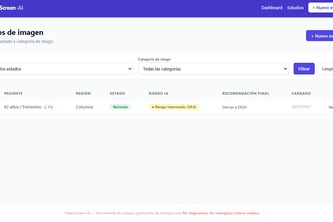
The description states that OsteoScreen-AI is a physician-in-the-loop clinical decision support prototype. It integrates:
- Clinical risk factors
- Conventional spine radiographs
- A deterministic engine for risk assessment
- Grad-CAM visual explanations
- Structured GPT-5.6 clinical reasoning
- Final physician validation
The system is built using Django and incorporates computer vision (Yolov8, MONAI), explainable AI (Grad-CAM), and generative AI (GPT-5.6 via OpenAI Responses API with Structured Outputs). It is described as a working prototype developed during the OpenAI Build Week.
Inference: The product is not a commercial offering but an exploratory tool designed to test how AI can assist in osteoporosis screening while maintaining physician control over final decisions.
Positioning & Claim Evolution
The description states that OsteoScreen-AI was created to explore how existing radiographs can become a practical screening opportunity. It aims to identify patients who could benefit from further osteoporosis assessment before a fracture occurs, rather than waiting for a fragility fracture.
It positions itself as a tool that:
- Uses clinical data and conventional radiographs
- Provides deterministic risk scoring
- Incorporates GPT-5.6 for structured explanations
- Keeps physicians fully in control of final decisions
Claim: The system is designed to be physician-in-the-loop, with no generative AI making clinical decisions.
Inference: This is a clinical AI exploration, not a commercial product or service. It reflects an early-stage idea, not yet validated for real-world use.
Target Customer & ICP
The description states that the system is intended for radiologists who review spine radiographs for various clinical reasons. These are the users who would interact with the tool in a clinical setting.
It also implies that the end-users are clinicians, not patients or hospital administrators, as the focus is on integrating AI into their workflow to assist in diagnosis.
Inference: The ICP (Ideal Customer Profile) likely includes radiologists or clinicians working in hospitals or imaging centers who may benefit from early osteoporosis detection tools.
Business Model & Pricing Evidence
Not evidenced. The description does not mention any pricing, monetization strategy, or business model. It is a prototype built for a hackathon and not described as a commercial product.
Technical & Delivery Signals
The system is built using:
- Django (web framework)
- Python, PyTorch, OpenAI API, MONAI, YOLOv8
- Grad-CAM for explainability
- Structured Outputs via OpenAI Responses API to control GPT-5.6 use
- Codex as an engineering collaborator during development
The architecture is described as modular and deliberately separates:
- Deterministic risk calculation
- Generative AI explanations
- Physician validation
It also mentions integration with hospital PACS/RIS environments as a future goal.
Inference: The system shows technical sophistication for a prototype, but no evidence of production-grade deployment or scalability.
Traction & Maturity Signals
Not evidenced. There is no mention of:
- Customers
- Revenue
- Product usage
- Clinical validation
- Deployment in hospitals or clinics
- Any form of traction beyond the hackathon prototype
The project is described as a working prototype developed during a single week-long event.
Competitive Context
Not evidenced. The description does not mention any competitors, market size, or competitive landscape. It is unclear whether similar tools exist or how this approach compares to existing clinical AI solutions in osteoporosis screening.
Open Questions & Risks
- Prototype-only: No evidence of real-world deployment or clinical validation.
- No commercial model: No pricing, monetization, or customer data.
- Unproven scalability: The system is described as a hackathon prototype with no indication of production readiness.
- AI integration risk: While the architecture separates deterministic and generative AI, it's unclear how well this approach will hold up in clinical practice.
- No regulatory or safety validation: No mention of compliance, ethics boards, or safety testing.
Questions the description leaves open
- What specific clinical datasets were used to develop the deterministic engine?
- Has the system been tested with actual radiologists in a clinical setting?
- How is the physician validation process implemented and audited?
- What are the plans for regulatory compliance or safety testing?
- Are there any partnerships or pilot programs with hospitals or imaging centers?
- What is the roadmap for moving from prototype to production-ready system?
Overall Assessment
Not evidenced. The project is described as a prototype and not yet validated in clinical settings or commercialized. There is no evidence of traction, revenue, or customer adoption.
Assessment: Early-stage exploration with potential but no demonstrated commercial viability or market readiness. Not suitable for investment or partnership at this stage without further development and validation.
User Stories BotA demo video on every pull request
Get a demo video on every new feature
GitHub App that watches your pull requests and records a narrated, captioned demo.
Save time on demo prep and make informed decisions faster with a video walkthrough of every new feature.
Source
Submitted to the OpenAI 2026 hackathon on Devpost. Project home on Devpost. Back to the full gallery on Devpost.
This competitive analysis was produced by top-founders.com (opens in a new tab)
Generated by a language model from this project's public Devpost page — its tagline, the author's own write-up and any built-with tags listed there — as captured in August 2026. Short quotations are the author's words. It is an opinion on the idea as a business, not on the people behind it, and it reflects the description as published then. If the project has moved on, request a correction below. The analysis is not independent research and contains no verified traction, revenue or customer data.
An independent guide by KFG International LLC — not affiliated with, endorsed by, or connected to Devpost or OpenAI.