

Archive position — measured, not model output
0 likes on Devpost
2,263 of the 7,850 archived projects have more likes, and 5,587 share exactly 0 — so this project's #3,800 place in the like-ranked listing is a tie-break inside that group, not a ranking.
Projects (log scale)
Likes on Devpost. ▲ marks this project's group.
Show the figures
| Likes | Projects | Share of archive |
|---|---|---|
| 0 | 5,587 | 71.2% |
| 1 | 1,758 | 22.4% |
| 2 | 284 | 3.6% |
| 3–4 | 132 | 1.7% |
| 5–9 | 75 | 1.0% |
| 10+ | 14 | 0.2% |
 User Stories BotA demo video on every pull request
Get a demo video on every new feature
GitHub App that watches your pull requests and records a narrated, captioned demo.
Save time on demo prep and make informed decisions faster with a video walkthrough of every new feature.
Executive Summary
Company: Dragon Head
Self-reported basis: The entire analysis is based on the author-supplied project description, tagline, and write-up — unverified, self-reported, and without external corroboration.
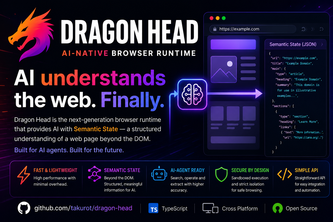
What it appears to be: A browser runtime designed for AI agents, transforming web pages into a semantic state instead of raw DOM access.
What changed: The project was submitted as part of the OpenAI 2026 hackathon, with an open-source release and a stated vision to become the runtime layer for AI agents on the web.
Single most important open question: Is there evidence of traction, usage or adoption beyond the author's own development and open-sourcing?
What The Product Actually Is
The description states that Dragon Head is an AI-native browser runtime. It transforms web pages into a structured Semantic State, which AI agents can use instead of interacting with raw DOM elements.
- The product is described as a browser runtime built in TypeScript, designed to analyze web pages and expose a simple API for AI agents.
- It is positioned as an alternative to traditional browser automation tools that rely on DOM access.
- The system is said to be fast, extensible, and compatible with modern LLM-powered applications.
Inference: The product appears to be a lightweight runtime or middleware layer that abstracts web page content into semantic elements for AI agents. It is not a full browser but a tool that enhances how AI interacts with web pages.
Positioning & Claim Evolution
The author states that the project was inspired by the idea that "browser automation is still built around the DOM—a representation designed for browsers, not AI."
- The core claim is that Dragon Head rethinks the browser from an AI-first perspective.
- It aims to provide semantic page understanding, rather than raw HTML or fragile CSS selectors.
- The project positions itself as a new abstraction layer beyond traditional DOM-based automation.
Inference: The positioning reflects a shift in thinking about how AI agents interact with web content — moving from low-level DOM parsing to high-level semantic interpretation. This is a conceptual evolution, not yet proven through usage or adoption.
Target Customer & ICP
The description does not explicitly name target customers or personas.
- It is implied that the primary users are AI developers, LLM-powered application builders, and AI agent framework integrators.
- The project is described as being built for the AI developer community, with an open-source release.
- There is no evidence of specific customer segments, buyer personas or use cases beyond general AI automation.
Inference: The ICP likely includes developers building AI agents or tools that interact with web content. However, no explicit segmentation or targeting data is provided.
Business Model & Pricing Evidence
There is no evidence in the description of a business model or pricing structure.
- The project was open-sourced.
- No mention of monetization, licensing, or paid features.
- No indication of whether it intends to be a freemium, enterprise, or SaaS product.
Inference: The business model is unclear. It may be an open-source tool with potential for future monetization, but no evidence supports this.
Technical & Delivery Signals
The project is described as:
- Built in TypeScript, with a Rust tag listed by the author.
- Designed to be lightweight, fast, and extensible.
- Aims to be compatible with modern LLM-powered applications.
- It supports AI agents by exposing a simple API for semantic page interaction.
Inference: The technical architecture is described as optimized for AI use cases, but no details on performance benchmarks, scalability or integration capabilities are provided.
Traction & Maturity Signals
The description states:
- The project was submitted to the OpenAI 2026 hackathon.
- It was open-sourced.
- The author claims to have built a simple developer experience and made AI-powered automation easier and more reliable.
However, there is no evidence of customer adoption, revenue, or usage beyond the author's own work. No metrics, user feedback, or product maturity indicators are provided.
Inference: The project is at an early stage, likely a prototype or proof-of-concept. There is no evidence of traction or market validation.
Competitive Context
The description does not mention competitors or provide context about the broader landscape.
- It positions itself as an AI-native alternative to traditional browser automation tools.
- No specific tools or platforms are named as direct competitors.
- The project is described as being built for AI agents, suggesting a niche in LLM-powered web interaction.
Inference: The competitive space includes browser automation libraries and frameworks, but no evidence of how Dragon Head compares to existing solutions or how it differentiates itself.
Open Questions & Risks
- No traction or adoption: The project is open-sourced and submitted to a hackathon — no evidence of real-world usage.
- Single founder: The team size is listed as 1, which may limit execution capacity.
- Unproven market fit: No evidence of customer demand or validated use cases.
- Lack of business model clarity: No indication of monetization or commercial strategy.
- No performance or scalability data: The product is described as fast and extensible, but no metrics are provided.
Inference: The project is in a very early stage with limited evidence of viability or commercial potential. Risks include lack of traction, execution risk, and unclear path to monetization.
Questions the description leaves open
- What specific AI agent frameworks or use cases does Dragon Head currently support?
- How does it compare in performance or reliability to existing browser automation tools (e.g., Puppeteer, Playwright)?
- Has the open-source version been adopted by any developers or teams?
- What is the roadmap for monetization or commercial product development?
- Are there any early partners or users who have tested the runtime in real-world applications?
Overall Assessment
Not evidenced.
The project is described as a hackathon submission, open-sourced, and built by one person. There is no evidence of revenue, customers, traction, or even a clear business model. It appears to be an early-stage idea or prototype, not yet validated in the market.
Confidence: Low. The description provides no commercial due-diligence signals beyond self-reported claims. Any potential value or risk must be inferred from limited information and is not substantiated.
User Stories BotA demo video on every pull request
Get a demo video on every new feature
GitHub App that watches your pull requests and records a narrated, captioned demo.
Save time on demo prep and make informed decisions faster with a video walkthrough of every new feature.
Source
Submitted to the OpenAI 2026 hackathon on Devpost. Project home on Devpost. Back to the full gallery on Devpost.
This competitive analysis was produced by top-founders.com (opens in a new tab)
Generated by a language model from this project's public Devpost page — its tagline, the author's own write-up and any built-with tags listed there — as captured in August 2026. Short quotations are the author's words. It is an opinion on the idea as a business, not on the people behind it, and it reflects the description as published then. If the project has moved on, request a correction below. The analysis is not independent research and contains no verified traction, revenue or customer data.
An independent guide by KFG International LLC — not affiliated with, endorsed by, or connected to Devpost or OpenAI.