

Archive position — measured, not model output
3 likes on Devpost
128 of the 7,850 archived projects have more likes, and 93 share exactly 3 — so this project's #196 place in the like-ranked listing is a tie-break inside that group, not a ranking.
Projects (log scale)
Likes on Devpost. ▲ marks this project's group.
Show the figures
| Likes | Projects | Share of archive |
|---|---|---|
| 0 | 5,587 | 71.2% |
| 1 | 1,758 | 22.4% |
| 2 | 284 | 3.6% |
| 3–4 | 132 | 1.7% |
| 5–9 | 75 | 1.0% |
| 10+ | 14 | 0.2% |
 User Stories BotA demo video on every pull request
Get a demo video on every new feature
GitHub App that watches your pull requests and records a narrated, captioned demo.
Save time on demo prep and make informed decisions faster with a video walkthrough of every new feature.
Executive Summary
Company: Roux
Self-reported basis: The description is entirely from the project author’s own submission to the OpenAI 2026 hackathon on Devpost. No independent verification or additional data is available.
What it appears to be: A tool that facilitates team knowledge sharing for AI-assisted planning, using conversational interviews and integration with Codex.
What changed: The project was built as a hackathon submission, with no evidence of prior development or commercial traction.
Most important open question: Does Roux demonstrate a viable product-market fit for teams seeking to integrate contextual knowledge into AI workflows?
What The Product Actually Is
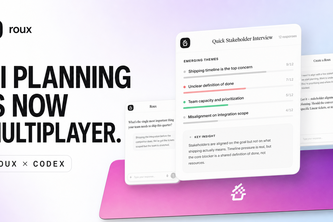
The description states that Roux is a tool that interviews a team through a conversational experience, gathering insights from individuals about their project context, concerns, and decisions. It then synthesizes this information and shares it back into Codex to help shape better AI plans.
- Claim: Roux interviews a team via conversation.
- Evidence: The description states: “Roux interviews a team through a simple conversational experience.”
- Claim: Roux brings insights back into Codex.
- Evidence: The description states: “Roux then brings those insights back into Codex, where they can shape clearer, more complete plans.”
- Claim: Roux is built using Codex and GPT-5.6.
- Evidence: The description states: “We used Codex and GPT-5.6 throughout the build...”
- Claim: Roux supports asynchronous team input.
- Evidence: The description states: “Roux lets people contribute asynchronously and turns many individual perspectives into one shared starting point.”
Inference: Roux appears to be a lightweight, conversational tool for gathering contextual knowledge before AI planning begins.
Not evidenced: Product functionality beyond the described workflow, user interface details, or integration depth with Codex.
Positioning & Claim Evolution
The author positions Roux as a bridge between human team knowledge and AI-assisted planning, emphasizing that “great AI plans start with great context,” and that this knowledge is often scattered.
- Claim: Roux helps teams share context with AI tools.
- Evidence: The description states: “We built Roux to make that knowledge easier to share with Codex.”
- Claim: Roux improves planning by integrating team insights.
- Evidence: The description states: “The result is a planning workflow that combines AI speed with the knowledge of the people doing the work.”
- Claim: Roux makes collaboration feel less like a meeting.
- Evidence: The description states: “collaboration does not need to feel like a meeting.”
Inference: Roux is positioned as a tool for improving AI planning workflows by structuring team input.
Not evidenced: Market positioning, competitive differentiation, or prior customer feedback.
Target Customer & ICP
The description implies that Roux targets teams working on projects where context and knowledge sharing are critical—especially in AI-assisted environments.
- Claim: Roux is for teams doing project planning with AI.
- Evidence: The description states: “Roux interviews your team, shares what they know back into Codex, and so much more; helping turn team knowledge into smarter, more useful plans.”
- Claim: Roux is for teams that want to avoid meetings but still gather input.
- Evidence: The description states: “collaboration does not need to feel like a meeting.”
Inference: Roux likely targets small to mid-sized teams working in AI-assisted environments, where context is critical.
Not evidenced: Specific customer personas, use cases beyond the hackathon submission, or team size or industry.
Business Model & Pricing Evidence
There is no evidence of pricing, monetization strategy, or business model in the description.
- Claim: Roux is a tool for AI planning.
- Evidence: The description states: “Roux interviews your team, shares what they know back into Codex, and so much more; helping turn team knowledge into smarter, more useful plans.”
- Not evidenced: Pricing model, revenue streams, or monetization strategy.
Technical & Delivery Signals
The project is described as built using Codex and GPT-5.6, with a focus on conversational UX and asynchronous input.
- Claim: Roux uses Codex and GPT-5.6.
- Evidence: The description states: “We used Codex and GPT-5.6 throughout the build...”
- Claim: Roux has a conversational UI.
- Evidence: The description states: “We focused on making Roux feel simple and approachable: one link for the team, thoughtful questions, clear progress, and a useful summary at the end.”
- Claim: Roux supports asynchronous input.
- Evidence: The description states: “Roux lets people contribute asynchronously...”
Inference: Roux is built with AI tools and prioritizes ease of use and conversational UX.
Not evidenced: Technical architecture, scalability, or integration depth beyond Codex.
Traction & Maturity Signals
There is no evidence of traction, customers, revenue, or product maturity beyond the hackathon submission.
- Claim: Roux was built for a hackathon.
- Evidence: The description states: “Context: this project was submitted to the OpenAI 2026 hackathon on Devpost.”
- Not evidenced: Customers, usage data, revenue, or product adoption.
Competitive Context
There is no mention of competitors or market positioning in the description.
- Claim: Roux is for AI planning workflows.
- Evidence: The description states: “Roux interviews your team, shares what they know back into Codex...”
- Not evidenced: Competitors, market size, or competitive landscape.
Open Questions & Risks
Several key risks and open questions emerge from the lack of evidence:
- No product-market fit evidence: The project is a hackathon submission with no traction.
- No monetization strategy: No indication of how Roux would generate revenue.
- No customer feedback or usage data: No evidence of real-world testing or user validation.
- Unproven AI integration: While Codex and GPT are mentioned, the depth of integration is unclear.
- No team experience or track record: The team has no prior product or company history.
Questions the description leaves open
- What specific problems in planning workflows does Roux solve, and how do you know?
- How does Roux handle sensitive or confidential information during interviews?
- What is the expected user journey from interview to Codex integration?
- Have you tested Roux with real teams or projects beyond the hackathon?
- What are your plans for product development beyond this prototype?
- How do you plan to monetize Roux, and what is your go-to-market strategy?
Overall Assessment
Not evidenced: No evidence of traction, revenue, or customer validation exists.
- Confidence level: Low.
- Reasoning: This is a hackathon submission with no commercial history. The description is self-reported and unverified.
- Assessment: Not ready for investment or partnership consideration without further product development, market testing, and evidence of traction.
User Stories BotA demo video on every pull request
Get a demo video on every new feature
GitHub App that watches your pull requests and records a narrated, captioned demo.
Save time on demo prep and make informed decisions faster with a video walkthrough of every new feature.
Source
Submitted to the OpenAI 2026 hackathon on Devpost. Project home on Devpost. Back to the full gallery on Devpost.
This competitive analysis was produced by top-founders.com (opens in a new tab)
Generated by a language model from this project's public Devpost page — its tagline, the author's own write-up and any built-with tags listed there — as captured in August 2026. Short quotations are the author's words. It is an opinion on the idea as a business, not on the people behind it, and it reflects the description as published then. If the project has moved on, request a correction below. The analysis is not independent research and contains no verified traction, revenue or customer data.
An independent guide by KFG International LLC — not affiliated with, endorsed by, or connected to Devpost or OpenAI.