

Archive position — measured, not model output
0 likes on Devpost
2,263 of the 7,850 archived projects have more likes, and 5,587 share exactly 0 — so this project's #6,432 place in the like-ranked listing is a tie-break inside that group, not a ranking.
Projects (log scale)
Likes on Devpost. ▲ marks this project's group.
Show the figures
| Likes | Projects | Share of archive |
|---|---|---|
| 0 | 5,587 | 71.2% |
| 1 | 1,758 | 22.4% |
| 2 | 284 | 3.6% |
| 3–4 | 132 | 1.7% |
| 5–9 | 75 | 1.0% |
| 10+ | 14 | 0.2% |
 User Stories BotA demo video on every pull request
Get a demo video on every new feature
GitHub App that watches your pull requests and records a narrated, captioned demo.
Save time on demo prep and make informed decisions faster with a video walkthrough of every new feature.
Executive Summary
What the company appears to be
RoadPilot is a self-reported AI-powered trip-planning tool that claims to integrate real-world vehicle constraints (e.g., fuel type, battery level, vehicle type) into route planning and itinerary generation using natural language input. It uses GPT-5.6 through Azure OpenAI for decision selection and free-form interpretation, with deterministic code handling validation and assembly of trip plans.
What changed
The author reports building a live product on Vercel and Azure, integrating AI with backend tools and frontend components to support explainable planning, What-if comparisons, and mobile-friendly views. The project was submitted as part of the OpenAI 2026 hackathon.
Single most important open question
Is there any evidence of real-world usage or traction beyond the author’s own demo and development environment?
What The Product Actually Is
The description states that RoadPilot is a trip-planning tool that takes natural-language requests and a selected vehicle profile to generate route-backed plans. It supports seven server-owned vehicle profiles across Electric, Hybrid, and Gas powertrains and Car, Pickup, Camper, and Motorcycle types.
It provides:
- A Quick Plan with real-time route, weather, place, and energy evidence;
- Charging or refueling stops based on vehicle type and remaining energy;
- A "Why" view linking recommendations to the map;
- A "Trace" view showing which tools ran and whether evidence succeeded;
- An optional Detailed itinerary that stays collapsible on mobile;
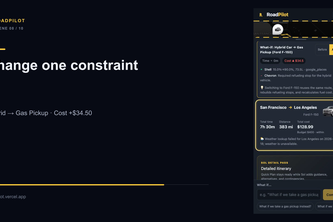
- Before/After What-if comparisons without restarting the conversation;
- A drive simulation following the actual plan polyline.
The system uses GPT-5.6 via Azure OpenAI for structured context extraction, candidate selection, and free-form What-if interpretation. Backend tools and deterministic code handle route geometry, energy, cost calculations, and constraint validation.
Evidence
- The description states this is a live product deployed on Vercel and Azure.
- It includes technical architecture details such as FastAPI backend, Cosmos DB for caching, Next.js frontend, and use of Playwright for automation.
- It mentions support for 7 vehicle profiles and 4 vehicle types.
Inference The system separates qualitative AI decisions from numerical integrity, using deterministic code to validate and assemble plans after GPT-5.6 selects candidates.
Positioning & Claim Evolution
The author positions RoadPilot as an “explainable AI co-driver” that turns real travel constraints into actionable road-trip plans. The tagline states: “An explainable AI co-driver that turns real travel constraints into a vehicle-aware road-trip plan you can actually drive.”
It claims to solve fragmentation in current travel planning workflows, where users manually combine data from multiple apps (maps, charging apps, weather, etc.) to make decisions.
Evidence
- The author states the product makes fragmented decision-making explainable and actionable in one place.
- It supports vehicle-specific constraints like battery level, fuel type, and refueling stops.
- It allows What-if comparisons between different vehicles or trip conditions.
Inference The positioning suggests a shift from generic route planning to constraint-aware, personalized trip planning — particularly for long-distance travel involving real-world vehicle limitations.
Target Customer & ICP
The description does not clearly define a target customer segment or ideal customer profile (ICP). It implies the tool is for travelers who plan road trips and want to consider vehicle-specific constraints like fuel or battery levels, but no explicit demographic, persona, or use case is described.
Evidence
- The author mentions planning for “real road trips” involving children, pets, weather, budget, and rest cadence.
- It supports multiple vehicle types (Car, Pickup, Camper, Motorcycle) and powertrains (Electric, Hybrid, Gas).
- The demo uses a Toyota RAV4 Hybrid and switches to a Ford F-150 Gas Pickup.
Inference The tool may appeal to frequent travelers or those planning long-distance trips with specific vehicle needs — but no explicit customer data or segmentation is provided.
Business Model & Pricing Evidence
There is no evidence of pricing, monetization strategy, or business model in the description. The author does not state whether RoadPilot charges users, offers freemium tiers, or intends to sell to businesses or individuals.
Evidence
- Anonymous plans use scoped 256-bit access grants and seven-day retention.
- No mention of paid features, subscriptions, or monetization.
Inference The product appears to be in a prototype or early-stage development phase, with no commercial model evident from the description.
Technical & Delivery Signals
RoadPilot is built using:
- Frontend: Next.js and TypeScript on Vercel
- Backend: FastAPI on Azure Container Apps
- Database: Cosmos DB for caching plans, artifacts, What-if changes, and details
- AI tools: GPT-5.6 via Azure OpenAI, Codex for development and verification
- Other tech: Playwright for automation, Python, Google Places API
The system separates AI decision-making from numerical integrity:
- GPT-5.6 selects candidates and interprets What-if scenarios
- Deterministic code handles route geometry, energy, cost, and validation
- Validators enforce constraints like coordinates, energy, budget, and rest cadence
Evidence
- The author describes backend architecture in detail.
- It uses Codex for development, debugging, and testing.
- The offline gate runs 111 backend tests plus frontend checks without external API keys.
Inference The architecture reflects a hybrid AI + deterministic system designed for trustworthiness and debuggability — not just performance or scalability.
Traction & Maturity Signals
There is no evidence of traction, revenue, customers, or adoption beyond the author’s own development and demo. The product is described as a live demo submitted to a hackathon, with no mention of user feedback, usage metrics, or market testing.
Evidence
- It was submitted to the OpenAI 2026 hackathon.
- The author mentions shipping a live product but does not describe any real-world use cases or users.
- No data on active users, retention, or monetization is provided.
Inference The project appears to be in an early stage of development — likely a prototype or proof-of-concept — with no evidence of market traction or commercial viability.
Competitive Context
The description does not provide any information about competitors or the competitive landscape. It does not mention existing tools for trip planning, vehicle-aware routing, or AI-powered travel assistants.
Evidence
- No competitor names, products, or market positioning are mentioned.
- The author does not compare RoadPilot to other platforms or services in the space.
Inference The competitive context is unknown — it’s unclear whether similar tools exist or how RoadPilot would differentiate itself in a crowded market.
Open Questions & Risks
- No commercial traction or evidence of adoption: The product appears to be a hackathon submission with no real-world usage.
- Unverified claims about AI integration: While it uses GPT-5.6, the description does not validate how well it performs in practice or whether its outputs are reliable.
- Limited scalability assumptions: The architecture is described as deterministic and explainable but lacks evidence of performance under load or large-scale usage.
- No monetization strategy: No indication of how the product will generate revenue or sustain itself.
- Single-person team: The project is built by one person (Paul Choi), which may limit development speed, testing, or long-term maintenance.
Evidence
- No mention of users, customers, or revenue.
- No evidence of performance, scalability, or monetization strategy.
- Only one developer is listed as part of the team.
Questions the description leaves open
- What real-world constraints are you planning to support beyond the 7 vehicle profiles described?
- How do you plan to scale this system beyond a single-person demo?
- Have you tested the AI’s ability to interpret complex or ambiguous user inputs in real-time?
- What is your roadmap for monetization and customer acquisition?
- Are there any known limitations of GPT-5.6 in handling edge cases or unexpected inputs?
- How do you plan to handle data privacy, especially with anonymous access tokens and plan retention?
Overall Assessment
Not evidenced.
There is no evidence of revenue, customers, traction, or a clear path to monetization. The product appears to be an early-stage prototype submitted for a hackathon, with no indication of commercial viability or market readiness.
The author describes a technically sound architecture that separates AI decision-making from deterministic validation — which may be valuable in trust-sensitive domains like travel planning. However, without evidence of real-world usage or a clear business model, it is not possible to assess whether this project has investment or partnership potential.
Confidence Low
Reasoning
The description is self-reported and unverified, with no data on users, revenue, or adoption. It lacks any commercial due-diligence signals beyond the author’s own claims.
User Stories BotA demo video on every pull request
Get a demo video on every new feature
GitHub App that watches your pull requests and records a narrated, captioned demo.
Save time on demo prep and make informed decisions faster with a video walkthrough of every new feature.
Source
Submitted to the OpenAI 2026 hackathon on Devpost. Project home on Devpost. Back to the full gallery on Devpost.
This competitive analysis was produced by top-founders.com (opens in a new tab)
Generated by a language model from this project's public Devpost page — its tagline, the author's own write-up and any built-with tags listed there — as captured in August 2026. Short quotations are the author's words. It is an opinion on the idea as a business, not on the people behind it, and it reflects the description as published then. If the project has moved on, request a correction below. The analysis is not independent research and contains no verified traction, revenue or customer data.
An independent guide by KFG International LLC — not affiliated with, endorsed by, or connected to Devpost or OpenAI.