

Archive position — measured, not model output
0 likes on Devpost
2,263 of the 7,850 archived projects have more likes, and 5,587 share exactly 0 — so this project's #6,412 place in the like-ranked listing is a tie-break inside that group, not a ranking.
Projects (log scale)
Likes on Devpost. ▲ marks this project's group.
Show the figures
| Likes | Projects | Share of archive |
|---|---|---|
| 0 | 5,587 | 71.2% |
| 1 | 1,758 | 22.4% |
| 2 | 284 | 3.6% |
| 3–4 | 132 | 1.7% |
| 5–9 | 75 | 1.0% |
| 10+ | 14 | 0.2% |
 User Stories BotA demo video on every pull request
Get a demo video on every new feature
GitHub App that watches your pull requests and records a narrated, captioned demo.
Save time on demo prep and make informed decisions faster with a video walkthrough of every new feature.
Executive Summary
What the company appears to be
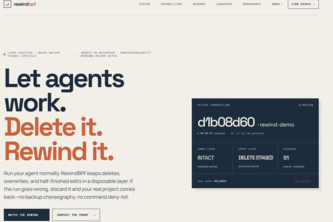
RewindBPF is a self-reported local runtime supervisor for AI agents that isolates filesystem writes and blocks sensitive reads using Linux eBPF, OverlayFS, Landlock, and other kernel-level technologies. It enables reversible execution of agent commands within a protected workspace, allowing operators to inspect changes, deny reads, roll back or commit results.
What changed
The project was submitted as part of the OpenAI 2026 hackathon. The author describes RewindBPF as a CLI tool with a Control Plane UI, built using Go, eBPF, and GPT-5.6 for development assistance. It supports Linux (with VM path), macOS, and Windows platforms, though only Linux is described as the reference enforcement path.
Single most important open question
Is there any evidence of real-world usage or adoption beyond the author's own testing and demo setup?
Note: This analysis is based entirely on the self-reported description provided by the author. No external verification, revenue data, customer names, traction metrics, or third-party sources are available.
What The Product Actually Is
- The description states that RewindBPF is a "reversible safety runtime for AI agents".
- It provides a "disposable filesystem transaction" where:
- Original workspace becomes an immutable lower layer.
- Agent works in a merged view, with writes/deletes stored in a temporary copy-on-write layer.
- Nothing reaches the real workspace unless explicitly accepted by the operator.
- The system includes:
- A CLI,
- A local supervisor,
- A Control Plane UI.
- It is not an MCP server or required agent SDK plugin — the agent command remains unchanged; RewindBPF supplies only the safety boundary.
- Enforcement uses:
- Linux-first (eBPF telemetry, OverlayFS/FUSE, Landlock, cgroup-v2),
- macOS (APFS clone-backed staging, Seatbelt read policy),
- Windows (fail-closed platform contract).
- The author claims it protects filesystem content inside the protected workspace but does not undo external side effects like database writes or API calls.
Inference: RewindBPF appears to be a local development tool for AI agent safety, designed to prevent accidental or malicious destructive actions during execution in a controlled environment.
Positioning & Claim Evolution
- The tagline states: “A reversible safety runtime for AI agents: isolate writes, block sensitive reads, inspect the diff, then roll back or commit with evidence.”
- The description positions RewindBPF as a safety boundary around AI agent commands.
- It emphasizes:
- Isolation of filesystem changes,
- Blocking of sensitive file access,
- Inspection of diffs and event timelines,
- Rollback or commit capabilities with evidence.
- The author claims it was built using Codex and GPT-5.6, suggesting a strong AI-assisted development process.
- No mention of enterprise features, scalability beyond local use, or integration into existing workflows.
Claim: RewindBPF is positioned as a tool to make AI agents safer in local environments by providing a reversible execution context.
Target Customer & ICP
- The description does not name specific customers or personas.
- Based on the technical setup and use case:
- Developers working with AI agents locally,
- Researchers testing agent behavior in sandboxed environments,
- Teams evaluating AI agent safety before deployment.
- The tool is described as a local CLI + UI supervisor, suggesting it targets individual developers or small teams rather than large enterprises.
- It is not described as being used in production, cloud, or enterprise settings.
Inference: The target customer likely includes developers and researchers who want to test AI agents safely in local environments. No evidence of a defined ICP beyond this.
Business Model & Pricing Evidence
- Not evidenced.
- The description does not mention pricing, licensing, monetization strategy, or any business model.
- It is described as a hackathon project, with source code and demo instructions publicly available.
- No indication of commercial intent or revenue-generating features.
Finding: No evidence of a business model or pricing structure.
Technical & Delivery Signals
- Built with:
- Go,
- eBPF,
- Landlock,
- OverlayFS/FUSE,
- cgroup-v2,
- APFS (macOS),
- Seatbelt (macOS),
- GPT-5.6 and Codex for development.
- Supports Linux (VM path), macOS, and Windows with separate native paths.
- Uses:
- Copy-on-write layers,
- Policy enforcement for reads,
- Event timeline inspection,
- Diff reporting,
- Rollback/commit actions.
- The reference path is Linux-first and runs in a disposable Ubuntu VM.
- Not described as an SDK, plugin, or server — it's a local supervisor.
Inference: RewindBPF is technically complex for a hackathon project, involving kernel-level technologies. It is not a commercial product but a proof-of-concept tool.
Traction & Maturity Signals
- Not evidenced.
- No mention of:
- Customers,
- Users,
- Adoption,
- Revenue,
- Product usage metrics,
- Community engagement,
- Public testing or feedback.
- The project is described as a hackathon submission.
- The demo uses synthetic data and disposable storage.
Finding: No evidence of traction, adoption, or maturity beyond the author’s own development and demo efforts.
Competitive Context
- Not evidenced.
- No mention of competitors, market analysis, or positioning relative to similar tools.
- The author does not reference other safety tools for AI agents or sandboxing systems.
- The use of eBPF, OverlayFS, Landlock, etc., suggests alignment with kernel-level sandboxing and security tools, but no comparison is made.
Finding: No evidence of competitive landscape or positioning in the market.
Open Questions & Risks
- The project is described as a hackathon submission, not a commercial product.
- It is built for local use only — no mention of cloud, enterprise, or multi-user support.
- The author states that GPT-5.6 was used for development but is not a runtime dependency — this may imply limited AI integration in actual operation.
- No evidence of:
- Security audits,
- Performance testing at scale,
- Production readiness,
- Long-term maintenance plans.
- The tool does not protect against all side effects (e.g., network calls, DB writes), which could be a limitation for real-world use.
Inference: Risk of limited commercial viability due to narrow scope and hackathon origins. Lack of production-grade features or security validation is a concern.
Questions the description leaves open
- What is the intended evolution path from this hackathon prototype to a product?
- Are there any plans for cloud or enterprise deployment, or is it strictly local?
- Has the tool been tested in real-world AI agent workflows beyond the demo?
- How does RewindBPF handle edge cases like nested filesystem operations or cross-platform compatibility?
- What are the performance implications of using eBPF and OverlayFS in a typical agent workflow?
- Is there any plan to open-source or monetize this tool, and how would that work?
- What is the long-term vision for integrating with AI agent frameworks like LangChain, AutoGen, or LlamaIndex?
Overall Assessment
- Not evidenced.
- No indication of funding rounds, valuation, or investment interest.
- The project appears to be a proof-of-concept built during a hackathon.
- It is not described as a commercial product or venture with growth potential.
Inference: Based on the self-reported description, RewindBPF is not currently positioned for investment or partnership. It may be an early-stage idea or prototype that requires further development to become viable.
User Stories BotA demo video on every pull request
Get a demo video on every new feature
GitHub App that watches your pull requests and records a narrated, captioned demo.
Save time on demo prep and make informed decisions faster with a video walkthrough of every new feature.
Source
Submitted to the OpenAI 2026 hackathon on Devpost. Project home on Devpost. Back to the full gallery on Devpost.
This competitive analysis was produced by top-founders.com (opens in a new tab)
Generated by a language model from this project's public Devpost page — its tagline, the author's own write-up and any built-with tags listed there — as captured in August 2026. Short quotations are the author's words. It is an opinion on the idea as a business, not on the people behind it, and it reflects the description as published then. If the project has moved on, request a correction below. The analysis is not independent research and contains no verified traction, revenue or customer data.
An independent guide by KFG International LLC — not affiliated with, endorsed by, or connected to Devpost or OpenAI.