

Archive position — measured, not model output
0 likes on Devpost
2,263 of the 7,850 archived projects have more likes, and 5,587 share exactly 0 — so this project's #6,414 place in the like-ranked listing is a tie-break inside that group, not a ranking.
Projects (log scale)
Likes on Devpost. ▲ marks this project's group.
Show the figures
| Likes | Projects | Share of archive |
|---|---|---|
| 0 | 5,587 | 71.2% |
| 1 | 1,758 | 22.4% |
| 2 | 284 | 3.6% |
| 3–4 | 132 | 1.7% |
| 5–9 | 75 | 1.0% |
| 10+ | 14 | 0.2% |
 User Stories BotA demo video on every pull request
Get a demo video on every new feature
GitHub App that watches your pull requests and records a narrated, captioned demo.
Save time on demo prep and make informed decisions faster with a video walkthrough of every new feature.
Executive Summary
What the company appears to be
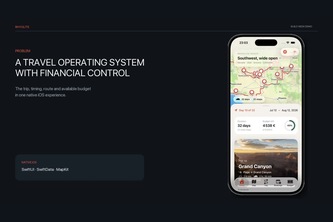
Rhyolite is a self-reported native iOS travel operating system built by one developer (Baptiste Mellinger). The app combines itinerary planning, booking management and financial steering into a single interface. It is positioned as a tool for travelers who want to maintain control over their trip budgets in real time.
What changed
The project was submitted as part of the OpenAI 2026 hackathon. No prior version or commercial launch is evidenced.
Single most important open question
Is there any evidence that Rhyolite has been used by users beyond its creator, or that it has achieved product-market fit?
What The Product Actually Is
The description states that Rhyolite is a native iOS travel operating system built using Swift, SwiftUI, SwiftData, MapKit and Xcode. It includes features such as:
- A financial cockpit that reconciles:
- Planned budget
- Committed costs
- Actual expenses
- Elapsed travel days
- Remaining travel days
- Revised daily spending capacity
- Separation of major trip costs (e.g., accommodation, flights) from daily operating categories (e.g., food, fuel).
- Integration of:
- Trip overview and route
- Day-by-day itinerary
- Destinations and maps
- Bookings and key travel information
- Category-level forecasts
The app is described as being built with AI assistance from GPT-5.6 and Codex, which supported product definition, implementation and testing.
Evidence
- The author states that Rhyolite is a native iOS application.
- It uses Swift, SwiftUI, SwiftData, MapKit and Xcode.
- It integrates financial reconciliation logic into a travel planning interface.
- GPT-5.6 and Codex were used in development.
Inference The app appears to be a prototype or proof-of-concept rather than a production-ready product.
Positioning & Claim Evolution
The author claims that Rhyolite addresses a "harder problem" than most travel apps — financial control during travel, not just destination selection. It positions itself as an alternative to scattered booking tools and spreadsheets by offering:
- Real-time budget tracking
- Financial steering (i.e., adjusting daily spending targets based on remaining time and money)
- A unified view of itinerary, bookings, and finances
The tagline reinforces this:
“Rhyolite is a native iOS travel operating system combining itinerary, bookings and controller-grade financial steering—so you always know whether the trip is still financially on track.”
Evidence
- The author states that most travel apps help users decide where to go.
- Rhyolite focuses on staying financially in control before and during the trip.
- It separates planned budget from actual expenses and calculates revised daily spending capacity.
Inference This is a positioning statement, not evidence of traction or adoption. The claim implies a niche market for travelers who prioritize financial discipline over convenience or discovery.
Target Customer & ICP
The description suggests that Rhyolite targets travelers who want to maintain strict control over their trip budgets — particularly those with complex itineraries involving multiple bookings and expenses across different categories.
It also implies a user base interested in controller-grade financial steering, which may appeal to finance professionals or individuals with strong financial discipline.
However, no explicit customer segments or personas are defined. The only reference is to the developer’s own background in finance and controlling.
Evidence
- The author mentions personal experience with travel planning needs.
- Background in finance and controlling informs the design.
- No named customers, user types or demographics provided.
Inference The target customer likely includes budget-conscious travelers, possibly including business travelers or those on tight financial constraints. But this is inferred from the developer’s perspective, not actual market data.
Business Model & Pricing Evidence
There is no evidence of a business model or pricing structure in the description. The author does not mention monetization strategies, subscriptions, freemium tiers, or any form of revenue generation.
Evidence
- No mention of pricing.
- No indication of how the product would be sold or distributed.
- No reference to partnerships, advertising, or other revenue streams.
Inference If Rhyolite is intended for commercial use, it has not yet been defined. As a hackathon submission, it may currently be non-commercial.
Technical & Delivery Signals
The project was built using:
- Swift, SwiftUI, SwiftData, MapKit
- Development environment: Xcode
- AI tools: GPT-5.6 (product and financial sparring partner) and Codex (implementation workflow)
The author describes an iterative development process involving:
- Defining expected behavior
- Challenging assumptions with GPT-5.6
- Implementing features in Xcode
- Testing and refining results
Evidence
- The app is built natively on iOS.
- AI tools were used to structure requirements, refine UX, and support implementation.
- The development process was iterative and focused on financial logic.
Inference The technical stack is standard for native iOS apps. The use of AI in product design suggests a modern, experimental approach but does not indicate scalability or robustness beyond the prototype stage.
Traction & Maturity Signals
There is no evidence of traction, adoption, or user feedback. The project was submitted to a hackathon and has no documented usage history.
Evidence
- No mention of users, customers, or downloads.
- No data on engagement, retention, or feature adoption.
- No revenue, ARR, or funding rounds mentioned.
Inference This is likely a prototype or proof-of-concept. There is no indication that it has moved beyond the idea or early development phase.
Competitive Context
The author states that most travel apps help users decide where to go, while Rhyolite focuses on financial control during the trip. This suggests a differentiation from mainstream travel platforms like Expedia, Booking.com, or Google Trips.
However, no direct competitors are named or analyzed in the description.
Evidence
- The app is positioned as solving a different problem than typical travel apps.
- No competitive analysis provided.
Inference Rhyolite may compete with budgeting tools (e.g., Mint, YNAB) or niche travel planners that offer limited financial tracking. But no actual market positioning or competitive landscape is described.
Open Questions & Risks
Several risks and open questions are evident from the self-reported description:
- Single-person team: The entire project was built by one developer (Baptiste Mellinger). This raises questions about scalability, long-term maintenance, and product depth.
- Prototype nature: Submitted to a hackathon; no evidence of commercial viability or user testing.
- AI dependency: Heavy reliance on GPT-5.6 and Codex for development may indicate lack of in-house technical capability or risk of obsolescence if AI tools change.
- No monetization strategy: No indication of how the product will generate revenue.
- Limited scope: The app focuses on iOS only, with no mention of cross-platform support or localization.
Evidence
- Only one team member is listed.
- Submitted to a hackathon.
- No commercial or user data provided.
- No pricing or monetization model described.
Inference The project lacks the infrastructure and traction needed for a scalable business. It may be a personal experiment rather than a viable product.
Questions the description leaves open
- What specific financial challenges did you encounter while building this app, and how were they resolved?
- Have you tested Rhyolite with real users? If so, what feedback did you receive?
- How do you plan to monetize the product if it moves beyond a prototype?
- Are there any plans for expanding beyond iOS or adding localization features?
- What are your thoughts on integrating receipt scanning and booking management into the app?
- How does Rhyolite handle edge cases such as currency fluctuations, cancellations, or unexpected expenses?
- Is there a roadmap for future development beyond the current features?
Overall Assessment
At this stage, there is no evidence of commercial traction, revenue, or user adoption. The project appears to be a hackathon submission by one developer, with no indication of market readiness or scalability.
The product concept is novel and addresses an unmet need in travel budgeting, but without data on usage, feedback, or monetization, it cannot be evaluated as a viable investment or partnership opportunity.
Confidence level Low
Next steps
If further information becomes available (e.g., early users, revenue model, team expansion), reassessment would be warranted.
User Stories BotA demo video on every pull request
Get a demo video on every new feature
GitHub App that watches your pull requests and records a narrated, captioned demo.
Save time on demo prep and make informed decisions faster with a video walkthrough of every new feature.
Source
Submitted to the OpenAI 2026 hackathon on Devpost. Project home on Devpost. Back to the full gallery on Devpost.
This competitive analysis was produced by top-founders.com (opens in a new tab)
Generated by a language model from this project's public Devpost page — its tagline, the author's own write-up and any built-with tags listed there — as captured in August 2026. Short quotations are the author's words. It is an opinion on the idea as a business, not on the people behind it, and it reflects the description as published then. If the project has moved on, request a correction below. The analysis is not independent research and contains no verified traction, revenue or customer data.
An independent guide by KFG International LLC — not affiliated with, endorsed by, or connected to Devpost or OpenAI.