

Archive position — measured, not model output
1 like on Devpost
505 of the 7,850 archived projects have more likes, and 1,758 share exactly 1 — so this project's #2,135 place in the like-ranked listing is a tie-break inside that group, not a ranking.
Projects (log scale)
Likes on Devpost. ▲ marks this project's group.
Show the figures
| Likes | Projects | Share of archive |
|---|---|---|
| 0 | 5,587 | 71.2% |
| 1 | 1,758 | 22.4% |
| 2 | 284 | 3.6% |
| 3–4 | 132 | 1.7% |
| 5–9 | 75 | 1.0% |
| 10+ | 14 | 0.2% |
 User Stories BotA demo video on every pull request
Get a demo video on every new feature
GitHub App that watches your pull requests and records a narrated, captioned demo.
Save time on demo prep and make informed decisions faster with a video walkthrough of every new feature.
Executive Summary
What the company appears to be
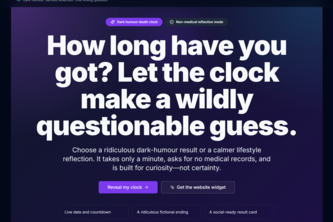
Ultimate Death Clock is a self-reported fictional entertainment product that uses AI to generate personalized, narratively consistent, and visually reconstructed death predictions. It offers two modes: an entertaining, absurdly humorous experience and a more reflective, non-medical lifestyle input-based mode. The author states it is built with Next.js, TypeScript, OpenAI GPT-5.6, and other tools, and is deployed live.
What changed
The product is presented as a completed, functional prototype submitted to the OpenAI 2026 hackathon. It includes a structured narrative engine, media generation pipeline, and entitlement system for sharing or unlocking full dossiers.
Single most important open question
Is there any evidence of user engagement, monetization, or traction beyond the author’s own deployment and testing?
What The Product Actually Is
The description states that Ultimate Death Clock is a fictional mortality experience that turns personal quirks into a countdown, a unique incident dossier, and a narrated six-scene reconstruction. It offers two modes:
- Entertainment mode: Generates a fictional predicted date, canonical age, live countdown, public result page, and absurd personalized ending.
- Reflection mode: Provides a calmer, non-medical look at lifestyle inputs like sleep, stress, movement, smoking, and social connection.
The product includes:
- A seven-chapter story;
- A fictional Ultimate Death Certificate;
- A breaking-news report;
- Witness statements;
- Predicted final words;
- An avoidability rating;
- Alternate timeline ("The Moment You Could Have Survived");
- A narrated six-scene visual reconstruction based on the same incident facts.
Key technical components:
- GPT-5.6 for structured narrative generation;
- Image generation via OpenAI;
- Text-to-speech via OpenAI;
- MediaRecorder and Canvas for video composition;
- Stripe for payment pathways;
- PostgreSQL with Prisma for data storage;
- Next.js 14, React, Tailwind CSS, TypeScript.
Inference: The product is a generative AI-driven experience built around the concept of fictional death prediction. It uses structured outputs to enforce narrative consistency and includes media generation as part of its core experience.
Positioning & Claim Evolution
The author states that Ultimate Death Clock began with the question: “what if confronting mortality could be made darkly entertaining, highly shareable, and unexpectedly reflective?”
It is explicitly framed as fictional entertainment or non-medical reflection, not a diagnosis or real prediction.
Key claims:
- It is a complete consumer experience around the moment after a death estimate.
- The result feels personalized rather than templated.
- All outputs (story, certificate, news report, etc.) are derived from a canonical incident manifest.
- The experience is designed to be shareable and emotionally resonant.
Inference: The positioning is that of a darkly humorous, narrative-driven, generative AI product with a strong emphasis on consistency, personalization, and emotional reward. It is not positioned as a medical or therapeutic tool.
Target Customer & ICP
The description does not state the target customer or ideal customer profile (ICP).
Inference: Based on the tone and structure, it appears aimed at users who are interested in darkly humorous, generative AI experiences, possibly with an interest in storytelling, self-reflection, or meme culture. It may appeal to users of AI tools or hackathon participants.
Not evidenced: No data on demographics, user segments, or customer personas.
Business Model & Pricing Evidence
The description states that the product includes:
- One-time dossier entitlement via Stripe;
- Public result pages with share-based unlocking;
- Judge-preview access using a protected query key and scoped media token.
It also mentions:
- Premium media is protected behind entitlement or short-lived judge-preview access;
- The system supports downloadable certificate and reconstruction assets.
Inference: There appears to be a freemium model, where basic results are public, but full dossiers (with media) require payment. The use of Stripe suggests monetization via one-time purchases.
Not evidenced: No pricing tiers, revenue streams, or monetization data beyond the mention of Stripe and entitlements.
Technical & Delivery Signals
The author states:
- The application is built with Next.js 14, React, TypeScript, Tailwind CSS, Prisma, PostgreSQL.
- GPT-5.6 is used for structured incident generation.
- Media assets are generated server-side and cached.
- The system uses Codex to accelerate development and debugging in a live environment.
- It includes a canonical IncidentManifest architecture with validation, retries, and originality checks.
Inference: The technical stack suggests a modern, scalable, and generative AI-driven web application, with strong emphasis on structured data, media generation, and secure access control.
Not evidenced: No information about scalability, infrastructure, or performance metrics.
Traction & Maturity Signals
The author states:
- The project is deployed and working at a live URL.
- Five fresh, structurally distinct entertainment results have been generated.
- Six generated portrait scenes and six narration beats per completed reconstruction.
- Cached media reuse, protected-media access checks, public-result locking, judge-preview unlocking, and judge-key removal from share links are implemented.
- Production verification includes build, restart, and HTTP checks.
Inference: The product is functionally complete, with a working prototype that has been tested in production. It includes features like media caching, entitlement control, and secure access.
Not evidenced: No user engagement data, customer feedback, or revenue information.
Competitive Context
The description does not mention any competitors or market context.
Inference: The product appears to be unique in its specific niche, combining AI-generated narrative with visual storytelling and media generation. It may compete with other generative AI experiences or meme-based tools, but no direct comparison is made.
Not evidenced: No competitive analysis, market size, or positioning against existing players.
Open Questions & Risks
- Fictional nature: The product is explicitly non-medical and fictional. This may limit its appeal to users seeking real insights.
- Monetization risk: The freemium model with paid unlocks may not scale without significant user engagement or viral sharing.
- AI dependency: Heavy reliance on GPT-5.6 and OpenAI tools may pose risks if those services change or become unavailable.
- Content safety: While the product is framed as non-graphic, it deals with death and may be sensitive to cultural or emotional contexts.
Inference: The product is technically sophisticated, but its commercial viability depends on user engagement and viral sharing. It lacks evidence of traction or monetization.
Questions the description leaves open
- What is the actual user engagement like? Are there any metrics on how many people use it, how often, or how much they share?
- How does the product plan to scale beyond a single developer’s prototype?
- Is there a long-term vision for monetization beyond one-time purchases?
- How are you handling potential misuse or emotional harm from users?
- What is the plan for content originality and avoiding repetitive outputs at scale?
- Are there any plans to expand into other narrative domains or formats?
Overall Assessment
Self-reported, unverified basis: The description states that this is a prototype submitted to a hackathon and is not independently verified.
Not evidenced: No revenue, customer data, traction, or monetization metrics are provided. The product is described as functional but without any evidence of adoption or commercial success.
Inference: This is a technically impressive prototype with strong execution, but it lacks commercial due-diligence signals such as user engagement, monetization, or market traction. It may be a compelling demo or proof-of-concept, but its readiness for investment or partnership is unclear without further evidence of product-market fit or scalability.
Confidence: Low — based on the thinness of the evidence provided and the lack of any commercial data.
User Stories BotA demo video on every pull request
Get a demo video on every new feature
GitHub App that watches your pull requests and records a narrated, captioned demo.
Save time on demo prep and make informed decisions faster with a video walkthrough of every new feature.
Source
Submitted to the OpenAI 2026 hackathon on Devpost. Project home on Devpost. Back to the full gallery on Devpost.
This competitive analysis was produced by top-founders.com (opens in a new tab)
Generated by a language model from this project's public Devpost page — its tagline, the author's own write-up and any built-with tags listed there — as captured in August 2026. Short quotations are the author's words. It is an opinion on the idea as a business, not on the people behind it, and it reflects the description as published then. If the project has moved on, request a correction below. The analysis is not independent research and contains no verified traction, revenue or customer data.
An independent guide by KFG International LLC — not affiliated with, endorsed by, or connected to Devpost or OpenAI.