

Archive position — measured, not model output
0 likes on Devpost
2,263 of the 7,850 archived projects have more likes, and 5,587 share exactly 0 — so this project's #4,098 place in the like-ranked listing is a tie-break inside that group, not a ranking.
Projects (log scale)
Likes on Devpost. ▲ marks this project's group.
Show the figures
| Likes | Projects | Share of archive |
|---|---|---|
| 0 | 5,587 | 71.2% |
| 1 | 1,758 | 22.4% |
| 2 | 284 | 3.6% |
| 3–4 | 132 | 1.7% |
| 5–9 | 75 | 1.0% |
| 10+ | 14 | 0.2% |
 User Stories BotA demo video on every pull request
Get a demo video on every new feature
GitHub App that watches your pull requests and records a narrated, captioned demo.
Save time on demo prep and make informed decisions faster with a video walkthrough of every new feature.
Executive Summary
What the company appears to be: FinChief is a personal financial decision-support app for one-off purchases, built as an educational prototype. The description states it helps users pause before spending by showing trade-offs clearly, without affecting credit or pretending to replace a financial adviser.
What changed: The project was submitted as part of the OpenAI 2026 hackathon. It is described as a self-contained prototype with no revenue, customers or traction beyond demonstration data.
Single most important open question: Is there any evidence of product-market fit or user adoption beyond the prototype stage?
The description states FinChief is an educational prototype using fictional data and does not provide regulated financial advice. There is no evidence of commercial traction, revenue, customer base or monetization strategy.
What The Product Actually Is
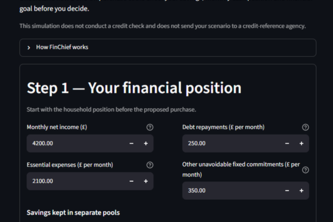
The description states FinChief is a personal financial decision-support app for one-off purchases. It allows users to enter:
- A fictional household position (income, unavoidable commitments, general savings, emergency fund, goal savings)
- A proposed purchase
- One funding source selection
It calculates:
- Whether the purchase is fully funded
- How much of the selected savings pool it consumes
- What remains afterwards
- Whether emergency resilience changes
- How monthly cash position is affected
- Whether a financial goal is delayed
- A 12-month liquid-savings projection
- Several transparent alternatives (reducing amount, waiting, different funding source)
The description states FinChief deliberately separates general savings, emergency savings and goal savings. It also separates baseline financial position from incremental effect of the proposed purchase.
Positioning & Claim Evolution
The description states FinChief's positioning is:
- "See what happens before you spend"
- Helps people pause before a purchase
- Explains where money has already gone (contrast with existing apps)
- Does not affect credit score
- Does not pretend to replace a financial adviser
- Educational prototype using fictional data
The author claims the app helps users understand trade-offs clearly, without regulated financial advice. The positioning appears to be a decision-support tool rather than a full financial management platform.
Target Customer & ICP
The description states FinChief is for individuals making one-off purchases who want to understand the implications before spending. It targets people who:
- Want to pause before spending
- Are interested in understanding trade-offs clearly
- Do not want to be affected by credit checks or bank connections
- Are looking for educational support rather than regulated financial advice
The description does not identify specific customer segments beyond "individuals" or "users." No evidence of market segmentation, persona development or target audience definition.
Business Model & Pricing Evidence
The description states FinChief is an educational prototype. It explicitly states:
- Uses fictional demonstration data
- Does not provide regulated financial, mortgage, tax or investment advice
- No credit check and no bank connection
- No revenue, customer or traction data available
There is no evidence of pricing structure, monetization strategy or business model beyond the prototype nature.
Technical & Delivery Signals
The description states FinChief was built with:
- Built with: altair, gpt-5.6, openai-codex, pytest, python, streamlit
- Financial engine uses Python Decimal arithmetic
- Deterministic and deterministic alternatives module
- 62 automated tests
- Responsive, mobile-first Streamlit interface
- Safeguarded optional GPT-5.6 explanation layer that validates responses
The description states the financial engine is deterministic and uses Python Decimal arithmetic. The GPT layer only selects from approved calculated facts and provides plain-language framing.
Traction & Maturity Signals
The description states FinChief is:
- An educational prototype
- Uses fictional demonstration data
- Submitted to OpenAI 2026 hackathon
- No revenue, customers or traction data available
- Team size: 1 person (Wessam Aly)
- No evidence of product-market fit or user adoption
There are no traction signals beyond the prototype submission.
Competitive Context
The description states FinChief is positioned as an alternative to existing personal-finance apps that explain where money has already gone. It does not mention specific competitors or market positioning against established players.
No evidence of competitive landscape analysis, market share or differentiation strategy.
Open Questions & Risks
- Educational prototype with fictional data and no commercial traction
- No revenue, customers or monetization strategy
- Single-person team (1 member)
- No evidence of product-market fit or user adoption
- Prototype nature suggests limited commercial viability
- No indication of scalability or growth potential beyond the hackathon submission
Questions the description leaves open
- What is the path from prototype to commercial product?
- How do you plan to monetize this tool?
- What specific market problems are you solving that existing solutions don't address?
- How will you validate user adoption beyond the prototype stage?
- What is your go-to-market strategy for reaching target users?
- How do you plan to scale from a single-person team?
- What are the key assumptions in your financial model that need testing?
Overall Assessment
The description states FinChief is an educational prototype submitted to a hackathon. There is no evidence of commercial traction, revenue, customers or monetization strategy.
The project appears to be a proof-of-concept with no demonstrated market demand or business model. The single-person team and prototype nature suggest significant risk for investment or partnership consideration.
Confidence level: Low. The entire analysis is based on self-reported information without any independent verification of commercial viability, traction or product-market fit.
User Stories BotA demo video on every pull request
Get a demo video on every new feature
GitHub App that watches your pull requests and records a narrated, captioned demo.
Save time on demo prep and make informed decisions faster with a video walkthrough of every new feature.
Source
Submitted to the OpenAI 2026 hackathon on Devpost. Project home on Devpost. Back to the full gallery on Devpost.
This competitive analysis was produced by top-founders.com (opens in a new tab)
Generated by a language model from this project's public Devpost page — its tagline, the author's own write-up and any built-with tags listed there — as captured in August 2026. Short quotations are the author's words. It is an opinion on the idea as a business, not on the people behind it, and it reflects the description as published then. If the project has moved on, request a correction below. The analysis is not independent research and contains no verified traction, revenue or customer data.
An independent guide by KFG International LLC — not affiliated with, endorsed by, or connected to Devpost or OpenAI.