

Archive position — measured, not model output
0 likes on Devpost
2,263 of the 7,850 archived projects have more likes, and 5,587 share exactly 0 — so this project's #6,061 place in the like-ranked listing is a tie-break inside that group, not a ranking.
Projects (log scale)
Likes on Devpost. ▲ marks this project's group.
Show the figures
| Likes | Projects | Share of archive |
|---|---|---|
| 0 | 5,587 | 71.2% |
| 1 | 1,758 | 22.4% |
| 2 | 284 | 3.6% |
| 3–4 | 132 | 1.7% |
| 5–9 | 75 | 1.0% |
| 10+ | 14 | 0.2% |
 User Stories BotA demo video on every pull request
Get a demo video on every new feature
GitHub App that watches your pull requests and records a narrated, captioned demo.
Save time on demo prep and make informed decisions faster with a video walkthrough of every new feature.
Executive Summary
What the company appears to be
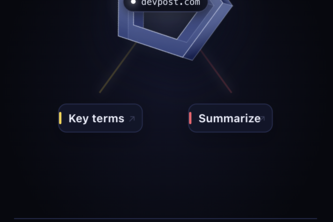
Prism is a self-reported Chrome extension built as a hackathon project (Devpost submission for OpenAI 2026). It claims to be a learning tool that reads web pages and presents them in five modes: Summarize, Quiz me, Key terms, Visualize, and Listen. The product is described as using AI (specifically Gemini) for content generation and enforces a "gated" quiz mode where answers are hidden until the user attempts to answer.
What changed
The project was submitted as a hackathon entry. No evidence of prior development or commercial activity exists beyond this description.
Single most important open question
Is there any evidence of traction, revenue, or customer adoption beyond the self-reported hackathon submission?
What The Product Actually Is
The description states that Prism is a Chrome extension built with Manifest V3. It includes a side panel that stays open and survives tab switches. The tool reads the current page and offers five modes of interaction:
- Summarize
- Quiz me (with answer gate)
- Key terms
- Visualize (concept map)
- Listen (text-to-speech)
It uses Gemini API for content generation, and integrates with technologies like React, Node.js, TypeScript, Vite, and SQLite. The quiz mode is described as enforcing a “gated” answer system via the backend.
Evidence
- Built as a Chrome extension using Manifest V3
- Uses Gemini API for AI generation
- Includes five learning modes (Summarize, Quiz me, Key terms, Visualize, Listen)
- Quiz mode enforces answer hiding until user attempts to answer
Inference The tool is designed to be used on live web pages and integrates with Chrome's APIs.
Positioning & Claim Evolution
The author states that Prism aims to fix the problem of forgetting what you read online, by turning the page you're already on into a learning tool. The tagline, “One concept. As many ways as it takes,” suggests a multi-modal approach to learning.
The positioning is described as:
- Not requiring users to open another app or upload PDFs
- Treating the current web page as material for learning
- Enforcing active recall through the quiz mode
Evidence
- Tagline: “One concept. As many ways as it takes.”
- Claim: “The web is built for reading fast, not for remembering.”
- Focus on active recall in quiz mode
Inference Prism positions itself as a tool for deep learning, not just skimming.
Target Customer & ICP
The description does not explicitly define the target customer or ideal customer profile (ICP). It implies that users are people who read web pages and want to learn from them, but no segmentation or persona is given.
Evidence
- No stated user personas
- No indication of industry, role, or use case beyond general readers
Inference The product likely targets students, researchers, or professionals who read online content and want to retain it.
Business Model & Pricing Evidence
There is no evidence in the description of a business model or pricing structure. The project is described as a hackathon submission with no mention of monetization, subscriptions, or sales.
Evidence
- No mention of revenue, pricing, or monetization
- No indication of paid features or tiers
Inference The product is likely free-to-use, but this cannot be confirmed without further evidence.
Technical & Delivery Signals
The project is built as a Manifest V3 Chrome extension with:
- Side panel functionality that persists across tabs
- Use of Gemini API for AI generation
- Integration of text-to-speech and concept mapping
- Backend enforcement of quiz answer gating
- Interface built using React, TypeScript, Node.js, and Vite
It was built end-to-end in a weekend, including:
- Capture through generation
- Speech output
- Gated backend
Evidence
- Built with Manifest V3 Chrome extension APIs
- Uses Gemini API, text-to-speech, concept maps
- Backend enforces quiz answer gate
- Interface uses React, TypeScript, Node.js, Vite
Inference The product is technically feasible and shows some engineering sophistication for a hackathon project.
Traction & Maturity Signals
There is no evidence of traction, revenue, or customer adoption beyond the self-reported hackathon submission. The team size is stated as 4, but no metrics on usage, downloads, or user feedback are provided.
Evidence
- No mention of downloads, users, or retention
- No revenue or monetization data
- No customer testimonials or case studies
Inference The project is in a pre-product-market fit stage and lacks any measurable traction.
Competitive Context
There is no evidence provided about the competitive landscape. The description does not mention competitors or how Prism differentiates from existing tools like Anki, Quizlet, or browser-based summarizers.
Evidence
- No mention of competitors
- No differentiation strategy described
Inference Prism may compete with AI-powered learning tools or browser extensions for content retention, but this is unconfirmed.
Open Questions & Risks
- No traction or revenue: The project is only a hackathon submission.
- Unverified claims: All features and functionality are self-reported.
- No monetization strategy: No indication of how the product will be monetized.
- Limited team size: Only 4 members, which may limit execution capacity.
- Unproven scalability: The tool is built for a single browser extension use case.
Evidence
- No revenue or user data
- No business model described
- No evidence of team experience beyond hackathon
Questions the description leaves open
- What is the actual user feedback from people who tried this tool?
- How does the quiz mode enforce answer gating in practice — is it a technical or behavioral solution?
- Are there any plans to monetize or scale this beyond the current prototype?
- What are the technical limitations of running this at scale, especially with AI APIs?
- Is there any plan for offline functionality or support for PDFs/videos beyond live web pages?
Overall Assessment
Not evidenced.
There is no evidence of revenue, traction, or customer adoption to assess investment or partnership viability. The project is described as a hackathon submission with no commercial activity beyond the author's own account.
Confidence Low. The description is self-reported and unverified, and lacks any data on product-market fit, monetization, or team execution history.
User Stories BotA demo video on every pull request
Get a demo video on every new feature
GitHub App that watches your pull requests and records a narrated, captioned demo.
Save time on demo prep and make informed decisions faster with a video walkthrough of every new feature.
Source
Submitted to the OpenAI 2026 hackathon on Devpost. Project home on Devpost. Back to the full gallery on Devpost.
This competitive analysis was produced by top-founders.com (opens in a new tab)
Generated by a language model from this project's public Devpost page — its tagline, the author's own write-up and any built-with tags listed there — as captured in August 2026. Short quotations are the author's words. It is an opinion on the idea as a business, not on the people behind it, and it reflects the description as published then. If the project has moved on, request a correction below. The analysis is not independent research and contains no verified traction, revenue or customer data.
An independent guide by KFG International LLC — not affiliated with, endorsed by, or connected to Devpost or OpenAI.