

Archive position — measured, not model output
3 likes on Devpost
128 of the 7,850 archived projects have more likes, and 93 share exactly 3 — so this project's #174 place in the like-ranked listing is a tie-break inside that group, not a ranking.
Projects (log scale)
Likes on Devpost. ▲ marks this project's group.
Show the figures
| Likes | Projects | Share of archive |
|---|---|---|
| 0 | 5,587 | 71.2% |
| 1 | 1,758 | 22.4% |
| 2 | 284 | 3.6% |
| 3–4 | 132 | 1.7% |
| 5–9 | 75 | 1.0% |
| 10+ | 14 | 0.2% |
 User Stories BotA demo video on every pull request
Get a demo video on every new feature
GitHub App that watches your pull requests and records a narrated, captioned demo.
Save time on demo prep and make informed decisions faster with a video walkthrough of every new feature.
Executive Summary
What the company appears to be
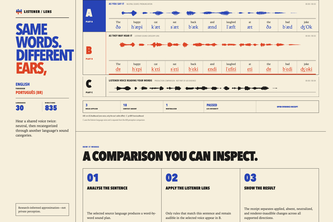
Listener / Lens is a self-reported educational tool designed to help language teachers and learners explore how speech sounds may be recategorized across languages. It provides three audio tracks — source pronunciation, listener approximation, and production comparison — with visual alignment of changed words and an evidence receipt explaining sound-category transformations. The system uses deterministic rules and GPT-5.6 Luna for classroom activity generation.
What changed
The project began as a personal exploration into how native speakers might hear speech differently depending on their linguistic background. It evolved into a prototype that supports 30 languages and 835 directed combinations, with an emphasis on transparent limitations and research-informed approximations rather than perfect replication.
Single most important open question
Is there a viable market or use case for this type of educational tool among language teachers or institutions? The description does not indicate any existing customers, revenue, or adoption beyond the hackathon submission.
What The Product Actually Is
The description states that Listener / Lens is a multilingual listening experience that allows users to compare how sentences are pronounced in their source language versus how they might sound to a listener from another language. It includes:
- Three audio tracks:
- A — Source pronunciation
- B — Listener approximation (based on supported sound-category effects)
- C — Production comparison (a voice reading the original sentence)
- Visual alignment of changed words.
- An evidence receipt showing which rules were applied or not.
- Sound Minus Meaning feature, which preserves syllable structure without semantic meaning.
- Integration with GPT-5.6 Luna for generating classroom activities.
It is built using:
- Cloudflare Workers
- Python services
- Azure Speech
- Codex + GPT-5.6 Luna
- Other technologies like Node.js, TypeScript, HTML, CSS
Inference The tool appears to be a prototype focused on educational use cases in multilingual listening and phonetic awareness.
Positioning & Claim Evolution
The author states that Listener / Lens started with the question: “Could teachers experience an evidence-informed approximation of that difference and better understand what a new language learner may be hearing?” This suggests a shift from curiosity to a potential pedagogical tool.
It positions itself as:
- A tool for exploring how speech sounds change across languages.
- An educational resource that emphasizes transparency about its approximations.
- Not a recreation of private perception but an evidence-informed rendering.
The claim evolution shows:
- From personal inspiration → prototype → classroom-ready tool (with caveats).
- Emphasis on deterministic transformation contracts and integrity checks over robotic outputs.
- A move toward teaching activity generation via GPT-5.6 Luna.
Inference The positioning is educational, research-oriented, and cautious in its claims — avoiding overstatement of accuracy or completeness.
Target Customer & ICP
The description states that Listener / Lens is intended for:
- Teachers
- Learners
- Classroom use (through optional tool)
It also mentions:
- Native-listener studies
- Language teachers as part of future testing
- Teacher-authored lesson templates and clearer practice activities
However, there is no evidence of:
- Specific customer segments beyond general educators or learners.
- Any identified personas or buyer profiles.
- Evidence of market demand or prior user feedback.
Inference The ICP likely includes language educators and institutions looking for tools to support phonetic learning, but the description lacks clarity on who exactly will use it or how.
Business Model & Pricing Evidence
There is no evidence in the description of:
- Revenue streams
- Pricing models
- Monetization strategy
- Customer acquisition plans
- Sales process or go-to-market approach
The project is described as a hackathon submission and prototype, not a commercial product.
Inference No business model or pricing data are evident. The tool appears to be non-commercial at this stage.
Technical & Delivery Signals
The system uses:
- Cloudflare Workers for API handling
- Python service for grapheme-to-phoneme conversion and rule application
- Azure Speech for audio rendering
- GPT-5.6 Luna via Azure AI Foundry for classroom activity generation
- Codex + GPT-5.6 for development support
Key technical features include:
- Deterministic transformation contracts
- Acoustic and integrity gates
- Aligned comparisons
- Cache validation
- Explicit failure states
- Sound Minus Meaning feature
- Visual alignment of changed words
Inference The architecture is built with attention to control, validation, and transparency — suggesting a deliberate approach to quality and reliability.
Traction & Maturity Signals
The description indicates:
- Prototype status (submitted to OpenAI 2026 hackathon)
- Support for 30 languages and 835 directed combinations
- Automated validation across layers
- Classroom activity generator using GPT-5.6 Luna
- Plans for native-listener studies, expanded renderer coverage, and classroom testing
However, there is no evidence of:
- Customers or users
- Revenue or monetization
- Product adoption metrics
- Market traction or growth indicators
Inference The product is at a very early stage — a prototype with limited real-world usage or validation.
Competitive Context
The description does not mention any competitors, nor does it provide context about:
- Existing tools for language learning or phonetic training
- Similar approaches in the market
- Market size or competitive dynamics
Inference No competitive landscape is described. The tool may be unique or niche, but this cannot be confirmed from the provided information.
Open Questions & Risks
Key risks and open questions include:
- No commercial traction or revenue: The project is a hackathon submission with no evidence of monetization.
- Unclear target market: No defined customer segments or use cases beyond general educators.
- Limited validation: Classroom testing is mentioned as future work, not done yet.
- Dependency on AI models: Heavy reliance on GPT-5.6 Luna and Azure AI Foundry raises questions about scalability and cost.
- Prototype-only status: No indication of product-market fit or long-term viability.
Inference The tool lacks commercial readiness and market validation — it is a proof-of-concept, not a product in the market.
Questions the description leaves open
- What specific educational outcomes are you trying to achieve with this tool?
- Have you conducted any classroom testing or pilot programs yet?
- How do you plan to validate the accuracy and usefulness of your sound-category transformations?
- Is there a clear path from prototype to product, and what resources would be needed?
- What is your go-to-market strategy for reaching language teachers or institutions?
- Are you planning to monetize this tool, and if so, how?
- How do you intend to scale beyond the current 30 languages and 835 combinations?
Overall Assessment
The description indicates that Listener / Lens is a hackathon prototype with no evidence of:
- Revenue
- Customers
- Market traction
- Commercial viability
It is described as a research-informed approximation tool for educational use, built with deterministic controls and transparency in mind.
Assessment Not commercially viable or ready for investment or partnership at this time. The project shows promise in concept but lacks the evidence of traction, market demand, or business model to justify further due diligence or commitment.
User Stories BotA demo video on every pull request
Get a demo video on every new feature
GitHub App that watches your pull requests and records a narrated, captioned demo.
Save time on demo prep and make informed decisions faster with a video walkthrough of every new feature.
Source
Submitted to the OpenAI 2026 hackathon on Devpost. Project home on Devpost. Back to the full gallery on Devpost.
This competitive analysis was produced by top-founders.com (opens in a new tab)
Generated by a language model from this project's public Devpost page — its tagline, the author's own write-up and any built-with tags listed there — as captured in August 2026. Short quotations are the author's words. It is an opinion on the idea as a business, not on the people behind it, and it reflects the description as published then. If the project has moved on, request a correction below. The analysis is not independent research and contains no verified traction, revenue or customer data.
An independent guide by KFG International LLC — not affiliated with, endorsed by, or connected to Devpost or OpenAI.