

Archive position — measured, not model output
0 likes on Devpost
2,263 of the 7,850 archived projects have more likes, and 5,587 share exactly 0 — so this project's #6,062 place in the like-ranked listing is a tie-break inside that group, not a ranking.
Projects (log scale)
Likes on Devpost. ▲ marks this project's group.
Show the figures
| Likes | Projects | Share of archive |
|---|---|---|
| 0 | 5,587 | 71.2% |
| 1 | 1,758 | 22.4% |
| 2 | 284 | 3.6% |
| 3–4 | 132 | 1.7% |
| 5–9 | 75 | 1.0% |
| 10+ | 14 | 0.2% |
 User Stories BotA demo video on every pull request
Get a demo video on every new feature
GitHub App that watches your pull requests and records a narrated, captioned demo.
Save time on demo prep and make informed decisions faster with a video walkthrough of every new feature.
Executive Summary
What the company appears to be
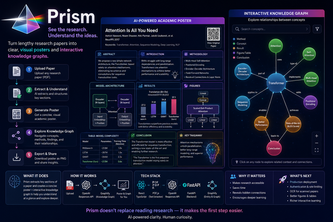
Prism is an open-source tool that converts research papers into interactive visual learning experiences. The description states it transforms academic posters into concise, interactive formats using AI and graph visualization.
What changed
This project was submitted as a hackathon entry for the OpenAI 2026 hackathon. It represents a proof-of-concept tool built by one developer (Qamar Dev) with no evidence of prior traction or commercial deployment.
Single most important open question
Is there evidence that Prism has moved beyond prototype stage, or whether it will be deployed in production environments?
The description is self-reported and unverified. No revenue, customers, or adoption data are available beyond what the author states. The project appears to be a technical demonstration with no demonstrated commercial traction.
What The Product Actually Is
- The description states Prism "transforms research papers into concise, interactive academic posters"
- It extracts key sections including abstract, introduction, methodology, results, figures, tables, keywords, and conclusion
- It generates an "interactive knowledge graph" that represents paper concepts as connected relationships
- The tool uses PDF.js for text extraction, OpenAI API for content structuring, FastAPI backend with Graphify for graph generation, and React/TypeScript frontend
- Users can export posters as PNG files
- The system supports searching, filtering, selecting, and exploring connections in the knowledge graph
Positioning & Claim Evolution
- The description states Prism is an "open-source tool that converts research papers into interactive visual learning experiences"
- It positions itself as helping people understand main ideas before becoming overwhelmed by paper length and technical language
- The author claims it makes "the first step easier" for students and non-academics to approach research papers
- The tool emphasizes keeping the original paper as source of truth while using AI to make content more accessible
- It evolved from a hackathon submission into a planned production deployment with improvements to API layer, authentication, rate limiting, and file processing
Target Customer & ICP
- Not evidenced. The description does not identify specific target customers or personas.
- The author states it helps "students and people outside academia" but does not define these groups or their needs
- No evidence of customer segments, usage patterns, or market targeting beyond general academic audiences
Business Model & Pricing Evidence
- Not evidenced. The description does not state any pricing model, monetization strategy, or business model.
- It is described as an open-source tool with no indication of commercial revenue streams
- No evidence of subscription tiers, licensing models, or paid features
Technical & Delivery Signals
- Built with React and TypeScript frontend using PDF.js for text extraction
- Uses OpenAI Responses API for content structuring
- FastAPI backend with Graphify for entity extraction and graph building
- Interactive node-based visualization for knowledge graphs
- Supports PNG export of generated posters
- Planned improvements include OCR support, better figure/table representation, and richer visualizations
- The author mentions challenges with prompt refinement, summary length control, and graph generation reliability
Traction & Maturity Signals
- Not evidenced. No evidence of revenue, customers, or adoption beyond the hackathon submission.
- The project is described as a "hackathon entry" submitted to OpenAI 2026
- It is described as being in "preparation for production deployment" stage
- No evidence of user base, usage metrics, or product-market fit
- Team size is listed as one person (Qamar Dev)
Competitive Context
- Not evidenced. The description does not mention competitors or market positioning.
- No evidence of existing solutions in this space or competitive advantages claimed
- No information about market size, addressable market, or competitive landscape
Open Questions & Risks
- Single-person team (Qamar Dev) with no evidence of additional contributors or support structure
- Project is described as a hackathon submission with no evidence of commercial viability or traction
- No revenue, customer, or adoption data available beyond the author's claims
- The tool is described as being in "preparation for production deployment" stage with planned improvements
- Open-source nature may limit monetization potential
- Technical challenges mentioned include prompt refinement and graph generation failures
Questions the description leaves open
- What specific user problems are you solving, and how do you know these problems matter to people?
- How will you generate revenue from an open-source tool?
- What is your go-to-market strategy for reaching students and non-academics?
- How do you plan to scale beyond a single developer team?
- What are the key technical challenges that remain unresolved before production deployment?
- How do you plan to validate that users actually want this solution?
Overall Assessment
Not evidenced. The description provides no information about financials, valuation, or investment readiness. The project appears to be a hackathon submission with no demonstrated commercial traction or business model. It is described as being in early development ("preparation for production deployment") with no evidence of revenue, customers, or market validation.
User Stories BotA demo video on every pull request
Get a demo video on every new feature
GitHub App that watches your pull requests and records a narrated, captioned demo.
Save time on demo prep and make informed decisions faster with a video walkthrough of every new feature.
Source
Submitted to the OpenAI 2026 hackathon on Devpost. Project home on Devpost. Back to the full gallery on Devpost.
This competitive analysis was produced by top-founders.com (opens in a new tab)
Generated by a language model from this project's public Devpost page — its tagline, the author's own write-up and any built-with tags listed there — as captured in August 2026. Short quotations are the author's words. It is an opinion on the idea as a business, not on the people behind it, and it reflects the description as published then. If the project has moved on, request a correction below. The analysis is not independent research and contains no verified traction, revenue or customer data.
An independent guide by KFG International LLC — not affiliated with, endorsed by, or connected to Devpost or OpenAI.