

Archive position — measured, not model output
0 likes on Devpost
2,263 of the 7,850 archived projects have more likes, and 5,587 share exactly 0 — so this project's #6,373 place in the like-ranked listing is a tie-break inside that group, not a ranking.
Projects (log scale)
Likes on Devpost. ▲ marks this project's group.
Show the figures
| Likes | Projects | Share of archive |
|---|---|---|
| 0 | 5,587 | 71.2% |
| 1 | 1,758 | 22.4% |
| 2 | 284 | 3.6% |
| 3–4 | 132 | 1.7% |
| 5–9 | 75 | 1.0% |
| 10+ | 14 | 0.2% |
 User Stories BotA demo video on every pull request
Get a demo video on every new feature
GitHub App that watches your pull requests and records a narrated, captioned demo.
Save time on demo prep and make informed decisions faster with a video walkthrough of every new feature.
Executive Summary
What the company appears to be
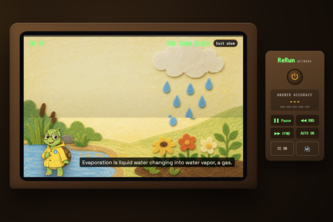
ReRun is a self-reported educational tool that turns class notes into interactive TV episodes using AI. The product is described as an "appointment television for your homework" where learning is enforced through retrieval practice, with the learner required to answer questions before advancing.
What changed
The project description states that it was built in one week by a single developer (Kyle Zemel) using AI tools including Codex, GPT-5.6, and others. It includes a working prototype with offline functionality and five pre-built episodes.
Single most important open question
Is there any evidence of traction, revenue, or customer adoption beyond the author's own account?
Analysis basis
This report is based entirely on the self-reported project description provided by the caller — no third-party verification, archived data, or independent sources. All claims are treated as stated by the author and not proven.
What The Product Actually Is
The description states that ReRun:
- Turns class notes into interactive retro-TV episodes
- Uses GPT-5.6 to write structured episodes with teach-before-ask steps and retrieval checks
- Employs gpt-image-2 for scene art and gpt-4o-mini-tts for voiceover
- Includes a CRT-style player UI with remote controls (pause, rewind, fast-forward)
- Enforces learning through a "miss" mechanic where wrong answers trigger corrective re-teaching
- Allows offline playback of five pre-built episodes
- Exports shows to MP4 or WebM format
The product is described as built with Next.js, React, TypeScript, and Vitest. It uses Zod for schema validation and Codex for implementation.
Evidence strength Self-reported. No external verification or data on actual use.
Positioning & Claim Evolution
The project positions itself as:
- An educational format that inverts traditional AI study tools
- A solution to problems identified in academic studies (e.g., passive consumption, answer handover, reduced persistence)
- A "format constraint" that makes retrieval practice mandatory rather than optional
- A tool that applies principles from children’s television to learning
It claims:
- The format is based on research showing that retrieval practice beats passive review
- It addresses three specific harms of current AI tools: passive consumption, answer revelation, and reduced later performance
- It enforces pedagogy through system architecture, not prompts
- It builds upon the "appointment viewing" model from kids' TV
Evidence strength Self-reported. No evidence of market testing or user feedback.
Target Customer & ICP
The description states:
- The primary audience is students who study using class notes
- It targets users who are already creating "brainrot" videos and AI study podcasts but want more effective learning methods
- It aims to improve retention over passive consumption tools like flashcards or chat tutors
It does not specify:
- Age groups
- Educational levels (K-12, college, etc.)
- Institutional use cases (teachers, schools)
- Geographic focus
Evidence strength Self-reported. No evidence of target segmentation or customer validation.
Business Model & Pricing Evidence
The description states:
- No pricing information is provided
- The product ships with five pre-built episodes offline
- There is no mention of subscription models, freemium tiers, or monetization strategies
- The author notes that judges can experience the full loop in under two minutes without API keys
Evidence strength Not evidenced. No business model or pricing details.
Technical & Delivery Signals
The description states:
- Built with Codex, GPT-5.6, gpt-image-2, gpt-4o-mini-tts
- Uses Next.js 15 / React 19 for the CRT player
- Implements a Zod EpisodeSpec schema to enforce pedagogical structure
- Includes 25 tests across 5 suites and typecheck + production build gates
- Features offline catalog with bundled media (MP3s, art plates)
- Uses deterministic option shuffle and fallback mechanisms for reliability
It also mentions:
- Pair-programming with Codex over one week
- Human-reviewed audit trail in CODEX_LOG.md
- No API keys required for judges to run the demo
Evidence strength Self-reported. No evidence of scalability, infrastructure, or deployment details beyond prototype.
Traction & Maturity Signals
The description states:
- A working prototype with five pre-built episodes
- Judges can experience the full loop in under two minutes
- The product was submitted to an OpenAI hackathon (Devpost)
- The author notes that the judge path works with zero setup:
npm install && npm run dev
It does not state:
- Any user base or customer data
- Revenue or monetization metrics
- Adoption rates or usage statistics
- Product roadmap beyond the hackathon submission
Evidence strength Not evidenced. No traction or maturity indicators.
Competitive Context
The description compares ReRun to:
- AI study podcasts / note-to-video tools (passive consumption)
- Flashcards & SRS apps (optional retrieval)
- Gamified quiz apps (skippable, reveals answer)
- AI chat tutors (answer-based, prompt-dependent)
It claims that ReRun enforces retrieval practice structurally — not through prompts or user choice — and that this is a key differentiator.
Evidence strength Self-reported. No competitive analysis or market positioning data.
Open Questions & Risks
Inferences based on the description:
- The product is described as a hackathon submission, suggesting it may be early-stage
- It relies heavily on AI tools (Codex, GPTs) for development and content creation — raises questions about scalability and control
- The lack of any mention of pricing, monetization, or customer data suggests no commercial traction yet
- The single-developer team size implies limited resources for growth or product iteration
- The focus on a specific pedagogical model may limit broader appeal
Evidence strength Inferred from self-reported content. No external validation.
Questions the description leaves open
- What is the current stage of development beyond the hackathon prototype?
- Are there any early adopters or pilot users? If so, what feedback have they provided?
- How does the team plan to scale beyond a single developer and one-week build?
- Is there a clear path to monetization or customer acquisition?
- What are the technical limitations of relying on AI for content generation and delivery?
- How is the pedagogical model validated beyond academic studies cited in the description?
- What is the long-term vision for the product beyond the current format?
Evidence strength Inferred from self-reported content. No data to support these questions.
Overall Assessment
The description states that ReRun was built as a hackathon submission and does not provide any evidence of:
- Revenue or financial performance
- Customer adoption or user base
- Product-market fit or traction
- Business model or monetization strategy
It is described as a working prototype with five pre-built episodes, but there is no indication of commercial viability or strategic positioning.
Evidence strength Not evidenced. No basis for investment or partnership assessment.
User Stories BotA demo video on every pull request
Get a demo video on every new feature
GitHub App that watches your pull requests and records a narrated, captioned demo.
Save time on demo prep and make informed decisions faster with a video walkthrough of every new feature.
Source
Submitted to the OpenAI 2026 hackathon on Devpost. Project home on Devpost. Back to the full gallery on Devpost.
This competitive analysis was produced by top-founders.com (opens in a new tab)
Generated by a language model from this project's public Devpost page — its tagline, the author's own write-up and any built-with tags listed there — as captured in August 2026. Short quotations are the author's words. It is an opinion on the idea as a business, not on the people behind it, and it reflects the description as published then. If the project has moved on, request a correction below. The analysis is not independent research and contains no verified traction, revenue or customer data.
An independent guide by KFG International LLC — not affiliated with, endorsed by, or connected to Devpost or OpenAI.