

Archive position — measured, not model output
0 likes on Devpost
2,263 of the 7,850 archived projects have more likes, and 5,587 share exactly 0 — so this project's #6,374 place in the like-ranked listing is a tie-break inside that group, not a ranking.
Projects (log scale)
Likes on Devpost. ▲ marks this project's group.
Show the figures
| Likes | Projects | Share of archive |
|---|---|---|
| 0 | 5,587 | 71.2% |
| 1 | 1,758 | 22.4% |
| 2 | 284 | 3.6% |
| 3–4 | 132 | 1.7% |
| 5–9 | 75 | 1.0% |
| 10+ | 14 | 0.2% |
 User Stories BotA demo video on every pull request
Get a demo video on every new feature
GitHub App that watches your pull requests and records a narrated, captioned demo.
Save time on demo prep and make informed decisions faster with a video walkthrough of every new feature.
Executive Summary
What the company appears to be
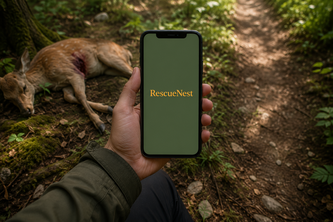
RescueNest is a self-reported AI-powered web application designed to assist people in identifying injured wild animals, providing first-aid guidance, locating nearby rescue centers, and generating professional rescue reports. It was built as a prototype for the OpenAI 2026 hackathon.
What changed
The project description indicates that this is an early-stage prototype developed by one individual (Yusra Fatima) with no evidence of prior traction or commercialization. The author states it was built using AI tools like Codex and GPT-5.6, and the system integrates image analysis, emergency reasoning, and rescue coordination.
Single most important open question
Is there any evidence that RescueNest has been tested in real-world conditions or used by actual users beyond its development phase?
What The Product Actually Is
The description states that RescueNest is an AI-powered web application. It combines:
- AI image analysis to identify injured animals
- Emergency guidance including first-aid instructions and actions to avoid
- Rescue coordination, such as locating nearby wildlife rescue organizations
- Report generation for sharing information with professionals
It was built using:
- Frontend: Next.js, React, TypeScript, Tailwind CSS
- Backend: FastAPI, Python, Pydantic
- AI tools: OpenAI Codex, GPT-5.6, multimodal AI model
- Mapping and location services: Google Maps, OpenStreetMap
The system is described as a full-stack web app with an end-to-end workflow from image upload to rescue report generation.
Confidence Low — all details are self-reported without verification or demonstration.
Positioning & Claim Evolution
The author positions RescueNest as:
- An AI-powered wildlife emergency assistant
- A tool that helps ordinary people respond safely during critical moments
- Not a replacement for professionals, but a way to improve early response quality until trained help arrives
Key claims include:
- The app provides safe first-aid guidance
- It identifies animal species and evaluates urgency
- It generates rescue reports that can be shared with experts
- It aims to reduce delays between discovery and professional intervention
The evolution of the positioning appears to have started from a personal challenge (helping people during wildlife emergencies) and evolved into a prototype solution involving AI-assisted development.
Confidence Low — this is entirely self-described, with no external validation or market feedback.
Target Customer & ICP
The description states that RescueNest targets:
- Hikers
- Drivers
- Park visitors
- Ordinary people who want to help injured animals
These users are assumed to be in situations where they encounter an injured wild animal and need immediate, reliable guidance.
There is no indication of segmentation beyond general user types or geographic scope. No specific demographics, behavioral patterns, or decision-making contexts are detailed.
Confidence Very low — no evidence of customer research or actual user interviews.
Business Model & Pricing Evidence
The description does not contain any information about:
- Revenue streams
- Pricing models
- Monetization strategy
- Customer acquisition costs
- Subscription plans or usage fees
It is unclear whether the tool will be offered free, paid, or through partnerships with rescue organizations.
Confidence Not evidenced — no commercial logic or financial structure described.
Technical & Delivery Signals
The project was built using:
- Frontend: Next.js, React, TypeScript, Tailwind CSS
- Backend: FastAPI, Python, Pydantic
- AI Integration: Multimodal AI model, OpenAI Codex, GPT-5.6
- Mapping Tools: Google Maps, OpenStreetMap
Key technical decisions include:
- Use of structured outputs and prompt engineering to improve reliability
- Focus on minimizing unnecessary questions or information overload
- Emphasis on user experience during high-stress situations
The author mentions using AI-assisted development tools (Codex, GPT) for coding, debugging, and UI improvements.
Confidence Medium — some technical details are provided, but no evidence of scalability, performance metrics, or production deployment.
Traction & Maturity Signals
There is no evidence of:
- Revenue
- Customers
- User adoption
- Product-market fit
- Beta testing or real-world usage
- Any form of traction beyond the hackathon submission
The project is described as a prototype, built by one person, submitted to a hackathon.
Confidence Very low — no signs of traction or maturity beyond initial concept and development.
Competitive Context
The description does not mention:
- Competitors
- Existing solutions in the wildlife rescue or emergency response space
- Market size or competitive landscape
- Differentiation from similar tools
No reference is made to how RescueNest compares to other apps, platforms, or services that may already exist for animal rescue or emergency assistance.
Confidence Not evidenced — no competitive analysis or market positioning provided.
Open Questions & Risks
Several risks and open questions are evident:
- Unverified AI outputs: The system relies on AI models without evidence of accuracy or safety validation.
- Single-person development: Only one team member is listed, raising concerns about scalability and long-term viability.
- No real-world testing: No mention of field trials, user feedback, or actual use cases beyond the prototype stage.
- Unclear commercialization path: No indication of how the tool would be monetized or distributed.
- Potential for harm: If the AI gives incorrect advice during an emergency, it could cause further injury to animals or delay proper care.
Confidence Medium — these are logical inferences based on the lack of evidence and self-reported nature of the project.
Questions the description leaves open
- Has RescueNest been tested with real users or in actual wildlife emergency scenarios?
- What is the accuracy rate of the AI model in identifying species and assessing injuries?
- Are there any partnerships with wildlife rescue organizations or professionals involved in testing?
- How does the system handle uncertainty or ambiguous inputs from users?
- What are the plans for expanding support to more regions or species?
- Is there a plan for integrating with existing wildlife rescue databases or emergency response systems?
- What is the intended business model and how will it scale beyond the prototype phase?
Overall Assessment
At this stage, RescueNest appears to be an early-stage prototype developed by one individual as part of a hackathon submission. There is no evidence of traction, revenue, customers, or commercial viability.
The idea has potential for impact in wildlife conservation and emergency response, but the current version lacks validation, scalability, and a clear path to market.
Assessment Not ready for investment or partnership at this time — requires significant development, testing, and proof-of-concept validation before any strategic move can be considered.
User Stories BotA demo video on every pull request
Get a demo video on every new feature
GitHub App that watches your pull requests and records a narrated, captioned demo.
Save time on demo prep and make informed decisions faster with a video walkthrough of every new feature.
Source
Submitted to the OpenAI 2026 hackathon on Devpost. Project home on Devpost. Back to the full gallery on Devpost.
This competitive analysis was produced by top-founders.com (opens in a new tab)
Generated by a language model from this project's public Devpost page — its tagline, the author's own write-up and any built-with tags listed there — as captured in August 2026. Short quotations are the author's words. It is an opinion on the idea as a business, not on the people behind it, and it reflects the description as published then. If the project has moved on, request a correction below. The analysis is not independent research and contains no verified traction, revenue or customer data.
An independent guide by KFG International LLC — not affiliated with, endorsed by, or connected to Devpost or OpenAI.