

Archive position — measured, not model output
0 likes on Devpost
2,263 of the 7,850 archived projects have more likes, and 5,587 share exactly 0 — so this project's #6,375 place in the like-ranked listing is a tie-break inside that group, not a ranking.
Projects (log scale)
Likes on Devpost. ▲ marks this project's group.
Show the figures
| Likes | Projects | Share of archive |
|---|---|---|
| 0 | 5,587 | 71.2% |
| 1 | 1,758 | 22.4% |
| 2 | 284 | 3.6% |
| 3–4 | 132 | 1.7% |
| 5–9 | 75 | 1.0% |
| 10+ | 14 | 0.2% |
 User Stories BotA demo video on every pull request
Get a demo video on every new feature
GitHub App that watches your pull requests and records a narrated, captioned demo.
Save time on demo prep and make informed decisions faster with a video walkthrough of every new feature.
Executive Summary
What the company appears to be
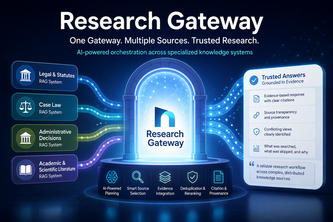
Research Gateway is a self-reported orchestration layer that connects multiple specialized retrieval-augmented generation (RAG) systems to support professional research workflows. It claims to provide a unified interface for searching across legal, case-law, administrative decision, and scientific literature databases.
What changed
The project was submitted as part of the OpenAI 2026 hackathon. The author describes it as an experimental system built using GPT-5.6 and Codex, with no evidence of prior commercial traction or product-market fit beyond its development phase.
Single most important open question — the commercial due-diligence read
Is there any evidence that Research Gateway has moved beyond a prototype or hackathon-level demonstration? The description contains no data on usage, adoption, revenue, or customer feedback. All claims are self-reported and unverified.
What The Product Actually Is
The description states that Research Gateway is:
- A structured orchestration layer above existing legal, case-law, administrative-decision, and scientific-literature retrieval systems.
- Built using GPT-5.6, Codex, and a set of source adapters with a common interface.
- Designed to analyze research questions, generate structured plans, select relevant databases, transform queries, execute searches, normalize results, detect duplicates, rerank evidence, and produce citation-backed answers.
It is described as a system that preserves provenance metadata and allows users to audit how the final answer was produced.
Inference The product appears to be an experimental or proof-of-concept tool for professional research workflows, not yet a commercial offering. It does not appear to have any live customers or revenue-generating mechanisms.
Positioning & Claim Evolution
The description states that Research Gateway was inspired by the need to replace "a fragile, manually defined search sequence" with a structured orchestration layer. The goal is to:
- Replace fragmented database searches.
- Provide a transparent research process.
- Enable auditable research workflows.
It positions itself as a tool for professional researchers who require access to multiple, specialized databases but want a unified interface.
Inference The positioning is focused on professional research, particularly in legal and policy domains. The claim evolution suggests an intent to build a system that improves upon traditional multi-source search by adding structure, transparency, and accountability — not necessarily a new or disruptive technology per se, but a new way of organizing existing tools.
Target Customer & ICP
The description states that Research Gateway is designed for professional researchers, including those working in legal, policy, and academic domains. It supports:
- Legal questions requiring statutes, court decisions, administrative decisions.
- Academic literature searches.
- Scientific evidence gathering.
It also mentions support for jurisdiction-aware retrieval and temporal policies, suggesting a focus on domain-specific research needs.
Inference The ICP (Ideal Customer Profile) likely includes legal professionals, policy analysts, academic researchers, or compliance teams who work with multiple databases and need structured, traceable research outputs. However, no evidence of actual customers or use cases is provided.
Business Model & Pricing Evidence
There is no evidence in the description of any business model or pricing strategy. The project is presented as a hackathon submission without mention of monetization, licensing, subscriptions, or customer acquisition.
Inference No commercial business model has been established or described. The system appears to be an experimental prototype with no indication of how it would generate revenue.
Technical & Delivery Signals
The description states that:
- The system uses GPT-5.6 for semantic interpretation and planning.
- It employs a source adapter architecture to connect independent databases.
- The adapters translate shared search requests into source-specific formats.
- Results are normalized into a shared evidence schema.
- Deterministic operations (e.g., deduplication, logging) are handled in application code.
- Codex was used for implementation and testing.
It also mentions challenges such as:
- Handling heterogeneous ranking methods.
- Preserving citation provenance.
- Managing partial failures.
- Balancing flexibility with predictability.
Inference The technical approach is modular and designed to integrate with existing systems. It shows an understanding of RAG complexities, but lacks evidence of production-grade reliability or scalability.
Traction & Maturity Signals
There is no evidence of traction, adoption, or user feedback. The project is described as a hackathon submission, and no data on:
- Users
- Revenue
- Customer engagement
- Product usage metrics
- Iteration history
The description does not indicate whether the system has been tested in real-world conditions or deployed beyond a prototype.
Inference The product is at an early stage of development. It lacks any maturity signals such as customer feedback, performance data, or production deployment.
Competitive Context
The description does not mention competitors or a competitive landscape. It focuses on the architecture and functionality rather than market positioning or differentiation from existing tools.
Inference There is no evidence of awareness of direct or indirect competitors in the RAG or research automation space. The project may be addressing a niche or underserved area, but this is not confirmed.
Open Questions & Risks
- No commercial traction or revenue: The system is described as a hackathon submission with no evidence of real-world use.
- Unverified claims: All functionality and performance are self-reported without independent validation.
- Unclear scalability: The architecture is described but not tested in production-scale environments.
- No pricing or monetization strategy: No indication of how the product would be sold or used commercially.
- High technical complexity: The system requires integration with many heterogeneous databases, which may introduce operational risk.
Inference The project is experimental and unproven. It has not demonstrated viability as a commercial product or service.
Questions the description leaves open
- What specific professional research workflows does Research Gateway aim to support?
- Has the system been tested with real users or in real-world scenarios?
- Are there any existing partnerships or integrations with legal, academic, or policy databases?
- How is the system currently being evaluated for accuracy and usability?
- What are the plans for scaling beyond the current prototype?
- Is there a roadmap for monetization or commercial deployment?
- What are the limitations of GPT-5.6 in this context, and how are they being addressed?
Overall Assessment
The description states that Research Gateway is a hackathon submission and does not provide any evidence of:
- Revenue
- Customers
- Product-market fit
- Commercial traction
- Scalability or production readiness
It is described as an experimental system with no indication of commercial viability.
Inference At this stage, there is no basis for investment or partnership consideration. The project lacks the fundamental signals required to assess its potential for growth or return. It remains a prototype with unverified claims and no demonstrated value proposition beyond its own self-description.
User Stories BotA demo video on every pull request
Get a demo video on every new feature
GitHub App that watches your pull requests and records a narrated, captioned demo.
Save time on demo prep and make informed decisions faster with a video walkthrough of every new feature.
Source
Submitted to the OpenAI 2026 hackathon on Devpost. Project home on Devpost. Back to the full gallery on Devpost.
This competitive analysis was produced by top-founders.com (opens in a new tab)
Generated by a language model from this project's public Devpost page — its tagline, the author's own write-up and any built-with tags listed there — as captured in August 2026. Short quotations are the author's words. It is an opinion on the idea as a business, not on the people behind it, and it reflects the description as published then. If the project has moved on, request a correction below. The analysis is not independent research and contains no verified traction, revenue or customer data.
An independent guide by KFG International LLC — not affiliated with, endorsed by, or connected to Devpost or OpenAI.