

Archive position — measured, not model output
0 likes on Devpost
2,263 of the 7,850 archived projects have more likes, and 5,587 share exactly 0 — so this project's #2,451 place in the like-ranked listing is a tie-break inside that group, not a ranking.
Projects (log scale)
Likes on Devpost. ▲ marks this project's group.
Show the figures
| Likes | Projects | Share of archive |
|---|---|---|
| 0 | 5,587 | 71.2% |
| 1 | 1,758 | 22.4% |
| 2 | 284 | 3.6% |
| 3–4 | 132 | 1.7% |
| 5–9 | 75 | 1.0% |
| 10+ | 14 | 0.2% |
 User Stories BotA demo video on every pull request
Get a demo video on every new feature
GitHub App that watches your pull requests and records a narrated, captioned demo.
Save time on demo prep and make informed decisions faster with a video walkthrough of every new feature.
Executive Summary
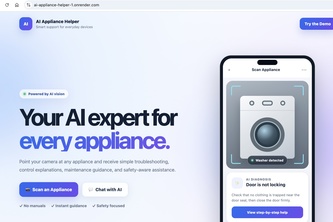
The company appears to be a solo-project, self-reported AI-powered appliance support assistant. The author states it uses GPT-5.6 vision via OpenAI APIs to analyze images of appliances and provide troubleshooting guidance. It is presented as a hackathon submission for the OpenAI 2026 build week.
What changed
The project description reflects an evolution from a personal problem-solving idea (homeowner frustration with appliance manuals) into a self-described solution that aims to make expert support universally accessible through image-based AI assistance.
The single most important open question
Is there any evidence of actual user testing, feedback loops, or product-market fit beyond the author's own experience and stated ambitions?
Analysis basis: This report is based entirely on the self-reported project description provided by the author. No external verification, traction data, revenue figures, customer names, or third-party corroboration are available.
What The Product Actually Is
The description states that AI Appliance Helper is an AI-powered assistant designed to help users understand appliance settings or fix problems quickly by pointing their camera at an appliance or uploading a photo. It claims to use OpenAI’s multimodal models for image analysis and contextual troubleshooting chat, with GPT-5.6 vision through the OpenAI Responses API.
It also mentions that OpenAI Codex was used for reviewing code, identifying defects, and improving reliability and accessibility.
Inference: The product appears to be a proof-of-concept or prototype built using React, TypeScript, Vite, Node.js, Express, and hosted on Render. It is not described as a commercial product with ongoing operations or user base.
Evidence: Author's own write-up; no independent confirmation of functionality or deployment status.
Positioning & Claim Evolution
The author positions AI Appliance Helper as a tool that eliminates the need to search manuals, browse the internet, or wait for technicians. It is framed as a time-saving solution for everyday appliance issues.
Claim evolution: The project started with a personal pain point — frustration with appliance manuals and YouTube searches — and evolved into a broader vision of universal accessibility to expert support through AI. The author emphasizes making appliance help available regardless of age, technical knowledge, or language.
Evidence: Author's own write-up; no external positioning or branding evidence.
Target Customer & ICP
The description does not explicitly define the target customer segment or ideal customer profile (ICP). However, it implies a general consumer audience — homeowners dealing with common household appliances like washers, freezers, and car dashboards.
Evidence: Author's own write-up; no explicit segmentation or persona definition.
Business Model & Pricing Evidence
There is no evidence of any business model or pricing structure described in the project. The author does not mention monetization, subscriptions, licensing, or sales channels.
Evidence: Not evidenced.
Technical & Delivery Signals
The project was built using:
- Frontend: React, TypeScript, Vite
- Backend: Node.js, Express
- Hosting: Render
- AI models: GPT-5.6 vision via OpenAI API, OpenAI Codex for code review
- Tools: GitHub, OpenAI APIs
It is described as a simple and easy-to-use interface.
Inference: The system appears to be a basic prototype or MVP built in a short timeframe (hackathon), not a production-ready product.
Traction & Maturity Signals
There is no evidence of traction, usage metrics, customer feedback, or product maturity beyond the author’s own account. No mention of users, adoption rates, retention, or revenue.
Evidence: Not evidenced.
Competitive Context
The description does not reference any competitors or existing solutions in the appliance support space. It does not describe how this project compares to other tools or services that might already exist for appliance troubleshooting.
Evidence: Not evidenced.
Open Questions & Risks
- Unverified claims: All statements are self-reported and unverified.
- No traction or validation: No evidence of users, feedback, or real-world testing.
- Prototype nature: Built as a hackathon project; unclear if it has progressed beyond prototype stage.
- Safety concerns: The author notes challenges in ensuring safe advice and knowing when to recommend professional help — this is a critical risk area not addressed with further detail.
- Lack of commercialization plan: No indication of how the idea would scale or monetize.
Inference: The project lacks any evidence of real-world application, user validation, or business viability beyond the author’s personal experience.
Questions the description leaves open
- What specific problems did you encounter while building this prototype?
- Have you tested this with actual users outside of your own experience?
- How do you plan to ensure safety and accuracy in AI-generated advice?
- Is there a path from prototype to commercial product or service?
- What are the technical limitations of using GPT-5.6 vision for appliance support?
- Do you have any plans for localization, multilingual support, or accessibility features beyond voice input?
Overall Assessment
Not evidenced — there is no evidence of revenue, customers, traction, or financial performance to assess investment potential or partnership viability.
The project is presented as a hackathon submission with no indication of commercialization, user adoption, or scalability. It remains a self-reported idea without external validation or data points that would support due-diligence decisions.
Confidence level: Low — based entirely on unverified self-reporting.
User Stories BotA demo video on every pull request
Get a demo video on every new feature
GitHub App that watches your pull requests and records a narrated, captioned demo.
Save time on demo prep and make informed decisions faster with a video walkthrough of every new feature.
Source
Submitted to the OpenAI 2026 hackathon on Devpost. Project home on Devpost. Back to the full gallery on Devpost.
This competitive analysis was produced by top-founders.com (opens in a new tab)
Generated by a language model from this project's public Devpost page — its tagline, the author's own write-up and any built-with tags listed there — as captured in August 2026. Short quotations are the author's words. It is an opinion on the idea as a business, not on the people behind it, and it reflects the description as published then. If the project has moved on, request a correction below. The analysis is not independent research and contains no verified traction, revenue or customer data.
An independent guide by KFG International LLC — not affiliated with, endorsed by, or connected to Devpost or OpenAI.