

Archive position — measured, not model output
1 like on Devpost
505 of the 7,850 archived projects have more likes, and 1,758 share exactly 1 — so this project's #1,808 place in the like-ranked listing is a tie-break inside that group, not a ranking.
Projects (log scale)
Likes on Devpost. ▲ marks this project's group.
Show the figures
| Likes | Projects | Share of archive |
|---|---|---|
| 0 | 5,587 | 71.2% |
| 1 | 1,758 | 22.4% |
| 2 | 284 | 3.6% |
| 3–4 | 132 | 1.7% |
| 5–9 | 75 | 1.0% |
| 10+ | 14 | 0.2% |
 User Stories BotA demo video on every pull request
Get a demo video on every new feature
GitHub App that watches your pull requests and records a narrated, captioned demo.
Save time on demo prep and make informed decisions faster with a video walkthrough of every new feature.
Executive Summary
What the company appears to be
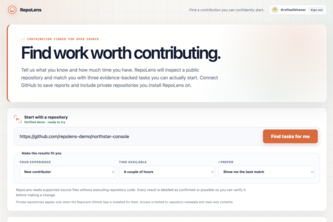
RepoLens is a developer tool that turns any GitHub repository into an evidence-backed guide to its architecture, interface, and contribution opportunities. The product is described as a read-only analysis tool that provides structured insights about codebases without executing or installing anything from them.
What changed
The project was built for the OpenAI 2026 hackathon. It includes both a web application and a Chrome extension that analyzes GitHub repositories in real-time, offering structured guidance on how to contribute.
The single most important open question — the commercial due-diligence read
Is there a viable path to monetizing this tool at scale, or is it primarily a proof-of-concept for developer engagement?
What The Product Actually Is
- The description states that RepoLens is a Next.js and TypeScript app sitting on top of a deterministic analysis pipeline.
- It analyzes GitHub repositories using static code analysis techniques.
- It offers:
- A friendly overview of the project and how it's put together
- Three contribution ideas matched to user experience, time, and work preferences
- A prioritized list of findings across docs, setup, testing, CI, maintainability, accessibility, and frontend quality
- Source lines behind every finding
- Maps of architecture, dependencies, routes, and interfaces
- Safe previews of screens and components
- An Ask RepoLens chat feature using LLMs (with citation validation)
- A pull request check that compares PRs against original findings
- The tool also includes a Chrome extension for real-time analysis.
- It is completely read-only: it never runs code, installs anything, or executes scripts from the repo being analyzed.
Inference This appears to be a developer productivity tool focused on open-source contribution facilitation and codebase understanding.
Positioning & Claim Evolution
- The description states that RepoLens was built to help people understand open source projects well enough to contribute something useful.
- It addresses common pain points: "finding an open source repo is the easy part. Actually understanding one well enough to contribute something useful is where most people get stuck."
- The tool positions itself as providing "real evidence" to back up its claims, rather than generic advice.
- It emphasizes safety and determinism, stating that it never runs code or installs anything from the repository.
Inference The positioning evolved from a hackathon project aimed at solving developer onboarding and contribution challenges in open-source projects into a tool that could potentially be expanded for broader use cases like internal codebase exploration or enterprise adoption.
Target Customer & ICP
- The description does not explicitly define target customers or personas.
- It implies usage by developers who are new to a project and want to contribute.
- It suggests users may have varying skill levels, time constraints, and preferences for types of work.
- The tool is designed to match contribution ideas with user profiles.
Not evidenced No explicit ICP, customer segments, or buyer personas identified.
Business Model & Pricing Evidence
- The description does not mention any pricing model or business model.
- There is no indication of monetization strategy, revenue streams, or paid features.
- It is described as a read-only tool with no apparent commercial layer.
Inference No evidence of a defined business model; likely a prototype or proof-of-concept at this stage.
Technical & Delivery Signals
- Built using Next.js, TypeScript, React, Node.js, and various AI/ML tools (e.g., Llama, Groq).
- Uses static analysis for code parsing and dependency graphing.
- Implements sandboxed iframes to render previews safely.
- Includes a Chrome extension with side-panel functionality.
- The pipeline includes cleaning GitHub URLs, pulling metadata, parsing JS/TS files, resolving imports, running audit rules, generating contribution tasks, ranking them against user profiles, and providing confidence levels.
- Uses Codex and GPT-5.6 for engineering assistance during development.
Inference Strong technical foundation with attention to security and determinism; however, no evidence of scalability or production deployment beyond the hackathon context.
Traction & Maturity Signals
- The project was submitted to the OpenAI 2026 hackathon.
- Team size is listed as two members (Rafia Ali, Universe Rover).
- No revenue, customer base, or adoption metrics are provided.
- No mention of users, usage data, or product traction beyond its creation.
Not evidenced No evidence of traction, customers, or market validation.
Competitive Context
- The description does not reference competitors or similar tools in the marketplace.
- It focuses on solving a specific problem — helping developers understand and contribute to open-source projects.
- There are no mentions of existing solutions addressing this exact need.
Not evidenced No competitive landscape or differentiation analysis provided.
Open Questions & Risks
- The tool is described as a hackathon project with no evidence of commercial viability or long-term strategy.
- It relies heavily on static analysis, which may limit accuracy and usefulness in complex codebases.
- The use of AI for chat functionality introduces potential risks around hallucination and citation validation.
- No clear path to monetization or customer acquisition is evident.
- The team size (2 people) raises questions about execution capacity at scale.
Inference High risk due to lack of traction, unclear business model, and limited team resources.
Questions the description leaves open
- What specific problems are you trying to solve for developers beyond the hackathon context?
- How do you plan to monetize this tool if it's not a freemium or enterprise offering?
- Are there any existing users or feedback loops from early adopters?
- What are your plans for scaling beyond the current prototype?
- How do you intend to handle edge cases in static analysis, especially with large or multi-language projects?
- Do you have any partnerships or integrations planned with GitHub or other platforms?
Overall Assessment
- The project is presented as a hackathon submission and lacks evidence of traction, revenue, or customer validation.
- It shows strong technical execution but no clear commercial strategy.
- The tool addresses an identifiable pain point in developer workflows but has not demonstrated market demand or scalability.
- Given the self-reported nature of all information, there is insufficient evidence to support investment or partnership decisions at this time.
Confidence Level Low. This analysis is based entirely on a single unverified description and lacks any external validation or performance data.
User Stories BotA demo video on every pull request
Get a demo video on every new feature
GitHub App that watches your pull requests and records a narrated, captioned demo.
Save time on demo prep and make informed decisions faster with a video walkthrough of every new feature.
Source
Submitted to the OpenAI 2026 hackathon on Devpost. Project home on Devpost. Back to the full gallery on Devpost.
This competitive analysis was produced by top-founders.com (opens in a new tab)
Generated by a language model from this project's public Devpost page — its tagline, the author's own write-up and any built-with tags listed there — as captured in August 2026. Short quotations are the author's words. It is an opinion on the idea as a business, not on the people behind it, and it reflects the description as published then. If the project has moved on, request a correction below. The analysis is not independent research and contains no verified traction, revenue or customer data.
An independent guide by KFG International LLC — not affiliated with, endorsed by, or connected to Devpost or OpenAI.