

Archive position — measured, not model output
1 like on Devpost
505 of the 7,850 archived projects have more likes, and 1,758 share exactly 1 — so this project's #1,810 place in the like-ranked listing is a tie-break inside that group, not a ranking.
Projects (log scale)
Likes on Devpost. ▲ marks this project's group.
Show the figures
| Likes | Projects | Share of archive |
|---|---|---|
| 0 | 5,587 | 71.2% |
| 1 | 1,758 | 22.4% |
| 2 | 284 | 3.6% |
| 3–4 | 132 | 1.7% |
| 5–9 | 75 | 1.0% |
| 10+ | 14 | 0.2% |
 User Stories BotA demo video on every pull request
Get a demo video on every new feature
GitHub App that watches your pull requests and records a narrated, captioned demo.
Save time on demo prep and make informed decisions faster with a video walkthrough of every new feature.
Executive Summary
What the company appears to be
RepoWitness is a developer tool that audits Git repository evidence in response to postmortem remediation claims. It evaluates whether changes promised in incident reports are actually supported by code commits and file modifications, using deterministic checks to avoid false positives.
What changed
The author built this as a hackathon submission for the OpenAI 2026 hackathon. It is described as a static demo with no external dependencies or API keys required. It uses Codex (a language model) for design assistance and semantic assessment but does not rely on it for final assessments.
Single most important open question
Is there any evidence of real-world adoption, usage, or traction beyond the author’s own synthetic testing?
What The Product Actually Is
The description states that RepoWitness audits Markdown postmortems against a local Git repository. For each remediation claim, it returns one of three outcomes:
- supported by repository evidence;
- no supporting evidence found within the completed search scope;
- not testable from the available evidence.
It records paths searched and excluded, Git range, tools executed, failures, evidence anchors, and provenance. A supported result must include a mechanically verified file, line, and commit anchor.
The tool is described as never turning “I did not find it” into “it does not exist,” nor inferring deployment or runtime state from Git.
Evidence The author’s own write-up.
Inference This is a read-only audit tool for verifying Git-based changes in incident reports, with deterministic logic to avoid false positives.
Positioning & Claim Evolution
The author states that RepoWitness was built because “a postmortem action item can be marked ‘Done’ without anyone checking whether the repository contains evidence of the promised change.” The tool aims to make this gap inspectable instead of treating workflow status as truth.
It is positioned as a witness to what Git repositories can and cannot support, based on its own self-description.
Evidence The author’s own write-up.
Inference The product is framed as a solution to a specific problem in incident management workflows — the disconnect between ticket state and actual code changes.
Target Customer & ICP
The description does not name specific customers or personas. However, it implies that RepoWitness targets developers or teams working with Git repositories and postmortems, particularly those involved in incident response or reliability engineering.
Evidence The author’s own write-up.
Inference Likely users are internal engineering teams or SREs who manage incidents and want to verify that remediation steps were actually implemented.
Business Model & Pricing Evidence
There is no evidence of a business model, pricing structure, or monetization strategy in the description. The tool is presented as a static demo with no API keys required, nor any indication of paid services or subscriptions.
Evidence The author’s own write-up.
Inference No commercial model is evident from the self-reporting content.
Technical & Delivery Signals
The tool was built using Codex (a language model) for design and implementation assistance. It uses deterministic host code to verify evidence anchors, enforce search scope boundaries, and retain final assessment authority. GPT-5.6 Sol was used once for narrow semantic assessment over fixed candidates in a synthetic fixture — it did not access the repository or issue final assessments.
The fastest judge path is an API-key-free static demo that can be opened directly from demo/index.html.
It includes features like:
- Bounded read-only file and Git tools;
- Evidence packet generation;
- Anchor verification;
- Search-scope accounting;
- Provenance records;
- Deterministic assessment gate;
- Replay system;
- Security regressions;
- Browser QA;
- Release checks;
- Static evidence board.
Evidence The author’s own write-up.
Inference The tool is designed for deterministic, secure evaluation of Git-based claims with minimal external dependencies.
Traction & Maturity Signals
The description mentions:
- Synthetic demo results where deterministic evaluation matched all 5 expected outcomes.
- One approved live GPT-5.6 semantic micro-smoke with 0 false SUPPORT results and 0 fabricated anchors.
- Final main branch passed 206 tests, including desktop and mobile browser QA.
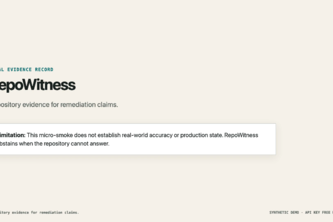
However, the author explicitly notes that these are limited synthetic results, not a real-world benchmark, and do not establish general accuracy or production-state verification.
There is no evidence of customers, revenue, usage metrics, or adoption beyond the author’s own testing.
Evidence The author’s own write-up.
Inference The tool exists in prototype form with some internal validation but lacks external traction or real-world deployment data.
Competitive Context
The description does not mention any competitors. It is unclear whether similar tools exist in the market for Git-based incident verification or postmortem auditing.
Evidence The author’s own write-up.
Inference No competitive landscape is described, so it's unknown if this addresses an existing gap or introduces a new category.
Open Questions & Risks
- No real-world usage or adoption: All evidence points to internal testing and synthetic validation.
- Unproven accuracy claims: The author explicitly states that results are not a real-world benchmark.
- Limited scope of use case: The tool is described as useful for postmortems but does not address broader software development workflows.
- Single-person team: Only one member (Dried Sandwich) is listed, suggesting limited capacity for scaling or iteration.
- No commercialization path: No pricing, monetization, or go-to-market strategy is evident.
Evidence The author’s own write-up.
Inference This appears to be a proof-of-concept or hackathon prototype, not a product ready for enterprise adoption.
Questions the description leaves open
- What specific incident management workflows does RepoWitness aim to improve?
- How would you scale this beyond the current synthetic testing environment?
- Are there any plans to integrate with existing issue trackers or CI systems?
- Has anyone outside of the author tested or used the tool in practice?
- What is your roadmap for moving from prototype to production-ready software?
Overall Assessment
Not evidenced.
The description provides no information about funding, valuation, traction, or commercial viability beyond a hackathon submission. There is no evidence of revenue, customers, or product-market fit.
Evidence The author’s own write-up.
Inference This is a conceptually interesting tool with potential but lacks any signs of commercial readiness or market validation. It should be considered a prototype at best.
User Stories BotA demo video on every pull request
Get a demo video on every new feature
GitHub App that watches your pull requests and records a narrated, captioned demo.
Save time on demo prep and make informed decisions faster with a video walkthrough of every new feature.
Source
Submitted to the OpenAI 2026 hackathon on Devpost. Project home on Devpost. Back to the full gallery on Devpost.
This competitive analysis was produced by top-founders.com (opens in a new tab)
Generated by a language model from this project's public Devpost page — its tagline, the author's own write-up and any built-with tags listed there — as captured in August 2026. Short quotations are the author's words. It is an opinion on the idea as a business, not on the people behind it, and it reflects the description as published then. If the project has moved on, request a correction below. The analysis is not independent research and contains no verified traction, revenue or customer data.
An independent guide by KFG International LLC — not affiliated with, endorsed by, or connected to Devpost or OpenAI.