

Archive position — measured, not model output
0 likes on Devpost
2,263 of the 7,850 archived projects have more likes, and 5,587 share exactly 0 — so this project's #3,771 place in the like-ranked listing is a tie-break inside that group, not a ranking.
Projects (log scale)
Likes on Devpost. ▲ marks this project's group.
Show the figures
| Likes | Projects | Share of archive |
|---|---|---|
| 0 | 5,587 | 71.2% |
| 1 | 1,758 | 22.4% |
| 2 | 284 | 3.6% |
| 3–4 | 132 | 1.7% |
| 5–9 | 75 | 1.0% |
| 10+ | 14 | 0.2% |
 User Stories BotA demo video on every pull request
Get a demo video on every new feature
GitHub App that watches your pull requests and records a narrated, captioned demo.
Save time on demo prep and make informed decisions faster with a video walkthrough of every new feature.
Executive Summary
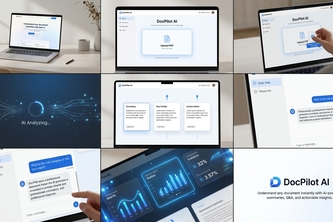
DocPilot AI is a self-reported document processing tool built as a hackathon project, designed to help users understand documents instantly using AI. The author states it allows uploading documents and interacting with them via AI for summaries, Q&A, key point extraction, and explanations. It was built using Python, Streamlit, OpenAI API, and PDF libraries.
The product is in an early stage of development — a single-person project submitted to a hackathon. No revenue, customers or traction are evidenced. The business model, pricing, and technical delivery details are not described beyond the author’s own account.
The single most important open question
Is there any evidence that this tool has been used by users beyond the author's own testing, or that it has moved beyond a proof-of-concept?
What The Product Actually Is
The description states that DocPilot AI is an AI-powered document assistant. It allows users to:
- Upload documents.
- Generate summaries.
- Answer questions about the document.
- Extract key points and action items.
- Explain complex sections in simple language.
- Help find information quickly.
It uses Python, Streamlit, OpenAI API, and PDF processing libraries (pypdf2, python-docx) to extract text from uploaded documents and process it for AI responses.
Inference The tool appears to be a document reader with AI summarization and Q&A capabilities, built as a prototype or MVP.
Positioning & Claim Evolution
The author states that DocPilot AI was inspired by the need to reduce time spent reading long documents. It positions itself as an AI assistant for document understanding, aiming to replace hours of manual reading with seconds of AI-powered insights.
It claims to offer:
- Instant summaries.
- Q&A functionality.
- Key point extraction.
- Simplified explanations.
- Fast information retrieval.
Inference The positioning is that of a productivity tool for individuals or teams who need to quickly digest documents, but no evidence exists that it has evolved beyond a self-reported concept.
Target Customer & ICP
The description does not state the target customer segment or ideal customer profile (ICP). It only says that people often spend too much time searching for key information in long documents, and that the tool helps users understand documents faster.
Inference The likely audience is individuals or teams who read a lot of documents — such as researchers, business professionals, legal teams, or students — but no explicit customer segment is defined.
Business Model & Pricing Evidence
No evidence of a business model or pricing strategy is provided. The description does not mention monetization, subscriptions, usage fees, or any commercial structure.
Inference The tool appears to be a prototype with no stated path to revenue or pricing.
Technical & Delivery Signals
The author states that the tool was built using:
- Python
- Streamlit
- OpenAI API
- PDF document processing libraries (pypdf2, python-docx)
It extracts text from uploaded documents and uses OpenAI models to generate summaries, answers, and insights.
Inference The technical stack suggests a lightweight, web-based prototype with no evidence of scalability or production-grade infrastructure.
Traction & Maturity Signals
The project is described as a single-person hackathon submission, built for the OpenAI 2026 hackathon. No evidence of:
- Revenue
- Customers
- Usage metrics
- Product adoption
- Iteration history
Inference The tool is at an early stage — likely a proof-of-concept or prototype with no traction or maturity indicators.
Competitive Context
The description does not mention any competitors, nor does it describe how DocPilot AI differentiates from existing tools in the document processing or AI summarization space.
Inference No competitive positioning or market analysis is evident. The tool may be entering a crowded market (e.g., Notion AI, ChatPDF, LlamaIndex, etc.), but no evidence supports this claim.
Open Questions & Risks
- No traction or commercial use: It is a hackathon project with no evidence of real-world adoption.
- Single-person development: No team or organizational support suggests limited scalability or long-term viability.
- Unverified claims: All features and functionality are self-reported without independent validation.
- No business model: No indication of how the product will generate revenue.
- Limited scope: The tool is described as a prototype, with future improvements listed but not implemented.
Questions the description leaves open
- What specific document types does DocPilot AI support today?
- How does it handle complex or multi-language documents?
- Has the tool been tested by users beyond the author’s own use?
- Are there any plans to monetize the product, and how?
- What are the technical limitations of the current prototype?
- Is there a roadmap for scaling beyond the current MVP?
Overall Assessment
Not evidenced.
The project is described as a single-person hackathon submission with no evidence of traction, revenue, or commercial viability. It is not clear whether this tool has moved beyond an idea or prototype stage.
Inference At this point, there is no compelling reason to pursue investment or partnership unless further evidence emerges that the product has gained traction or evolved into a scalable solution.
User Stories BotA demo video on every pull request
Get a demo video on every new feature
GitHub App that watches your pull requests and records a narrated, captioned demo.
Save time on demo prep and make informed decisions faster with a video walkthrough of every new feature.
Source
Submitted to the OpenAI 2026 hackathon on Devpost. Project home on Devpost. Back to the full gallery on Devpost.
This competitive analysis was produced by top-founders.com (opens in a new tab)
Generated by a language model from this project's public Devpost page — its tagline, the author's own write-up and any built-with tags listed there — as captured in August 2026. Short quotations are the author's words. It is an opinion on the idea as a business, not on the people behind it, and it reflects the description as published then. If the project has moved on, request a correction below. The analysis is not independent research and contains no verified traction, revenue or customer data.
An independent guide by KFG International LLC — not affiliated with, endorsed by, or connected to Devpost or OpenAI.