

Archive position — measured, not model output
0 likes on Devpost
2,263 of the 7,850 archived projects have more likes, and 5,587 share exactly 0 — so this project's #7,697 place in the like-ranked listing is a tie-break inside that group, not a ranking.
Projects (log scale)
Likes on Devpost. ▲ marks this project's group.
Show the figures
| Likes | Projects | Share of archive |
|---|---|---|
| 0 | 5,587 | 71.2% |
| 1 | 1,758 | 22.4% |
| 2 | 284 | 3.6% |
| 3–4 | 132 | 1.7% |
| 5–9 | 75 | 1.0% |
| 10+ | 14 | 0.2% |
 User Stories BotA demo video on every pull request
Get a demo video on every new feature
GitHub App that watches your pull requests and records a narrated, captioned demo.
Save time on demo prep and make informed decisions faster with a video walkthrough of every new feature.
Executive Summary
What the company appears to be
Winback Ops is a self-reported tool designed to help local service businesses (e.g., med spas and clinics) recover lost revenue by analyzing messy booking data and generating human-approved win-back campaigns. It uses AI to interpret inconsistent data formats, segment dormant clients, and draft targeted outreach.
What changed
The project was built as part of the OpenAI 2026 hackathon. It is described as a working prototype with live GPT-5.6 integration and deterministic demo mode, but no production deployment or customer base is evidenced.
Single most important open question
Is there any evidence that local service businesses are actually interested in or using this type of revenue-recovery tool, or whether they would pay for it?
What The Product Actually Is
The description states that Winback Ops:
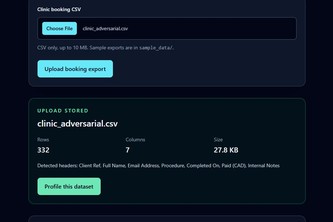
- Uploads raw clinic booking CSVs.
- Profiles schema and maps fields like client, service, date, payment, and notes.
- Identifies service aliases, treatment cadence, and dormancy rules.
- Filters duplicates, invalid dates, missing identities, and unclassified services.
- Segments dormant clients and estimates recoverable revenue.
- Drafts service-specific win-back campaigns.
- Requires human approval before a mocked send.
It is built with Next.js + TypeScript for the frontend and FastAPI + SQLite for the backend. The live profiling path uses GPT-5.6 Sol through OpenAI’s Responses API, while a deterministic demo mode runs without external API calls.
Inference The tool appears to be an agentic workflow that processes unstructured data into actionable insights, with a focus on transparency and safety via human gates.
Positioning & Claim Evolution
The author claims:
- The hard problem is not writing marketing emails but making messy operational data trustworthy enough to decide who should be contacted.
- Winback Ops turns “a clinic booking CSV into an approval-gated win-back workflow.”
- It is not “send an email to everyone,” but rather a transparent, prioritized list of revenue-recovery opportunities.
Inference The positioning evolves from a generic data cleanup tool to a specialized revenue recovery operator for local service businesses. The emphasis on trustworthiness and human oversight suggests a focus on compliance and risk mitigation in sensitive industries like healthcare.
Target Customer & ICP
The description states:
- Winback Ops targets “local service businesses like med spas and clinics.”
- It is designed to help these businesses recover value from relationships they already earned.
- The tool aims to address the challenge of inconsistent data formats across different clinics.
Inference The target customer segment appears to be small-to-medium-sized local service providers with booking systems that produce inconsistent or unstructured export data. However, no evidence exists about actual customers or their willingness to adopt such a solution.
Business Model & Pricing Evidence
There is no evidence in the description of:
- Revenue model
- Pricing structure
- Monetization strategy
- Customer acquisition costs
- Unit economics
Inference The business model remains undefined. The project is presented as a hackathon prototype, not a commercial offering.
Technical & Delivery Signals
The description states:
- Built with Next.js, TypeScript, FastAPI, SQLite.
- Uses GPT-5.6 Sol via OpenAI Responses API for live profiling.
- Codex accelerated implementation of the full workflow.
- Includes deterministic demo mode for reproducible local demonstrations.
- Has sandbox execution, validation checks, run logging, and bounded repair flow.
- Implements strict Pydantic output schema, import allowlist, timeout, and visible UI logs.
Inference The technical stack reflects a modern, AI-integrated SaaS architecture with strong emphasis on safety, auditability, and reproducibility. However, no evidence of production deployment or scalability is provided.
Traction & Maturity Signals
The description states:
- Team size: 0
- No mention of revenue, ARR, customers, or usage metrics.
- The project was submitted to a hackathon (OpenAI 2026).
- Includes four intentionally different clinic-export fixtures and adversarial CSV tests.
Inference There is no evidence of traction, adoption, or product-market fit. This is a prototype with limited real-world validation.
Competitive Context
The description does not mention:
- Competitors
- Market size
- Existing solutions in the revenue recovery space for local service businesses
- Differentiation from similar tools
Inference No competitive landscape is described. The tool may be addressing an underserved niche, but there is no evidence of prior art or market dynamics.
Open Questions & Risks
Key risks and open questions based on the description:
- No traction or revenue: The project is a hackathon submission with no commercial activity.
- Unproven demand: No evidence that local service businesses are interested in this type of tool.
- AI dependency without validation: Reliance on GPT-5.6 for data interpretation raises concerns about accuracy and consistency without real-world testing.
- Limited team size: Zero-team size implies no operational capacity or go-to-market strategy.
- No compliance or privacy features mentioned: The description lacks any mention of GDPR, HIPAA, or other relevant regulations.
Questions the description leaves open
- What specific pain points do local service businesses have with their current data management and win-back processes?
- Have you conducted any interviews or surveys with actual clinic owners or managers?
- How do you plan to validate treatment cadence and recovery assumptions in real-world settings?
- Are there any existing partnerships or pilot programs with clinics?
- What is your go-to-market strategy for reaching local service businesses?
- How will you ensure data privacy and compliance (e.g., HIPAA, GDPR) in a B2B SaaS context?
- Do you have any plans to monetize this tool beyond the initial prototype?
Overall Assessment
Assessment Not evidenced.
The description presents Winback Ops as a hackathon prototype with a clear concept and technical implementation, but lacks any evidence of traction, revenue, customers, or commercial viability. The tool addresses a plausible need in local service businesses, but without real-world validation or a defined business model, it cannot be evaluated for investment or partnership potential.
Confidence level Low — based entirely on self-reported claims with no external corroboration or data points.
User Stories BotA demo video on every pull request
Get a demo video on every new feature
GitHub App that watches your pull requests and records a narrated, captioned demo.
Save time on demo prep and make informed decisions faster with a video walkthrough of every new feature.
Source
Submitted to the OpenAI 2026 hackathon on Devpost. Project home on Devpost. Back to the full gallery on Devpost.
This competitive analysis was produced by top-founders.com (opens in a new tab)
Generated by a language model from this project's public Devpost page — its tagline, the author's own write-up and any built-with tags listed there — as captured in August 2026. Short quotations are the author's words. It is an opinion on the idea as a business, not on the people behind it, and it reflects the description as published then. If the project has moved on, request a correction below. The analysis is not independent research and contains no verified traction, revenue or customer data.
An independent guide by KFG International LLC — not affiliated with, endorsed by, or connected to Devpost or OpenAI.