

Archive position — measured, not model output
1 like on Devpost
505 of the 7,850 archived projects have more likes, and 1,758 share exactly 1 — so this project's #1,806 place in the like-ranked listing is a tie-break inside that group, not a ranking.
Projects (log scale)
Likes on Devpost. ▲ marks this project's group.
Show the figures
| Likes | Projects | Share of archive |
|---|---|---|
| 0 | 5,587 | 71.2% |
| 1 | 1,758 | 22.4% |
| 2 | 284 | 3.6% |
| 3–4 | 132 | 1.7% |
| 5–9 | 75 | 1.0% |
| 10+ | 14 | 0.2% |
 User Stories BotA demo video on every pull request
Get a demo video on every new feature
GitHub App that watches your pull requests and records a narrated, captioned demo.
Save time on demo prep and make informed decisions faster with a video walkthrough of every new feature.
Executive Summary
What the company appears to be
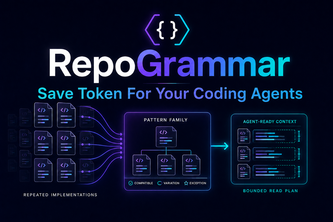
RepoGrammar is a tool that helps coding agents reduce token usage by providing them with a compact, auditable map of repeated implementation patterns within a repository. It operates locally and avoids LLMs or cloud dependencies at runtime.
What changed
The project was submitted as part of the OpenAI 2026 hackathon. It is described as a pattern-family-first CLI tool integrated with Codex and Claude Code, using Rust for its core architecture and Tree-sitter for parsing.
Single most important open question
Is there any evidence of real-world adoption or usage beyond the hackathon submission?
What The Product Actually Is
The description states that RepoGrammar:
- Provides a compact and auditable map of repeated implementation patterns before broad source-code exploration begins.
- Returns:
- Family: repeated implementation pattern with sufficient compatible support.
- Variation and exception: observed differences, accepted variations, and intentionally unsupported cases.
- Evidence: repository-relative paths, content hashes, byte ranges, and support counts (without source snippets by default).
- Read plan: a prioritized set of hash-checked source spans to inspect before editing.
- UNKNOWN: typed abstention for stale, ambiguous, dynamic, unsupported, or out-of-scope cases.
It also states:
- It is built with a Rust core using a layered architecture (core → ports → application → adapters → interfaces).
- Uses Tree-sitter to generate candidates but not prove semantics.
- Operates locally with no LLM or cloud-model dependency at runtime.
- Integrates with Codex and Claude Code via an MCP tool named
repogrammar_context. - Has a one-command setup process that combines agent detection, MCP integration, repository indexing, autosync configuration, and self-test.
Inference The product appears to be a local-first context reduction engine for coding agents, designed to improve efficiency by limiting token consumption through pattern recognition and evidence-based guidance.
Positioning & Claim Evolution
The description states:
- The inspiration behind RepoGrammar is that coding agents waste tokens rediscovering conventions already present in repositories.
- Humans rarely read an entire codebase; they inspect representative examples and follow established patterns.
- RepoGrammar applies this same principle by reading only what is necessary and trusting only what the repository evidence supports.
It also claims:
- Repository-aware context reduction does not require another LLM, vector database, embedding service, or cloud model.
- The tool provides evidence-backed repository pattern families.
- Metadata-first output with optional and bounded source spans.
- Hash-checked and prioritized read plans.
- First-class typed abstention instead of fabricated certainty.
- Fully local operation with no runtime dependencies on LLMs or cloud models.
Inference RepoGrammar positions itself as a lightweight, local-first alternative to traditional code-search or context-aware tools that rely heavily on LLMs or vector databases. Its evolution seems to focus on improving pattern recognition accuracy and expanding language support without compromising its core evidence model.
Target Customer & ICP
The description does not explicitly identify target customers or personas. It mentions:
- Integration with Codex and Claude Code.
- Use case: helping coding agents reduce token usage by providing structured context.
Inference The likely users are developers working with AI-assisted coding tools, particularly those who want to optimize token efficiency while navigating large codebases. However, no explicit ICP is defined.
Business Model & Pricing Evidence
There is no mention of pricing or business model in the description.
Not evidenced
Technical & Delivery Signals
The description states:
- Built with Rust core and layered architecture (core → ports → application → adapters → interfaces).
- Uses Tree-sitter for candidate generation but not semantic proof.
- Operates locally using SQLite database under
.repogrammar/. - Supports one-command setup including agent detection, MCP integration, repository indexing, autosync configuration, and self-test.
- Targets Python, TypeScript workers; does not execute target-repository code.
- Implements safeguards like typed uncertainty, lookalike rejection, untrusted-input handling, and mutable-index correctness.
Inference The technical design suggests a robust, secure, and scalable architecture focused on local execution and minimal resource usage. It avoids common pitfalls like executing arbitrary code or relying on external services during runtime.
Traction & Maturity Signals
The description states:
- Submitted to the OpenAI 2026 hackathon.
- Demonstrates evidence-backed repository pattern families.
- Has a transparent support matrix distinguishing official support, structural previews, and discovery-only languages.
- Next steps include adding analyzer-backed semantic evidence, improving target resolution, advancing Go, PHP, Ruby, Swift support, and integrating with more coding agents.
Not evidenced No data on actual usage, user feedback, or performance metrics beyond the hackathon submission.
Competitive Context
The description does not mention competitors or market positioning directly. However, it implies:
- A niche in reducing token waste for AI-assisted coding.
- Comparison to tools that rely on LLMs, vector databases, or cloud embeddings.
- Focus on local-first operation and evidence-based context reduction.
Inference RepoGrammar competes with tools that provide repository-aware context to coding agents but does so without requiring external dependencies or large-scale AI infrastructure. Its uniqueness lies in its approach to pattern recognition and abstention rather than certainty.
Open Questions & Risks
Key risks identified from the description:
- The project is described as a hackathon submission, suggesting early-stage development.
- No evidence of traction, revenue, or customer adoption beyond the author's own claims.
- Lack of pricing or monetization strategy.
- Limited language coverage (only discovery-only for some languages).
- Dependency on Tree-sitter and Rust core may limit extensibility or integration options.
Inference The lack of real-world usage data raises questions about scalability, utility, and commercial viability. The tool’s focus on local operation and minimal dependencies could be both a strength and a limitation depending on how widely it is adopted.
Questions the description leaves open
- What specific use cases have you identified for RepoGrammar beyond the hackathon?
- How do you plan to expand language support beyond discovery-only status?
- Are there any plans for monetization or commercialization of this tool?
- Has the tool been tested in real-world development environments?
- What are the performance implications of local indexing on large repositories?
- How does RepoGrammar handle edge cases where patterns are ambiguous or inconsistent?
Overall Assessment
The description indicates that RepoGrammar is a hackathon project submitted to the OpenAI 2026 hackathon. There is no evidence of revenue, customers, or traction beyond the author’s own claims.
Not evidenced
Confidence Low — this analysis is based entirely on self-reported information with no external validation or historical data. The tool shows promise in addressing token inefficiency for coding agents but lacks any indication of real-world adoption or commercial viability.
User Stories BotA demo video on every pull request
Get a demo video on every new feature
GitHub App that watches your pull requests and records a narrated, captioned demo.
Save time on demo prep and make informed decisions faster with a video walkthrough of every new feature.
Source
Submitted to the OpenAI 2026 hackathon on Devpost. Project home on Devpost. Back to the full gallery on Devpost.
This competitive analysis was produced by top-founders.com (opens in a new tab)
Generated by a language model from this project's public Devpost page — its tagline, the author's own write-up and any built-with tags listed there — as captured in August 2026. Short quotations are the author's words. It is an opinion on the idea as a business, not on the people behind it, and it reflects the description as published then. If the project has moved on, request a correction below. The analysis is not independent research and contains no verified traction, revenue or customer data.
An independent guide by KFG International LLC — not affiliated with, endorsed by, or connected to Devpost or OpenAI.